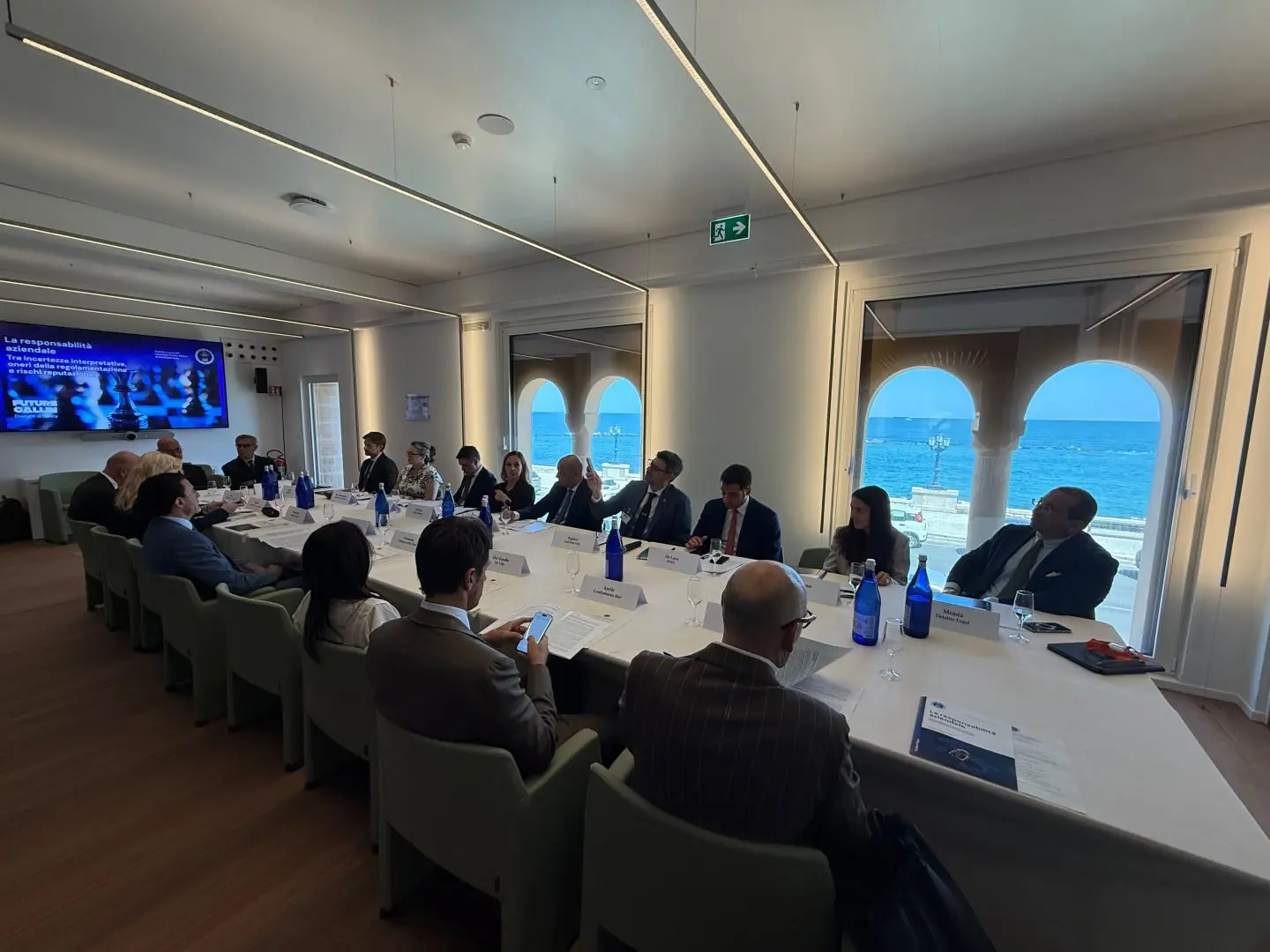
BARI (ITALPRESS) – A potential inexpressed of 12 billion dollars of foreign direct investments towards Italy between 2023 and 2024 according to the UNCTAD World Investment Report 2025. A possible increase in GDP per head estimated by the OECD in over 3% over the last 20 years. A growth in competitiveness towards other European partners, due to endogenous factors of the Italian industrial fabric capable of productions elsewhere not practicable – an excellence particularly appreciated by US investors. These potential benefits would result from a simplification of the Italian regulatory framework, which alone would be able to multiply the investment opportunities of multinationals in our territory. It was discussed today in Bari during the closed door meeting “Future callin’: Policy dialogues. The company’s responsibility, among interpretative uncertainties, burdens of regulation and reputational risks,” promoted by the American Chamber of Commerce in Italy at the Auditorium Deloitte in Via Paolo Pinto, 2 in the Apulian capital.
During the morning – which saw the participation among others by Simone Crolla, CEO, American Chamber of Commerce in Italy; Jennifer Kane-Zabolotskaya, Senior Commercial Officer of the American Embassy in Italy; Mario Aprile, President of Confindustria Bari; Federico Villa, Ass. Vice President Corporate Affairs & Patient Access of Lilly and President Public Affairs Committee of the American Chamber of Commerce in Italy – the possible simplified solutions that would allow Italy to fully free its potential attractiveness towards multinationals, in a comparison between companies and institutions that saw participation of the Deputy Minister of Justice, Francesco Paolo Sisto, and the Undersecretary Elena.
“According to the Managing Director of AmCham, Simone Crolla,” said the interventions taking place in several sectors – as the Single Text of national pharmaceutical legislation now under discussion, together with those that can be put on the construction site to simplify the legislation on digital, telecommunications, logistics, transport, renewable energies and advanced manufacturing, can give Italy the necessary impetus to a lasting cycle of growth and development. We are at the disposal of the institutions to try not to miss this historical occasion.”.
In particular, it is desirable to transpose without any further complexity of the “Omnibus” directives launched by the EU Commission in 2025 for the simplification of the European regulatory load in the digital field, of sustainability reporting, of two diligence of supply chain, investment and carbon adjustment at frontiers, as it is important to work to reduce the time of checks and reduce the complexity of the procedures of fiscal investigation.
“Italy and specifically the companies of a virtuous territory such as Puglia – said Francesco Paolo Bello, Managing Partner of Deloitte Legal – have all the features to attract international investments and create an increasingly solid axis with the US ecosystem. From skills, industrial capacity and a strategic position in the Mediterranean it is possible to transform this potential into growth as long as it has clear, proportioned and predictable rules. Businesses do not require less controls, but a regulatory framework that reduces uncertainty and allows investment to be programmed with confidence. The comparison between institutions, enterprises and professionals is the key to building a territory and in general an increasingly competitive and attractive country.”.
On the current state of relations between Italy and the United States, Federico Villa, Chairman of the AmCham Public Affairs Committee, said: “the state of the alliance Italy- US is not measured by tweets, but by regulatory measures emanating from the two countries to promote reciprocal investment in strategic sectors. Industrial collaboration and trade are the true glue of transatlantic relations, because they guarantee economic prosperity and social security in the long term. Important signals will come from the budgetary law that will close this legislature, the hope is that the government’s attention is directed in particular to the realities that generate strong added value for the entire national economic and social ecosystem”.
At the same time, it has been observed, it is necessary to calibrate the supervisory obligations on the supply chain, to be calibrated not only on the perspective of the large contractors, but also on the impact they produce on the PMI of the supply chain itself, which are having to meet increasing standards to maintain access to contracts with multinational companies. Similarly, the co-operative compliance regime, based on the prior dialogue with the Financial Administration and appropriate fiscal risk control systems, can help reduce the risk of criminal consequences in case of tax disputes, another major obstacle to the investments in Italy of multinationals, as well as the considerable delay in justice times that amplifies uncertainties.
The times of authorization procedures also have a considerable margin of improvement: for data centers, for example, before the DL 21/2026 fixing authorization terms in 10 months, the average authorization time stood between two and three years, with significant variations between geographical areas, from the year in Lombardy up to five years in Lazio.
In the field of renewable energies, the gap with other European countries is even more marked: the average authorisation time ranges in Italy between 4 and 7 years, against 1-2 years in the main European countries. The multiplication of the Authorities also has aggravated the load of compliance of multinationals.
-Photos press office
(ITALPRESS).