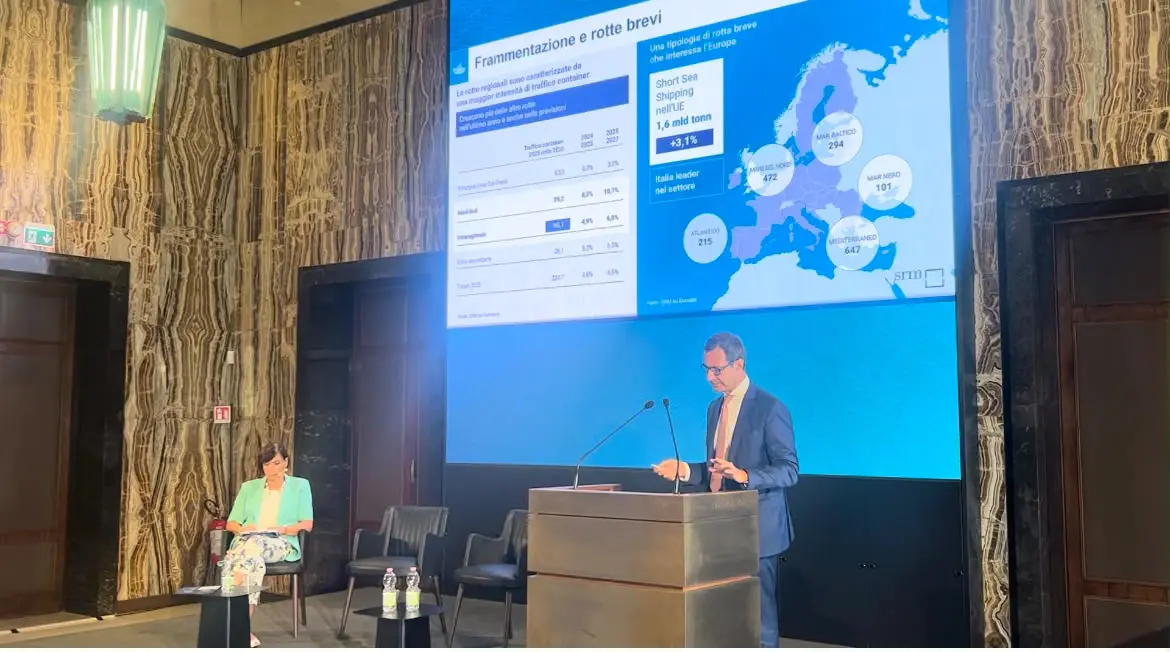
NAPOLI (ITALPRESS) – Srm, Centro Studi e Ricerche linked to the Intesa Sanpaolo Group, presented in Naples, at the headquarters of the bank in Gallerie d’Italia, the thirteenth annual report “Italian Maritime Economy”, a focus dedicated to sea routes in the new global scenario, discussing the centrality of the Mediterranean between increasing competition and changes of the logistic-portal chains.
The works opened the greetings of the president of Intesa Sanpaolo, Gian Maria Gros-Pietro, of the president of the foundation Compagnia San Paolo, Marco Gilli and of the President of Srm, Paolo Scudieri. Following the introductory intervention on the geopolitical scenarios of Marta Dassù, director of Aspenia. They presented the report: Massimo Deandreis, Managing Director Srm, and Alessandro Panaro, Maritime & Energy Manager of the Centro Studi. To follow two moments of debate: the first session entitled “Global Shipping between geopolitics, security and new business routes”, while the second one had as object “Porti, logistics and intermodalità in the new corridors of the Mediterranean”.
Luca Bocca, Chief Financial Officer of Intesa Sanpaolo. Among the highlights of the report, the change in geography of world trade: from the Strait of Hormuz transited 37% of the world trade of crude oil, the almost closure involved volumes of 10% of the world production of oil. The ships, therefore, change course, supply chains redesign.
Carriers and logistic operators responded to crises with deviations, transhipment and alternative routes. At the same time, USA and China move away, Asia reorganizes: in 2025 the US import from China fell by 30%, while that from the Asean countries grew by 29%. Beijing looks south: more export to Africa and Southeast Asia. China compensates for the decline in trade with the United States by increasing exports to Africa (+25.8%) and South-East Asia (+13.4%).
Meanwhile the Mediterranean also grows with Suez in crisis. In 2025 the main container ports of the area have exceeded 72 million Teu, with an increase of 5.9%. Italy remains a power of export: in 2025 the foreign trade of our country exceeded 1,200 billion euros, with an export of 643 billion. By sea it moves about a quarter of our international exchanges in value, the Italian ports exceed 500 million tons. In 2025 the Authorities of Harbour System have enlivened 511 million tons of goods, in increase of 3.5%. Container (132 million tons) and Ro-Ro (122 million) tow the growth of the ports of call. On Short Sea Shipping, Italy is always first in Europe: our country enlivens 304 million tons and holds a market share of 15.6%. Finally among the themes the new challenge of the ports that concerns the connection with the markets. More than 13 billion euros of investments in Italy focus on last mile, railway, maritime accessibility and digitization.
“The theme chosen by Srm for this year’s Report – commented Gian Maria Gros-Pietro, President Intesa Sanpaolo – draws with great effectiveness one of the most important challenges of our time. Never as today the sea represents a privileged key to understanding the evolution of the world economy. Maritime routes, ports, strategic routes and logistic infrastructure are not only elements of the transport system: they are places where international trade, energy security, industrial policy and new geopolitical balances are interwoven. It is also for this reason that the maritime transport and logistics sector has a strategic value for Intesa Sanpaolo. Through the sea transit the exports of our enterprises, energy supplies, tourist flows and an increasing share of investments that support the growth of our country. Ultimately, a significant part of the competitiveness of Italy is played precisely on the efficiency and capacity of its logistic-portal system, essential infrastructure to support growth, international openness and economic resilience”.
“The international geopolitical crises – Massimo Deandreis, Managing Director Srm – are redesigning routes, times and costs of world trade, making the sea an increasingly sensitive indicator of global economic balances. In this scenario the Mediterranean confirms a growing strategic centrality: despite the tensions on Suez and Hormuz, there remains a decisive platform for connection between Europe, Asia and Africa. For Italy, large exporting and manufacturing country, ports, shipping and logistics are essential economic infrastructure, not only transit knots. The competitiveness of the production system goes from the ability to connect better ports of call, railway networks, industrial areas and international markets. The Italian ports, with over 500 million tons enlivened and investments relevant to the last mile, digitization and accessibility, can become one of the strongest tools to support growth, resilience and international projection of the national economy”.
– Photo xc9/Italpress –
(ITALPRESS).