ROMA (ITALPRESS) – The Budgetary Office (UPB) today published the Working Note “The remuneration dynamic and the role of income tax for individuals”, which reconstructs the performance of wages for private employees in Italy from the 1990s to today and analyses the role of Irpef reforms in supporting net wages and mitigating their inequality.
The analysis, which uses INPS administrative data and a model of Irpef microsimulation to analyse the evolution of gross and net wages of private sector employees, extends from 1990 to 2026 and proposes a methodological approach to measure the change in tax pay capacity and analyse its determining factors.
The data examined confirm the decline of real gross earnings in the private sector: between 1990 and 2026 the average wage is reduced by 6.6 percent, with a contraction concentrated in the lower part of the distribution. In the same time, the weak wage dynamics have been flanked by the spread of parttime work and by a growing segmentation of the labour market by sector, type of contract and qualification, which have accentuated the dispersion of gross wages.
In this context, Irpef has increasingly affected the inequalities produced by the labour market. The reforms – in particular the introduction of the Irpef bonus in 2014 and the reform of 2025, which transposed the tax reliefs – progressively reduced the levy on low and average employee income, while for higher income the actual load increased, especially due to the tax drainage related to the failure to index the tax parameters. The redistribution index is more than doubled, from 0.028 to 0.065.
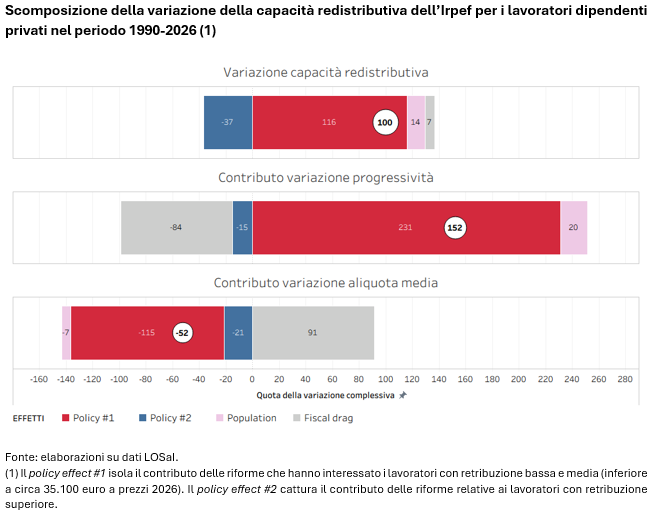
In order to identify the determinants of this strengthening, the UPB has developed a decomposing methodology that distinguishes four factors (the reforms aimed at low and medium income, those intended for higher income, tax drainage and changes in income distribution and labour force composition), separating the impact of regulatory changes from inflation and labour market changes.
Overall, Irpef reforms explain about 80 percent of this increase: the growth of redistribution is driven by the strengthening of progressiveness, partly offset by the reduction of the average rate resulting from the reductions introduced over time. In detail, the breakdown shows that the increase in redistributive capacity in the 1990-2026 period is mainly due to the reforms aimed at low and medium incomes, which account for 115.8 percent of the overall increase; interventions on higher income instead reduce the scope (-36.7 percent), while fiscal drainage and changes in income distribution contribute positively, respectively for 7.4 and 13.5 percent.
It follows, in summary, that the Irpef played a growing role in offsetting the dispersion of gross income from dependent labour, although it is not possible to establish a causal link between wage dynamics and reforms by not being able to exclude the hypothesis that the availability of fiscal instruments supporting lower income may have influenced the results of bargaining.
The UPB also highlights some limits of the current redistributive model. The strengthening of the redistributive capacity was achieved mainly by reducing the levy on low and medium income and concentrating the burden on medium-high incomes, with a greater exposure of the system to the effects of fiscal drainage and with treatment differences between employees and other categories of taxpayers. These interventions, while reducing the increasing dispersion of gross incomes, do not address the structural causes of wage stagnation and precarization of work.
“More redistribution increases would require additional interventions, such as the revision of the facilitated schemes, which subtract the basis imponable to the ordinary system, the enlargement of the taxable base through the contrast to evasion and structural policies aimed at countering wage stagnation, possibly flanked by means of income support instruments operating on the side of expenditure. These evidences suggest that the current redistributive model may have reached its own limits,” the UPS emphasises.
-Photo press office Upb-
(ITALPRESS).