ROMA (ITALPRESS) – More than one million and six hundred thousand visits and diagnostic tests in more guaranteed within the waiting time. It is the result recorded in the first half of 2026 compared to the same period last year by the National Health Service, the result of increased productivity and a better organization of the offer.
The data emerges from the first quarterly bulletin on the trend of the waiting lists prepared by AGENAS, after the presentation, last May, of the new National Platform for the monitoring of the Expected Lists, which allows to follow month by month and Region for Region the trend of waiting times for 14 types of first visits and 22 diagnostic tests.
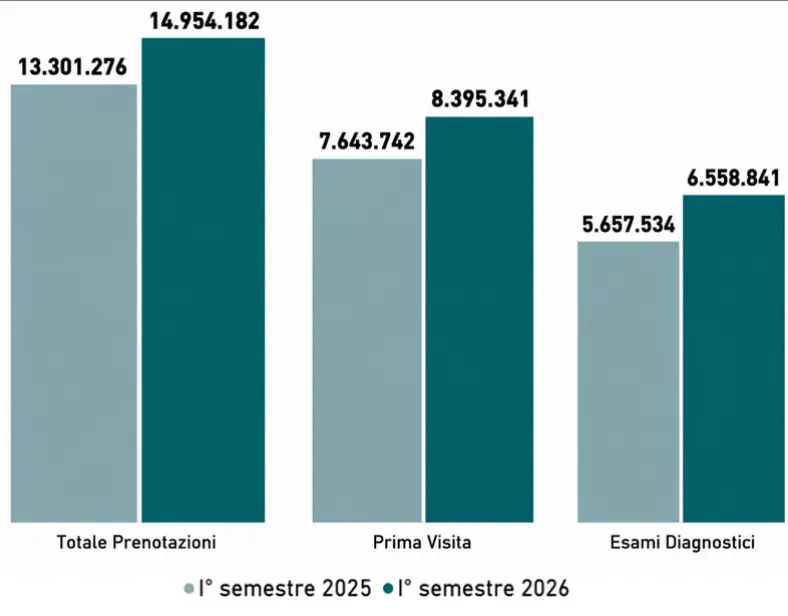
The comparison shows an increase in bookings made, from 13.3 million in the first half of 2025 to 14.9 million in the first half of 2026. It also increases the offer of visits and exams carried out on weekends: they were 330 thousand in the first half of last year and are 357 thousand in the first six months of 2026. To increase productivity – which is the result of a better organization and resources dedicated to the increase of the offer to break down the waiting lists – is paid a further step in respect of the warranty times. The first visits made within the expected time date date from 76.4% to 78.5%, while diagnostic tests pass from 82.8% to 84.6%.
The first visits in warranty times increase from approximately 5.8 million to 6.6 million, with 757 thousand more performances than the first half of 2025. Diagnostic examinations, however, range from 4.7 million to 5.5 million, equal to 867 thousand tests carried out within the threshold. Overall, there are a million and 624 thousand bookings made in compliance with the expected maximum waiting times for each priority code. As a result of the overall increase of the activity, the absolute number of bookings made beyond the maximum guarantee time, which passes from 2 million and 782 thousand to 2 million and 811 thousand.
Of these, from 552 thousand to 606 thousand the bookings made with delays contained regarding the guarantee threshold (yellow color in the figure). The other bookings made beyond warranty times (red color) remain substantially stable in absolute numbers (from 1,47 million to 1,44 million for first visits and from 754 thousand to 759 thousand for diagnostic examinations) but with a lower percentage weight on total performance (respectively from 19,3% to 17,2% for first visits and from 13.3% to 11.6% for diagnostic examinations).
The most important aspect concerns the improvement recorded in urgent performance, to be supplied within three days, and in those classified as “Breve”, which must be guaranteed within ten days. The first urgent visits made within three days pass from 77.7% to 81%, while those in class B increase from 77.3% to 80.2%. An improvement is also observed for diagnostic tests: the urgent ones guaranteed within three days rise from 73.2% to 76.4%, while those in Class B pass from 75.9% to 77.6%. They also improve deferred performance, which must be guaranteed within 30 days for first visits and within 60 days for diagnostic tests.
For visits, the rate of performance provided in the expected time increases from 70% to 73.3%, while for diagnostic examinations passes from 82.8% to 85.1%. However, the programmable performance remains stable within 120 days, at 84.3% for the first visits, while diagnostic tests increase from 85.4% to 86.8%.
The first oncological visits are those with the highest percentage of respect for warranty times, and they further improve between the 1st semester 2025 and the 1st semester 2026, from 94.2% to 95.2%. Significant improvements also for gastroenterological visit (from 70.8% to 74.7%), pneumological visit (from 77.7% to 80.9%) and physiological visit (from 78.5% to 82.7%). The most consistent improvement in the comparison between the first half of 2025 and the first half of 2026 concerns the dermatological visit, which while remaining one of the performances with respect for the lowest guarantee times, goes from 65.5% to 70.2%.
Among the diagnostic tests, the most significant recovery is that of the colonoscopy, which records the increased increase among all the monitored performance, from 60.8% to 69.8%. Gastroscopy also rises from 66.4% to 71.9%, the ultrasound of the breast from 78% to 81.6%, the magnetic resonance of the abdomen from 78.6% to 81%, the cardiovascular test from 80% to 82.2%, the ultrasound abdomen from 84.6% to 86.7%. Particularly significant is the improvement of mammography, which goes from 86.1% to 89%.
The only performance that has a slight decrease is the magnetic resonance of the encephalic trunk, which passes from 83.9% to 81.9%. Analyzing the data and trend of the individual regions, between the 1st semester 2025 and the 1st semester 2026 regarding the first visits, there is a good trend in most regions: 7 Regions confirm a high percentage of respect for the maximum guarantee times already reached in 2025. 2 Regions, Liguria and Lombardy, significantly improve compared to the first half of 2025. 3 Regions, while maintaining the percentages of compliance with the times below 80%, however, have improvements (Emilia-Romagna, Piemonte, PA di Bolzano). Some regions have worsening than the corresponding period of 2025, such as Abruzzo, Sicily, Sardinia and the Autonomous Province of Trento.
There remain percentages of respect for the times still below 70% in 5 Regions, although with signs of inversion of trend, as in Friuli-Venezia Giulia, in Puglia and in Umbria. Also for diagnostic tests, in comparison between 1st semester 2025 and 1st semester 2026 most regions show good results. In particular: 10 Regions confirm a high percentage of the maximum guarantee times already achieved in 2025, higher than 80%. 2 Regions, Liguria and Lombardy, significantly improve compared to the first half of 2025. L
to Region Friuli-Venezia Giulia passes from 76.1% to 80.4%; 4 Regions while maintaining percentages of respect for the times below 80% however present improvements (P.A. Trento, Puglia, Sardinia, Umbria). Some regions with less than 80% have worsening than the corresponding period of 2025, such as Abruzzo, Sicily and Aosta Valley.
MELONI “SIAMO SULLA STRADA GIUSTA”
“Reducing waiting lists is one of the most important challenges for our health. The first data of 2026, certified by Agenas, tell us that we are on the right track: in the first six months of this year, 1.6 million visits and exams were carried out more within the timeframe than the same period last year. It is an encouraging result, the result of the work started with the reform on waiting lists.” So on X the President of the Council Giorgia Meloni. “We know that there is still a lot to do and that too many citizens still expect too much for a health benefit. This is why we will continue to work with determination, together with the Regions, to ensure faster and faster times and more efficient health service,” he continues.
-Photos print office Agenas-
(ITALPRESS).