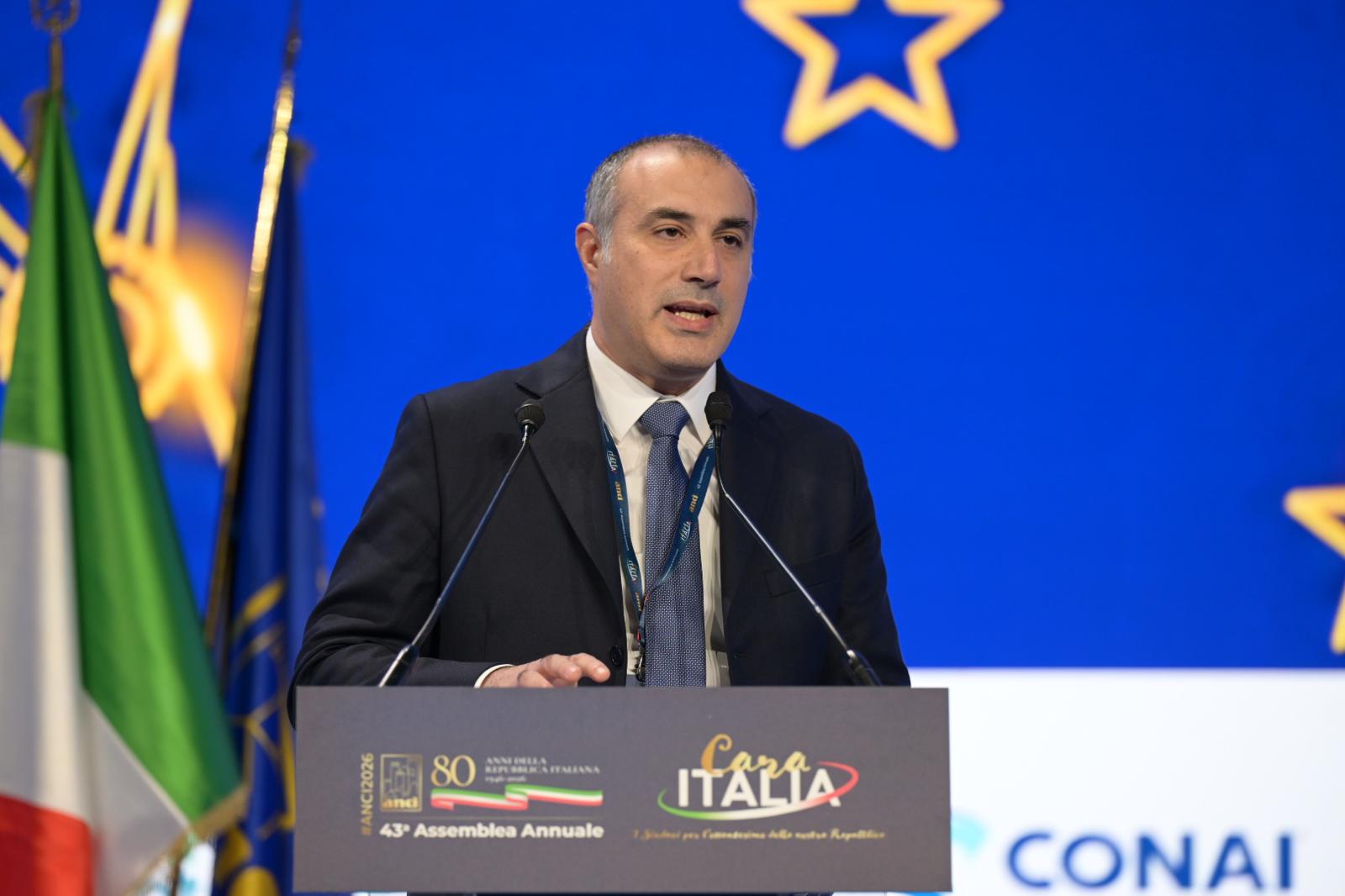
ROMA (ITALPRESS) – “Over 5 billion euros for research and development over the next 5 years, 14 models produced in Italy, to which will be added another 9 within 2030 and more than 7 billion euros per year of purchases from Italian suppliers are figures that testify the commitment with which we contribute to support the Italian industrial fabric. A commitment made increasingly complex by a difficult context and constantly changing variables.” Thus Emanuele Cappellano, head of Stellantis in Europe, during his intervention in Verona for the Anci assembly. “I am referring, in particular to the geopolitical context, which is generating significant costs, to an increasingly competitive market also because of the increasing presence of imported cars and the transition to the electrician that brings a further increase in costs. Under these conditions, guaranteeing the productive continuity that Italy needs becomes a daily challenge. We feel all the responsibility of this challenge. But a long-term industrial presence requires the commitment of all actors involved. Only through the collaboration between companies, institutions and local authorities, in fact, can we face the many challenges that the Italian and European industry have ahead of itself.”.
“Beyond European level, it is also important to intervene at national level. And here, I think there are two elements on which our country should focus, namely: the cost of energy and the simplification of administrative processes. I leave from energy, a topic that touches shared ropes with those who administer the cities. In September, in our Italian plants we spent 287Ç MWora, against 183Ç of September 2025. 57% more.” “It is a dramatic increase, which makes the gap between us from other countries unsustainable, not just European ones. While appreciating the initiatives taken by the Government, including the recent “Decreto Bollette”, it is urgent to intervene in order to reduce energy costs structurally. Only in this way will it be possible to preserve the industrial activity of the country and our territories. In addition to unsustainable bills, companies often have to deal with approved processes that do not respond to the rhythms imposed by global competition.”.
“On this point, I would like to share an example that concerns us – he continued –. To reduce energy dependence and environmental impact, we are working on the development of photovoltaic plants and biomethane production within some of our plants. Unfortunately, we are encountering an approach that does not always grasp the importance of these projects, not only for Stellantis but for the territories themselves that would host them. This often results in an extension of time, an increase in costs or even an impossibility to proceed. I think it is necessary to intervene with a “patto” between public and private able to safeguard investments, occupation and decarbonization of urban areas. I invite the mayors to work with us to achieve joint results of common interest. Stellantis works daily with the territories for the common good,” he concluded.
“We are dialogue with the European institutions to find pragmatic solutions that meet both environmental needs and industrial and social needs. I am obviously referring to the ongoing debate on made in europe and CO2. A comparison that in recent weeks seems to have recorded a promising evolution. In fact, what is shared by the main parliamentary groups and some Member States could be consolidated by the end of the year, providing the sector with the flexibility and legal certainty necessary to share. If the trajectory of this evolution is confirmed, by the next spring we could have new rules on which to found the relaunch of the industry”, he said. “In recent years, European rules for the sector have failed to reconcile climate objectives with industrial sustainability. Objectives which must not be alternative to us, but complementary to each other. In fact, a strong and competitive industry is indispensable to manage the challenges of ecological transition without leaving anyone behind. In particular, for Italy, reasonable trajectories for commercial vehicles and small cars Made in Europe (which are the flagship of Italian production) certainly represent the most qualifying elements”.
– Stellantis press office photos –
(ITALPRESS).