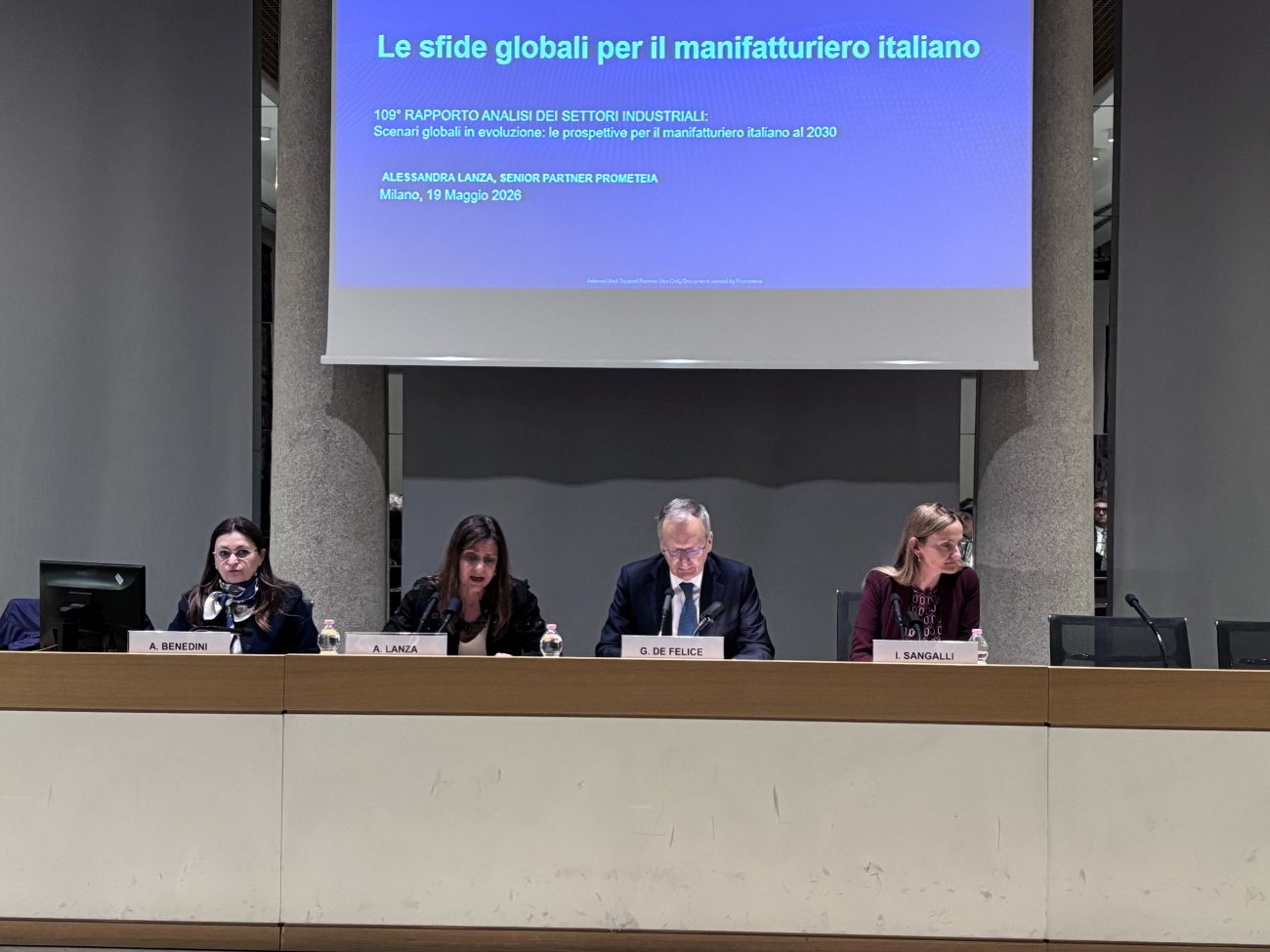
MILAN (ITALPRESS) – The Italian manufacturing sector, from here to 2030, is oriented towards a moderate growth of turnover, close to the average annual 1% at constant prices. However, it weighs the uncertainty caused by the war in the Persian Gulf and the blockade of the Strait of Hormuz. In the second half of the year, the Italian manufacturing industry would suffer a strong penalty in terms of turnover, expected to contract 1.5% in the average of the 2026-27 period. These are the main results contained in the Analysis Report of Industrial Sectors realized by Intesa Sanpaolo and Prometeia and presented today in Milan.
In introducing the data Gregorio De Felice, Chief Economist and Research Department of Intesa Sanpaolo, he talks about “two important factors of uncertainty: the Persian Gulf and the conflict on technology between the United States and China, with the latter becoming a geopolitical and potentially macroeconomic risk”. According to the report, the Italian manufacturing industry will close 2026 with a stable turnover at constant prices (+0.2% tendential), supported by the good dynamism of Electronics (+2.2%), Mechanics (+1.4%) and Electronics (1.3%), and moderate increase at current prices (+3.8%), and with a total turnover of 1,168 billion euros.
It will be the internal market to provide the main support for the Italian manufacturing activity during 2026, especially on the investment side, which will maintain an expansion profile thanks to tax incentives and the final phase of the PNRR. Specifically, the most dynamic components will be investments in instrumental assets, supported by the new incentive scheme (hyper-mortization), intangible investments and investments in buildings linked to infrastructure works.
Investments in means of transport, instead, are expected to slow down the step (mainly because of the attenuation of the drive to the renewal of the long-term rental fleets and the expected decrease of the registrations of heavy vehicles). The recovery of consumption will be dampened by the framework of greater uncertainty and renewed pressure on incomes, resulting from the new inflation wave, which will lead to cuts in the most compressible costs. It will be the purchases of goods to suffer more, especially of durable for mobility and of voluptuous products such as fashion, which already placed on depressed levels.
Observing the possible sectoral trends in the period 2027-2030, the scenario is quite diversified. The Pharmaceutical will be the most dynamic sector in the forecast horizon at 2030, with a expected growth of turnover at constant prices of +2.5%, supported by exports but also by the strengthening of consumption on the internal market. The purchases of drugs will continue to receive great attention in the basket of consumer spending, in a context of progressive demographic aging and attention to personal well-being. Less dynamic, but still growing above the manufacturing average, also the Largo consumer sector (+1.4%), which includes cosmetics. In increase supported the sectors connected with the double transition, such as Electronics (+1.9%), Mechanical (+1.5%) and Electronics (+1.3%). The expectations are also of modest rebound for motor vehicles and motorcycles (in increase to +1.5% average annual in the four-year forecast), always at grips with a difficult passage to electrification. All other manufacturing sectors will present growth rates below the average annual 1%.
The manufacturers of durable goods for home, furniture and household appliances will suffer from an internal market still weak, only partly offset by sales on foreign markets. Furniture can leverage the competitive advantage of specialization on high-end products, intended for the luxury segment; household appliances will suffer more international competition, especially Asian colossi. Food and beverages and Fashion System, which will suffer from the weakness of consumption and the growing maturity of the European market. In the case of fashion, moreover, it will weigh the intensification of international competition, especially in segments with less differentiation and more exposed to the price competition of Asian producers.
– Photo xh7/Italpress –
(ITALPRESS).