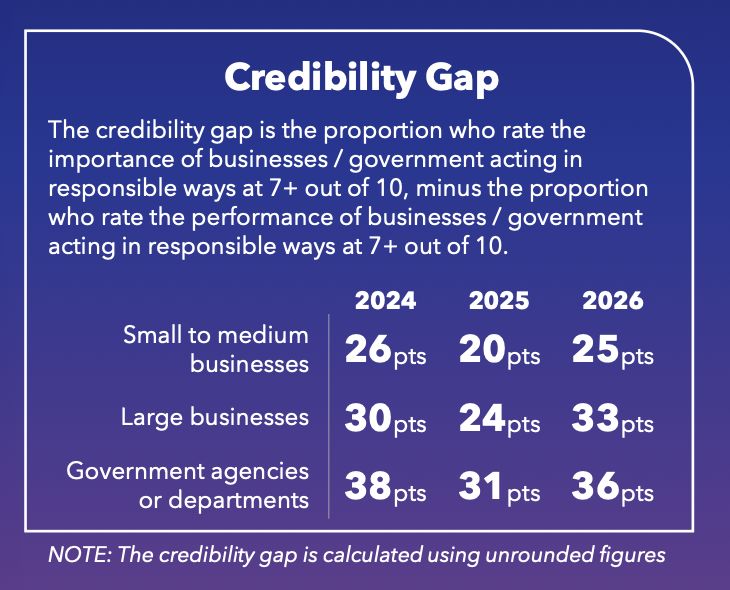
MILAN (ITALPRESS) – In a context marked by the pressure on the cost of life, by geopolitical tensions, by increasing attention to the resilience of economic systems and the rapidity of technological change, enterprises are subjected to a more severe judgment by citizens. 84% of Italians consider it important that large companies act responsibly on the environmental, social and governance level, but only 50% positively evaluate the results (it was 58% in 2025), judged more and more on very concrete issues: sustainability of costs, safety and value generated locally. The credibility gap rises to 33 points, compared to 24 last year. A phenomenon that is part of a global trend: at the international level, the judgement on the work responsible for large enterprises has fallen from 61% to 56%.
This is what emerges from the Impact Monitor 2026: Closing the Credebility Gap, the annual SEC Newgate survey on community expectations for large organizations. At the sixth edition, the study involved 20,473 people in 20 countries and territories.
The judgment on companies is based on the economic and social conditions in which people live and the dissatisfaction linked to the context of their country. And if 49% of respondents globally consider that their country is on the right track and 51% on the wrong road, in Italy the picture is more critical: only 32% believe that the country is going in the right direction, down from 36% of 2025. The major issues concern the issues that directly affect everyday life: cost of living, health, wages and working conditions, safety and employment. 77% negatively judges the cost of living, 71% that of wages and working conditions, 70% that of health, 69% safety and 64% employment opportunities. In addition, the Italians are more critical than the global average on the management of all the topics analysed, with the major waste on safety (+25 points), health (+24) and wages and working conditions (+23).
“In this context, the expectation towards corporate responsibility is becoming even more demanding – says Fiorenzo Tagliabue, Group CEO of SEC Newgate – In the markets under our investigation, eight out of ten people continue to feel a responsible conduct important. What has changed is the perception of how companies are up to this expectation. This year the evaluations have worsened in all sectors analysed, creating a credibility gap that enterprises cannot afford to ignore. The context in which enterprises operate has become more difficult and the same phenomena affecting their decisions – pressures on the cost of life, geopolitical tensions, political polarization, rapidity of technological change – are redefining the criteria in which they are judged. Responsibility is increasingly interpreted in terms of economic accessibility, security and benefits for local communities. The best-equipped companies to deal with the coming years will not necessarily be those with the most ambitious global narrative. They will be able to keep their own raison d’être clear, recognizing at the same time that credibility must be achieved increasingly market by market, decision by decision and stakeholders by stakeholders. The credibility gap can be filled, but it is not enough to communicate better. Enterprises must listen first, understand the societies in which they operate and let what they hear or hear their decisions.”
One of the clearest signs is the distance in trust between local and foreign companies. In Italy, 70% declares to trust Italian-owned companies, against just 39% of foreign-owned companies, with a gap of 31 points.
The phenomenon is global, but in Italy it iseven more pronounced: altogether 76% of respondents trust national companies, only 52% of foreign companies (24 points are discarded). A challenge for multinationals whose global dimension can represent a competitive advantage, but does not automatically translate into confidence in individual markets.
The expectations on the contribution to the local economy are also particularly strong. 81% of Italians (vs 62% globally) prefer that goods are produced in the country even when this can mean higher prices. In addition, 70% believes that companies should invest in communities in which they operate even when this can affect profitability but 50% judges insufficient how big companies do today to support them. Italian companies therefore ask to make visible the value produced in the country in terms of employment, investments, productive capacity, supply chain and contribution to the local economy. It is the same imperative that emerges globally: the report identifies the visibility of the value generated in individual markets a priority for multinationals.
The local value is intertwined with an increasing demand for economic resilience. 69% of Italians believe that the country’s energy independence is inadequate, compared to 45% globally, while 49% consider national manufacturing to be too limited compared to 44% globally. Similar to the concern about strategic resources: 67% consider the country excessively dependent on critical minerals and 65% for semiconductors.
In this context, localization and resilience are not only industrial issues: they become increasingly directly involved in the assessment of the responsibility and reputation of enterprises.
Support for energy transition remains significant, but is weakened by increasing pressure on the cost of life and energy security concerns. It is a global trend that emerges with particular evidence in Italy. Here, in fact, the positive judgement on the move to renewables drops from 63% of 2025 to 55% against a global decline from 64% to 60%. However, this does not mean a reduction in environmental priority. 64% of Italians continue to favour the reduction of emissions compared to the containment of prices, compared to 55% overall. But there is a growing concern about the consequences of the transition: 84% fears an increase in energy costs, 80% of foreign dependence on renewable technologies and materials, and 76% of the risk of energy deficiencies or blackout.
The demand that emerges is therefore more articulated than a contrast between sustainability and convenience. Enterprises and institutions are called to explain who will support the costs of the transition, who will receive the benefits and how the consequences will be handled equally, putting together climate objectives, economic accessibility, reliability, national security and competitiveness.
The Impact Monitor points out that the expectation of business involvement on the main environmental, social and political issues remains high, but the most appropriate way to intervene varies considerably between markets and circumstances.
The Italians ask companies to take more responsibility also on public issues, but there is no general mandate to take a position. 52% believe, for example, that large enterprises are too little public on environmental issues. At the same time, people would tend to prefer a private interlocution with respect to a public stance if government actions should jeopardize democratic institutions. Finally, preference for neutrality prevails in international disputes. For enterprises, therefore, it is not simply a matter of talking more, but of understanding when to intervene, with what methods and what degree ofexposure.
Globally, optimism prevails sharply: 50% positively considers the growing spread of AI, compared to 22% negatively assessing it. Geographical differences are very marked, with positive judgments reaching 88% in China, 76% in India and 75% in the United Arab Emirates.
Italy takes a more prudent position: only 38% positively evaluates the spread of artificial intelligence, while 28% expresses a negative judgment. The expectations of opportunities are accompanied by concrete fears. In Italy, 59% fear more risks to privacy and personal data, 56% more widespread dissemination of false or misleading information and 54% less job opportunities. For enterprises that introduce AI systems, the indication is therefore to start from the concrete benefits for customers, employees and communities and accompany innovation with credible guarantees on privacy, accuracy, disinformation and impact on work.
The final message of the Impact Monitor 2026 is clear: the credibility gap cannot be filled only through communication. Businesses must immediately listen to communities and stakeholders, understand how expectations and priorities change between different countries and publics and use these insights to guide the most relevant decisions.
The report identifies six priorities for companies: Replace corporate formulas and terminologies with specific and verifiable evidence of the generated impact; Understand which stakeholders are decisive for business objectives; Do not assume that there is consensus between different markets; Check, before the most controversial decisions, who will support the costs and who will receive the benefits; Make visible local leadership, employment, suppliers, investments and tax contribution;
Define shared criteria to decide when to take a position publicly and when to prefer other forms of interlocution.
Paola Ambrosino, CEO of SEC Newgate Italia, comments: “The Italian entrepreneurial fabric, so lively and widespread, leads citizens to bind in a profound way the credibility of enterprises and rooting in the country, and thus contributes to economic development and value generation for communities. But today we must interpret economics and value in an increasingly complex perspective of expectations: energy transition yes, but attention to the costs and security of supply, openness to artificial intelligence, but guarantees on work, privacy and the quality of information, and so on.
The possibility to bridge the gap of credibility and build a stronger relationship with the country passes from the ability to demonstrate a concrete impact on people, economy and territories and this engages both Italian companies and multinationals in their industrial choices and social responsibility before they communicate.
-photo print office SEC Newgate –
(ITALPRESS).