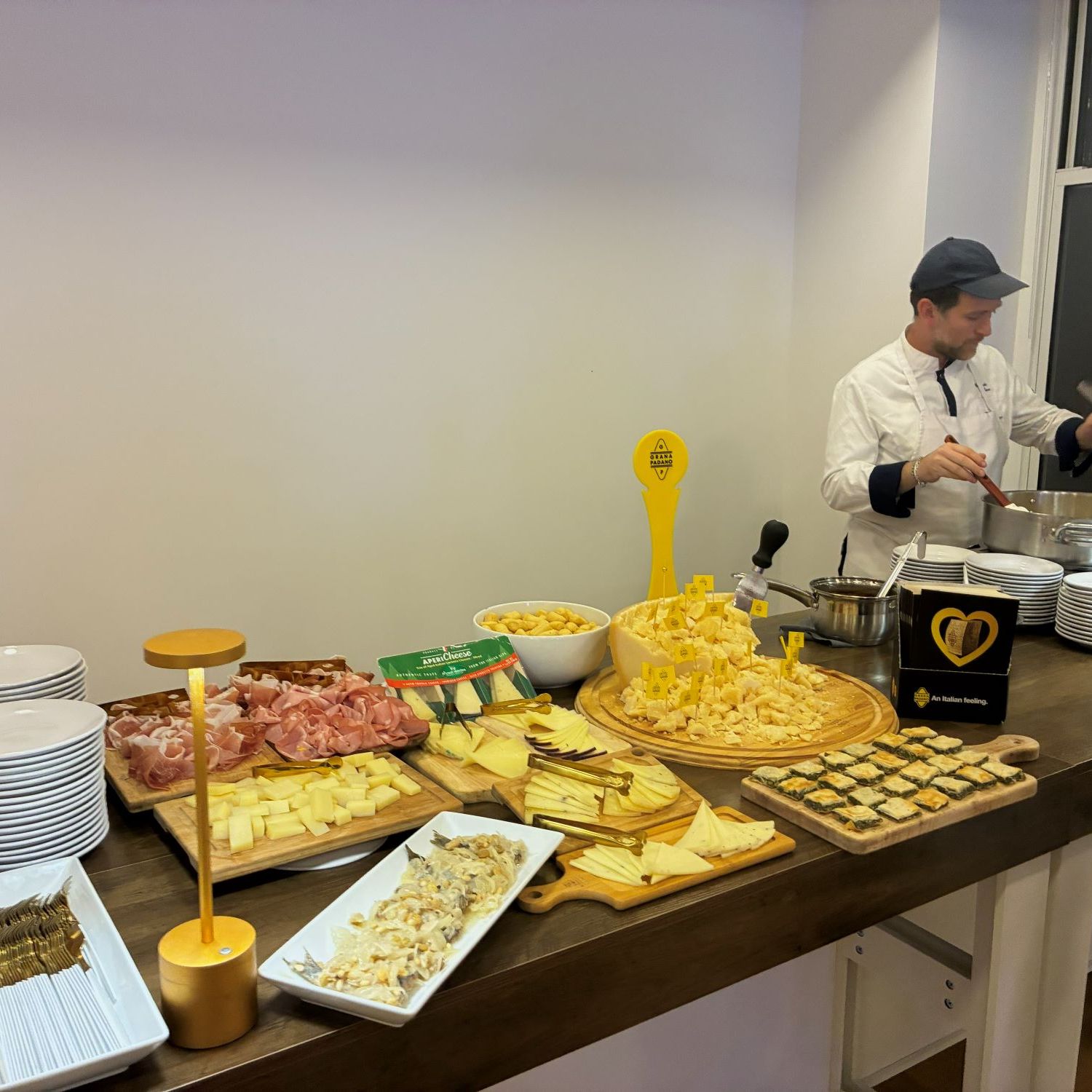
After the South, in April, and central Italy, the Italian Trade Agency in New York closed the cycle ITA Talks 2026 with the North: from the Aosta Valley to Friuli Venezia Giulia, passing through Piedmont, Trentino-Alto Adige and Veneto. The meeting, entitled Northern Italian Regions, was opened by the Trade Commissioner and executive director for the United States of the agency, Erica Di Giovancarlo.
Di Giovancarlo recalled that evening was the last of the cycle and also the last with Raimondo Lucariello, who leads the Food & Wine department of ITA New York. “You are all witnesses of what he did with passion”, he said, congratulating him for the work he did in many years and wishing him good luck for his next destination.
Valeria Robecco, president of UNCA and correspondent of the NSA to the UN. “Speaking North Italy is not a single culinary identity,” he said. “We talk about a mosaic of regions and landscapes”, of traditions “from the Alps to the Po Valley, from the lakes to the Adriatic coast”. And he specified: “This evening is not a lesson, it is a conversation.”.
At the table was the menu curated and presented by the Venetian chef Riccardo Orfino: a Venetian dish linked to the tradition of his family, a risotto with saffron with caramelised celery and roasted sauce, a braised, whose sauce is also served to finish the risotto, and as sweet a strudel of apples of Trentino.
For Dino Borri, global advisor in food, wine retail and hospitality, North cuisine has always been “a very family cuisine”, and it is still. All the food, he explained, “it was done saving and not wasting, a very common term today”. Borri also told how social media is changing customer requests: many come by asking for a product of Lake Como, but “almost no product of Lake Como is available”, and they do not always realize that Italy “has the greatest diversity of the world in food”. On the denominations, he said, if you see the brand DOP is already a good sign, and Italy “has more DOP cheeses of France”.
Stefano Viero, general manager of Monti Trentini, described the reality of small mountain producers: the family company has five or seven cows and Monti Trentini works with 140 farms. “If they do not produce and do not sell, they do not survive,” he said. “Identity is closely linked to the territory and its protection.” For this reason, he explained, the controls on naming products are continuous and almost weekly, without notice. Viero also recalled a little known story: in the past the South was the rich part of Italy and the North the poorest, and that is why many Italian North farmers are today in Australia, Brazil, Argentina and North America.
For wines, Damiano Sorato, vice president of sales USA of Ethica Wines, has highlighted the variety of territories, from volcanic soils to large lakes like that of Como, and a taste that the market asks today: wines “sofisticated and fresh”. Two bottles of the same region, he explained, can be completely different even to thirty kilometers away, and its task is to let taste and let choose. Drinking, he added, also means “being together, spending time together, talking to others”, and that’s what you really are looking for.
From the point of view of the kitchen, German Rizzo, executive chef and owner of the Plado restaurant, told that he learned in years of work in the kitchens that “less is more and more”, and that at the end of the dinner there is always something sweet as a tribute, “because something sweet always makes everyone happy”. To the question about what more surprises those who taste the North kitchen, he closed: “It’s exactly our goal as a chef: let us discover.”.
L’articolo North Italy at the table in the last ITA Talks in New York proviene da IlNewyorkese.