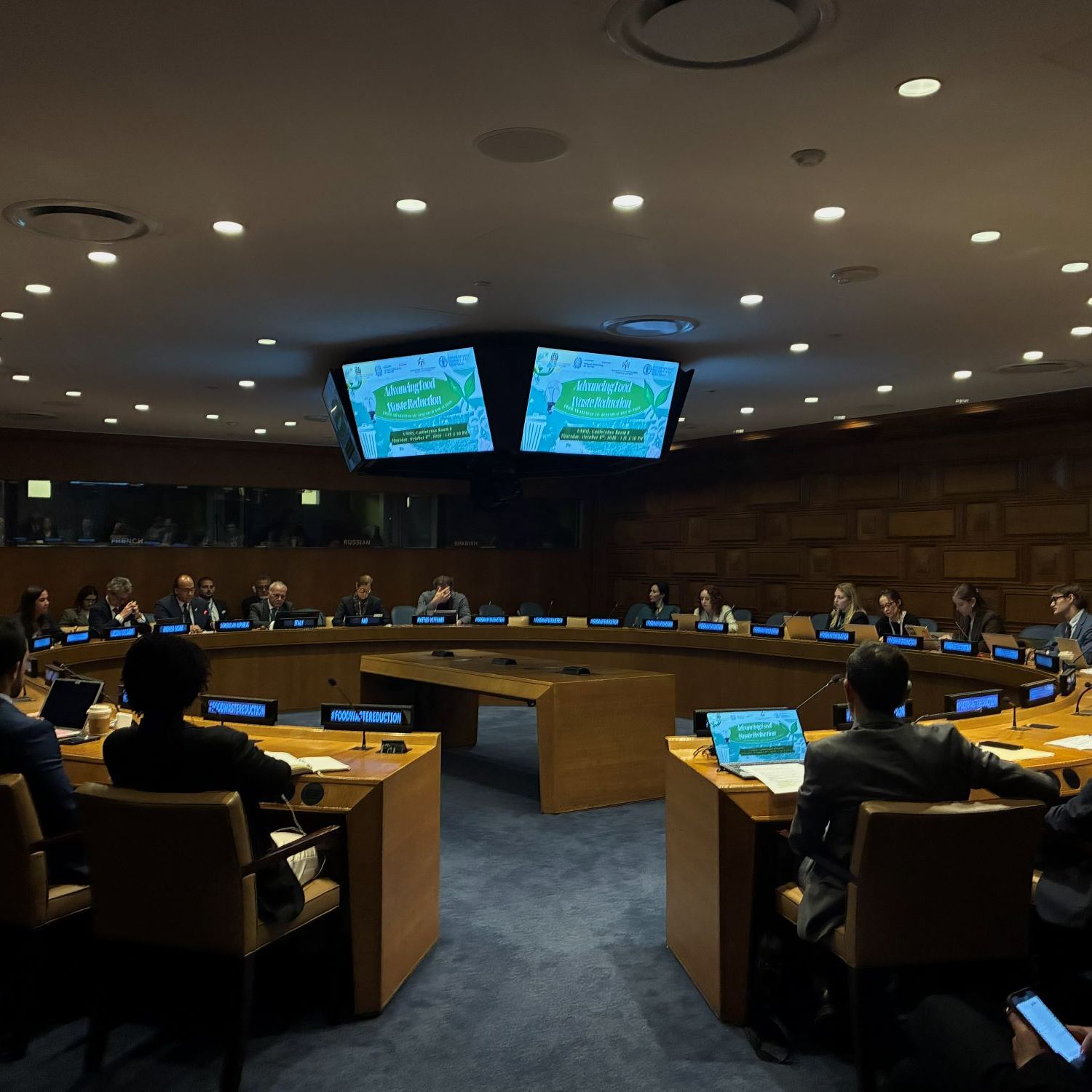
Every year a significant share of the food produced in the world is lost or wasted, while hundreds of millions of people do not have enough access to food. It is the paradox from which, in the text of his speech published by the Representation, the Permanent Representative of Italy at the United Nations, Giorgio Marrapodi, opening Thursday 8 October the event “Advancing Food Waste Reduction: From Awareness to Research and Action”, organized by the Italian Representation with those of the Dominican Republic and the Hascemita Kingdom of Jordan, in collaboration with the FAO, which moderated the discussion. The initiative took place a few days from the International Day of Awareness on Food Loss and Waste, celebrated on 29 September, and met, according to the Representation note, institutional representatives, international organizations and academic experts, including FAO and CIHEAM.
The Italian point of view is domestic, in the literal sense of the term. For Marrapodi technology and politics are indispensable, but most of the food you waste is wasted at home, in the kitchens, through daily decisions: how often you do the shopping, how you plan meals, how you read a label, as you judge if a food is still good to eat. They are choices related to habits and circumstances that change from one country, from one community and from one family to another, and precisely for this reason the policies, it claims, must start from this reality. At the beginning of the work he said: “The real challenge that concerns us all is to move from awareness to research and research to action.”.
Professor Andrea Segrè of the University of Bologna, who held the main intervention, recalled that for the objective 12.3, which asks to reduce food waste by 2030, four years remain. He then retraced the Italian work, which since 2010 focused on the prevention and behaviour of consumers, from the Spreco Zero campaign, whose name remained in Italian because the English translation, zero waste, indicates another thing, to the Waste Watcher Observatory, born just before 2015 to measure progress towards the 2020 goal.
In a slide of the Waste Watcher observatory, realized with Ipsos-Doxa and shown during the meeting, the declared domestic waste in the last seven days is compared between Italy and the United States. The individual national average is 493.7 grams in Italy and 775.7 grams in the United States, and in both countries the younger generations declare to waste more than average: the Gen Z 32% more in Italy and 44% more in the United States, the millenniums 21% and 10% more. The Gen X is below average, 19% in Italy and 26% in the United States, and boomers are the most virtuous, with 21% less in Italy and 49% less in the United States.
For FAO, a technical advisor for food losses and waste has intervened, which has emphasized how the challenge is to move from awareness to action and how there is no single solution, because the causes change along the supply chain. In production and post-harvest phases, losses can depend on inadequate storage, parasites and climate variability; in consumption and catering, menu planning, product availability and purchasing habits. He cited a school program in the Dominican Republic that reached more than two million students and proposed a continuous cycle of measurement, understanding, action, monitoring and analysis: the measurement says where it is, the analysis helps to understand why.
The most concrete testimony came from Jordan. The representative of the Jordanian High Council for Food Safety explained that its is one of the countries with greater water scarcity in the world and depends on the imports of food, so wasting food also means wasting water, energy and money: reducing losses is together a matter of food security, water balance and economic balance. The first official national study, conducted with the Department of Statistics and the World Food Programme, collected data in houses, restaurants, hotels and hospitals, with young Jordanians responsible for the collection. Waste in households is estimated at 81.3 pounds per person per year, for a total of almost one million tonnes per year. They are figures that the representative has defined a starting point and an invitation to act, and the study suggests that waste and food insecurity can live in the same family.
In Jordan behaviour has cultural roots: family, hospitality, generosity. The representative said that this culture should not be changed and that it is necessary to show what a responsible generosity means. The national campaign has a simple message: to buy what you need, to keep food well and to use what progresses. Young innovators have used the black soldier fly to transform food waste into animal feed and organic fertilizer, and a committee dedicated to losses and waste, established at the High Council, helps institutions to work together. Jordan proposes three things: to measure regularly and not once, to study the links between waste, nutrition and food insecurity, and to extend what works. The national objective is to reduce food losses and waste by 30%. The representative also recalled that food is a blessing and that what gives value should not be wasted.
In conclusion, Marrapodi has reiterated that Italy remains engaged on this agenda, also through the collaboration with agencies based in Rome, and that reducing food losses and waste is one of the most practical and effective ways to bring together food security, climate action and responsible consumption.
L’articolo At the UN, Italy raises the fight against food waste proviene da IlNewyorkese.