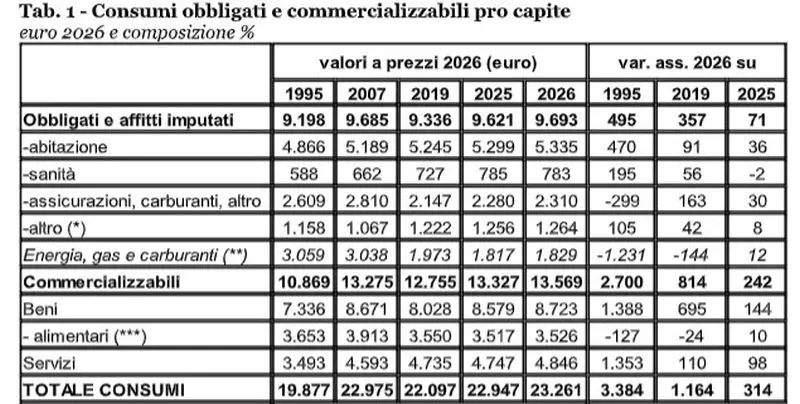
ROMA (ITALPRESS) – In 2026, the compulsory expenses – that is, those related to goods and services that families cannot do without, such as home, energy, bills, health, transport and insurance – continue to “eat” a very substantial share of the total consumption of households with an incidence of 41.7% (+4.7% compared to 1995). On the other hand, the share for services (+2.9%) is slightly increased, whereas the share for goods (-7.6%) is contracted. Expenditure for the home is confirmed by the higher cost item with 5,335 euro per head (+72 euro compared to 2025) on the total amount of compulsory expenditure (equal to 9.693 euro); they follow insurance and fuels (2.310 euro) and energy (1.829 euro); the latter is, however, the component that, while maintaining a high incidence on family budgets, from 1995 to now has recorded the most significant reduction in consumption-1.2 The greater incidence of expenditure on family budgets is mainly determined by the different dynamics of prices increased much faster than those of goods and services marketable: from 1995 to today, their index grew by 140%, almost two and a half times compared to that of goods marketable (+57%) and once and a half compared to services (+88.4%), with the peak touched by the aggregate energy, gas and fuels whose prices grew by 211%. The analysis highlights, however, how families have demonstrated a significant holding capacity, trying to maintain levels of consumption, renouncing the composition of expenditure, containing above all the more traditional goods, more than drastically reducing it, even in the presence of a progressive increase in in incomprehensible costs that reduced discretionary spending spaces.
These, in summary, are the main results of the analysis of the Study Office of Confcommercio on the compulsory expenses of Italian families in the period 1995-2026 (here the full note of the Study Office).
The recovery of demand from the end of last year – which also sees some segments of durable goods interested – seems to have produced in 2026 a crystallization in the distribution of consumption between obligated and marketable. The estimated figure for the current year, which maintains the quota for the purchase of goods and services marketable to 58.3% does not change, in essence, the evaluations made previously on long-term dynamics. In thirty years the share of consumption destined to support those expenses to be considered obligated has passed from 37.0% to 41.7%, compressing the part reserved to the purchase of those goods and services that belong to the free choices of consumers and that are related to the preferences and lifestyles of individuals or families.
Lifestyles that over time have undergone profound changes, making in some cases more nurtured the border between compulsory and non-expenditure. Among these products and services is certainly part of the “technological” (smartphone, tablet, pc and related services) which gradually became also necessary tools for the work, study and use of services included among the compulsory expenses (bank and financial services, relations with public administration, etc.).
In line with changes over the years in lifestyles and consumer preferences, the compression of the share for the consumption of commercial goods and services is the result of dynamics.
“Despite a slowdown in compulsory expenditure, the incidence on family budgets remains high, particularly for fuels and bills due to energy relapses. It is necessary to intervene on tax and charges, eliminating the distortions that we have”The President of Confcommercio, Carlo Sangalli, said.
According to estimates, even in 2026 families confirm the tendency to try to recover mainly those spaces intended for the purchase of commercialized services, which after the stop of 2020 and the significant recoveries of the following years, have not yet returned to the quota of 21.3% reached in 2019.
On the other hand, the goods marketable as a whole should see, in the current year, a further reduction in the incidence at 37.5%.
In the light of the different dynamics recorded by the prices of the bonds and the commercial ones, it seems clear that a large part of the increase in the share of expenditure destined for the expenses to which the families cannot give up is derived from the need to maintain the volumes purchased in the presence of dynamics of the prices progressively increasing: that is, the increase in the share of the expenses obliged is derived from the effect of the greater prices to consumption.
It should also be considered the important demographic changes that occurred during the period under observation. In addition to the ageing of the population (to date more than 25% of the residents are over 65 years old) which has changed their consumption needs and preferences, since 2015 the population has shown a progressive reduction (in the average of 2026 the decline compared to the peak of 2014 should be approximately 1.5 million).
To try to sterilize, even partially, the possible price effect and demographic fall on the dynamics evidenced by Figure 1 reported the volume data (expressed at 2026) to the resident population.
In total terms, the per capita consumption expressed at 2026 prices increased between 1995 and 2026 to a more significant extent to the marketable component, especially as a result of what happened between 1995 and 2007.
Differences between value and volume dynamics once again reaffirm the role of prices in determining family choices. Choices that have been made in a context that for almost 20 years does not know a growth of volumes purchased per inhabitant: only on horseback between 2025-2026 will return to an expense in quantity similar to that of 2007.
Also confirmed in 2026 the preponderant role of the expenses for the house, whose volumes per inhabitant amount, at current prices, to little more than 5 thousand and three hundred euros a year (i.e. more than half of the expenses obliged in quantity).
Within the compulsory expenditure it is important to stress that the most significant reduction, in real terms, affected the energy component, which has not been translated into a similar compression of the share to value to such consumption intended. The figure is the result, in addition to the behaviour of the families who reacted to increasing prices, reducing consumption, perhaps above all, of the technological advances that have allowed to realize products increasingly oriented to energy saving.
On the side of the commercial goods, in 2026 the process of recovery of the purchased volumes, which in recent years has been largely guided by computer equipment and communications, also favored by the reduction of relative prices, should be supported also by a part of those durables whose expenses had been strongly compressed in previous periods.
-photo press office Confcommercio –
(ITALPRESS).