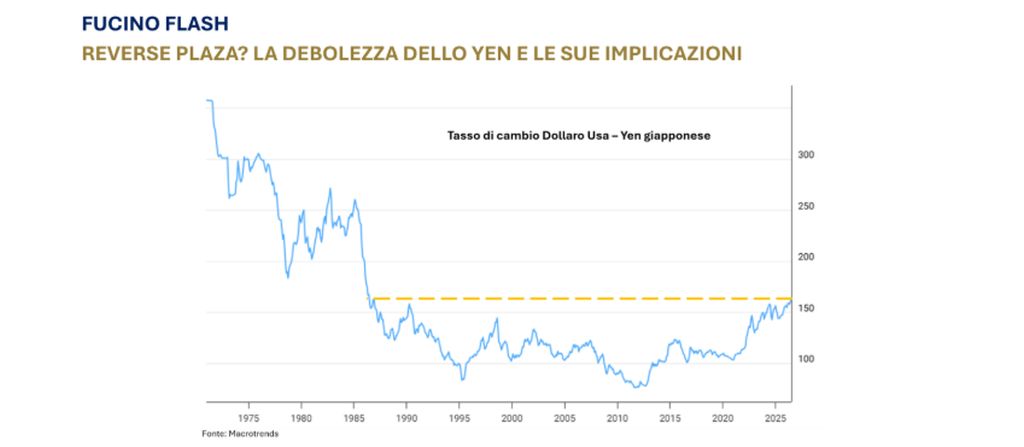
ROMA (ITALPRESS) – Between June and July 2026, the Japanese yen has reached the lowest level of recent decades. A change of about 162.5 yen per dollar has not been recorded for over forty years since the arrivals of the Plaza in 1985. Is the marked devaluation of the Japanese currency an opportunity or risk for the economy of the country? This is the question, of particular relevance in a phase in which the imbalances of the commercial balances have returned to the center of the international debate, and with them the hypothesis of new agreements for the devaluation of the US dollar (this time not so much compared to the yen, but compared to the Chinese RMB) – to which the new Fucino Flash report, entitled “Reverse Plaza? The weakness of the yen and its implications”, of the Study Office of Banca del Fucino, directed by Vladimiro Giacchè. It emerges as Japan must continue to normalize interest rates, but the process is complex. Despite this, the Bank of Japan maintains strong control over currency and bond markets, has large reserves and the country benefits from a positive balance of current accounts. Ultimately, it is only in the short term, according to the study whose authors are Vladimiro Giacchè and Michele Tonoletti – that the devaluation of the yen could prove to be a benefit in total terms, through the impulse imprinted to the export and the profits of the Japanese societies. On a wider time horizon, however, the authors conclude, “the ongoing reorganization will force Japan to seek new balances and new management strategies of its huge debt because on the long term the only one-off corrective interventions of the BoJ on the exchange market will not be enough to govern the transformation in place”.
– photo press office Banca del Fucino – (ITALPRESS).