ROMA (ITALPRESS) – Italian agriculture is going through a complex context, characterized by global and national challenges that make it essential to strengthen the competitiveness of enterprises. Also within this scenario, sustainability is a determining factor in company success and development for the environment, the territory and the entire country.
The share of enterprises reaching a high level continues to increase, rising to 57.9% from 49.3% of 2020, the first year of investigation. In the same period from 21.6% to 11.9% the share of companies remained at an initial level only.
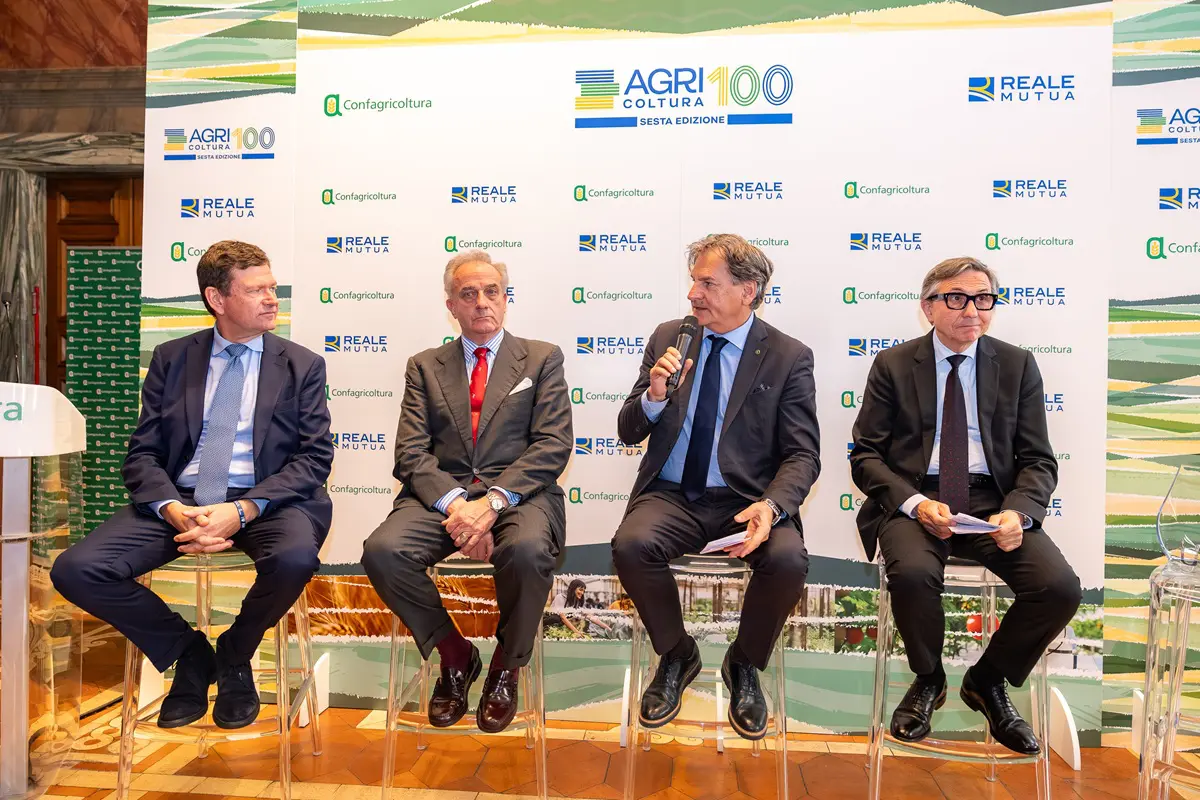
In the last year, it also recorded a growth of turnover 30.6% of enterprises with a high level of sustainability, compared to 14.6% of those with a basic level. This is what emerges from the sixth edition of AGRIculture100, the multiannual initiative of Reale Mutua in collaboration with ConfAgricoltura, in the Report 2026 realized by MBS Consulting (Gruppo Cerved). The survey was conducted on over 3,800 companies in the sector, growing steadily since 2020. The results were presented this morning in Rome, at Palazzo Della Valle, headquarters of ConfAgricoltura.
The survey also verified the consequences of tensions in international trade and duties that limited a strategic market such as the US.
42% of farmers say they are concerned about the effect of trade conflicts. The firms surveyed reported in particular an increase in raw material costs, market difficulties and reduction of exported quantities. In response, more than 70% of companies operating on foreign markets have activated new policies: 45% have sought new target markets, 20% have reviewed contracts and trade conditions with foreign countries, others (always 20%) have reorientated towards the internal market.
Trade tensions have caused difficulties and increased costs even in purchases, and 20% of agricultural enterprises have sought alternative suppliers.
More recently, the conflict in the Middle East has opened a cycle of energy crisis and inflation to which Italian agriculture is particularly exposed. As early as last year, 42% of farms had increased costs, and only one out of four (26.4%) reported that they had access to market prices. The costs, between the consequences, compress the profitability of the enterprises: 47.5% of the companies interviewed get a profit less than 5% of the turnover.
Sustainability is a transversal movement and its levels are quite homogeneous in the territory, without great differences between North and South. The most structured companies reach higher levels, but the share of small companies with a high sustainability index is significant.
The area that has grown the most is environmental sustainability, in which high-level companies have increased from 49% in 2020 to 63.8% in 2025. The increase in the quality of development (which includes competitiveness, innovation and quality of employment), from 49% to 58.9%. They also reach a high level of sustainability 47.9% of enterprises in the social area and 43.9% in the management of risks and relationships.
Tensions in international trade, increased competition in the internal market and the threats of a new cycle of inflation increase the urgency of a transformation of Italian agriculture that widens the scale of business activities and strengthens the integration of supply chain. The Report identifies 5 sustainability factors that can lead this transformation in the near future.
1. Quality as a competitive factor. The quality, understood as a combination of origin, traceability, safety, sustainability and symbolic value of the product, is probably the main distinguishing factor of Italian agriculture and therefore represents a strategic lever of competition. 65.5% of companies have reached a high level of sustainability in this area, and 34.6% are at the highest level.
2. Investment and innovation. Italian agriculture is a sector oriented to innovation and 70.3% of companies have invested in the last two years. Innovation is the factor that most of all generates positive impacts on the environment, on the quality of production and on the same business economy, and its correlation with sustainability is very strong: among enterprises with a high sustainability level, 82.2% presents a high level of innovation.
3. Industrial integration. Excessful fragmentation is a structural factor of weakness of Italian agriculture. Approximately half of agricultural enterprises (50.2%) has developed activities related to primary production, such as product transformation, energy production, receptive-tourism services and social and training services. These activities contribute to the growth and solidity of the enterprise and for more than half of those that practice them contribute to corporate revenues for more than 30%.
4. Mitigate hydrogeological vulnerability. Climate change affects agriculture, which nevertheless plays a leading role in the defense of the territory, with measures of channelling and rationalization of water use, care for soil processing, natural barriers to erosion, cover of uncultivated land. The perception of being exposed to risk is however very different between those who have suffered damage and those who do not, since it calls into question the need for a vast work of information and involvement to increase awareness of threats to agricultural enterprises and to develop skills on the most efficient ways to manage risks.
5. Human capital and social impacts. Offering stable work, attracting and enhancing women and young people and managing the generational change are key factors to developing the human capital of agriculture and thus represents a further lever to look at in a context of evolution and challenges such as the current one.
“The new edition of the AGRIculture100 Report, realized with our historical partner ConfAgricoltura, confirms the central role of sustainability and innovation as transformative factors capable of supporting the growth of the enterprises of the sector, allowing them to cross, with a solid base, also a complex scenario like the current one – says Luca Filippone, General Manager of Reale Group -. In their path, a central role can also be played by insurance covers, which help protect the business, strengthen the ability to prevent risks and consolidate their resilience to face future challenges.”.
“Today we have to ask ourselves how to address the new path of sustainability, which remains an absolutely strategic theme just if well defined and developed with realistic and challenging goals. If well conjugated, it becomes a tangible surplus value – says Massimiliano Giansanti, President of ConfAgricoltura -. To continue investing in this direction, slender, effective accompaniment policies are needed, in line with the international context, but there is also a cultural approach that the new generations have already in the ropes. The generational change becomes a decisive factor in achieving even more important sustainability goals, with beneficial effects on the economy of the territories and those who live there.”.
– photo press office Conf agriculture –
(ITALPRESS).