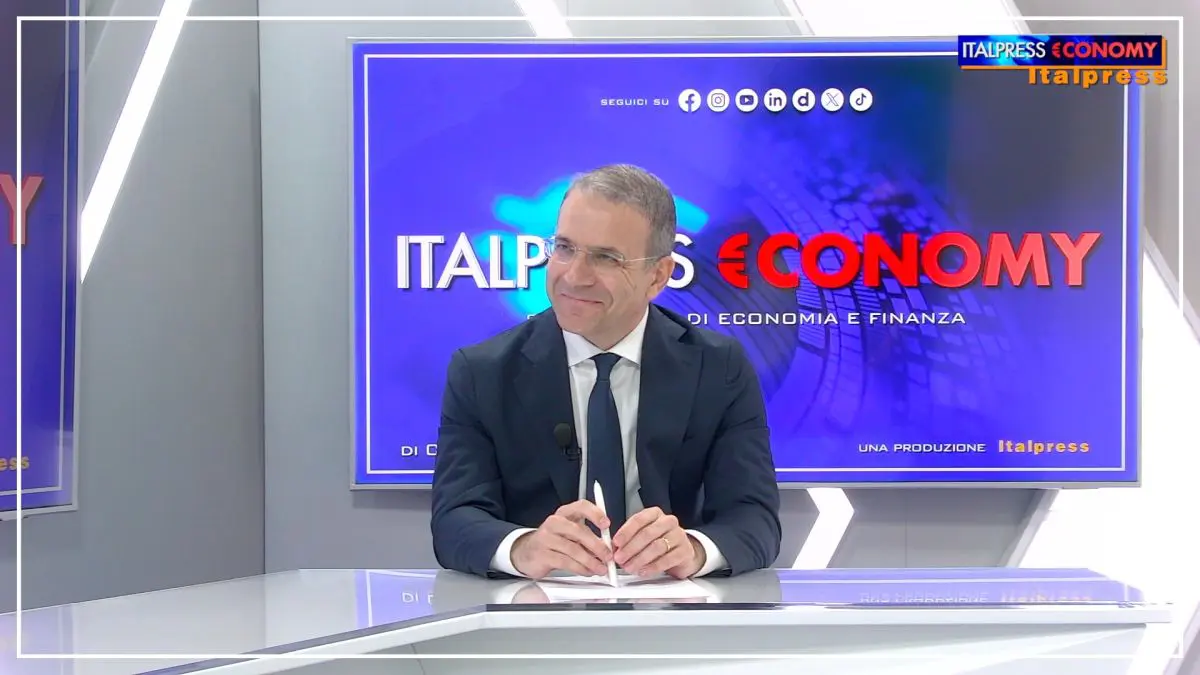
MILAN (ITALPRESS) – Corporate welfare is no longer an option for a few large companies, but a strategic lever destined to redesign the relationship between companies and workers in an era marked by inflation, wage stagnation and a labor market in deep transformation. Tommaso Palermo, managing director of Pluxee Italia, interviewed by Claudio Brachino for the television magazine Italpress Economy.
Pluxee – born from the spin-off of the Benefits and Rewards Services division in Sodexo in 2023 and listed on the Paris Stock Exchange – operates in 28 countries, from Latin America to Asia, with a precise mission: to support companies in providing benefits to employees. “It’s not just a name change compared to Sodexo,” explains Palermo, “but a strategic identity change to place us in the market more effectively, young and innovative. The world of work is evolving at an extraordinary speed and we want to be part of this transformation.”
The starting point of the analysis of Palermo is the economic scenario. “Increasing inflation for a few years now, stagnant wages, OECD figures say it, and productivity grew by just 6% over the last thirty years. The entrepreneur struggles to provide high wages if productivity is limited.” In this context, corporate benefits become a concrete tool for income integration: contributions to lunch break, fuel, daily spending, acting in a defiscal perspective. “The tax lever is the starting point – the manager points out – but it is not the only one. In recent years there has emerged a more strategic dimension linked to people management: where welfare is well constructed and well communicated, the worker feels more engaged, develops a greater sense of belonging and a closer relationship of trust with his own company”.
Palermo devotes ample space to the role of the legislation, which in recent years has reserved increasing attention to the sector. “All governments, of every colour, have encouraged the tax levers of the welfare. The state, somehow, is outsourcing some dynamics that touch the welfare of workers.” Two of the rules cited as particularly significant. Budgetary Law 2025 made certain provisions on fringe benefits stable and structural, eliminating uncertainty related to temporary rules that made business planning difficult. Since January of this year, the tax rate of the meal voucher has been increased. “Just think that the average value of the meal voucher in Italy is 7 euros (according to internal Pluxee data), while the average cost of a meal is around 15 euros. Every push in that direction is important for workers and companies that support them.” The market moves on three large axes. The first is digitization. “The employee is first of all a consumer, accustomed to managing the digital in all its purchasing processes. Companies must operate extremely digitally to ensure a smooth and simple user experience. And it is a win-win situation: digital makes life easier for those who manage welfare services within companies and those who enjoy it.” The second axis concerns small and mediumsized enterprises. Until today the corporate welfare has been the prerogative of large companies – about 70% of which already has tools in this sense – but the trend is changing. “The collective agreements are playing a decisive role: about 20 CCNL, from the Orafi to Metalmeccanico, embrace welfare instruments. Companies are somehow guided towards a virtuous model.” For SMEs, however, the main challenge remains cultural. “What is needed is training, bringing into a system that is often more complicated for them, because they operate out of the classic schemes of big companies,” says Palermo. The third axis is sustainability, with an increasingly evident intersectionbetween the welfare agenda and the ESG agenda. “Welfare is a bouquet of services that companies make available to employees. We are seeing an interesting trend: workers can choose sustainable content, linked to social enterprises that do social justice”. And there is also the concept of “circularwelfare”, which Palermo describes as one of the most interesting news of recent times: “Businesses ask that in the bouquet of services there is the possibility to spend in the local ecosystem, in the induced around the company itself. Not only big partners, but the economy of the territory. An added value that moves from corporate well-being to the surrounding community.” Pluxee conducted a research with Ipsos Doxa that highlighted a misalignment between the welfare offer proposed by companies and the perception of its value by employees. “Many companies believe they have built effective programs, but the benefit perceived by workers does not always reach the same levels – explains the manager –. It is a dystonia that must be addressed.”
The cause, according to Palermo, is in an approach often too standardized by enterprises, in the face of an increasingly heterogeneous workforce by role, experience, background and generations. The solution indicated is customization. “We need to meet the real and daily needs of very different workers. The welfare project must be built together with communication and training: design and accompaniment must proceed in parallel so that everything can work.” Welfare, in summary, must stop being an equal catalogue for all and become a tailor-made tool.
– Photo Italpress –
(ITALPRESS).