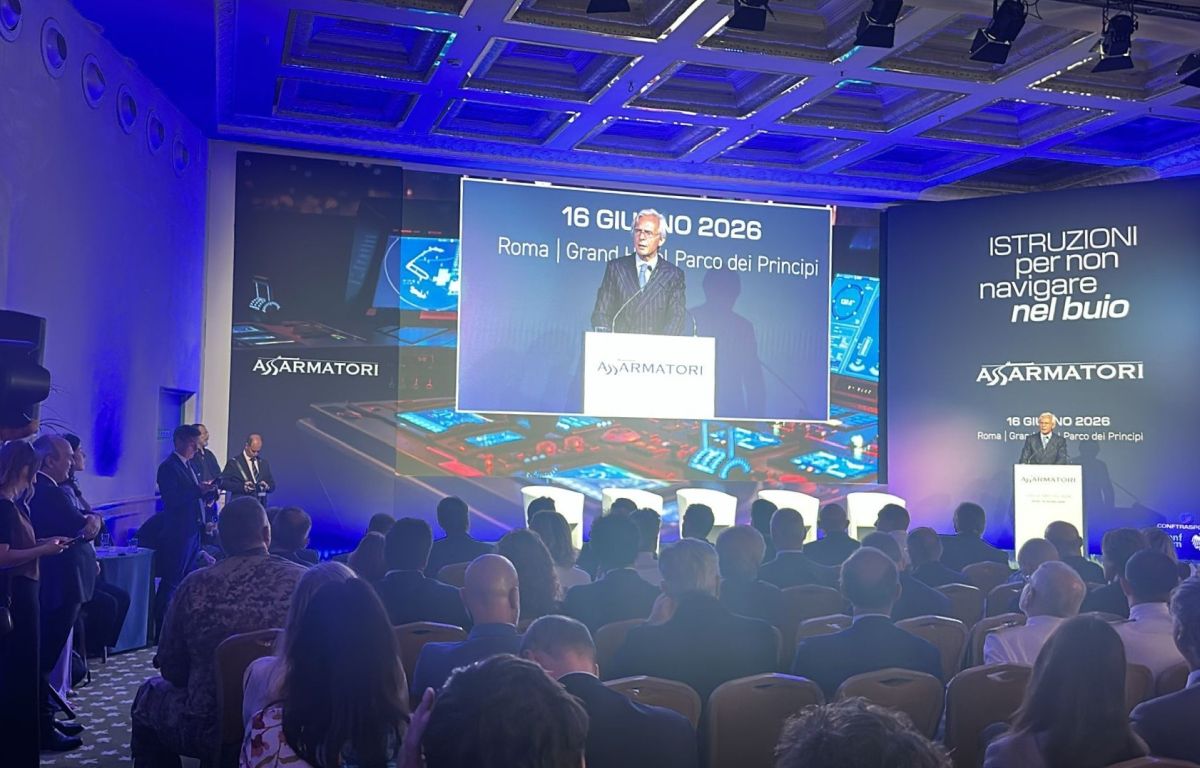
ROMA (ITALPRESS) – A decisive attack on European maritime policies for the decarbonization of maritime transport and, at the same time, the indication of a clear and truly viable way to really zero emissions: the use of nuclear power. These are the two main themes highlighted by the President of Assarmatori, Stefano Messina, this morning during his report to the Annual Meeting of the shipowning association, staged in Rome at the Grand Hotel Parco dei Principi. A report also touched on geopolitical currents, downstream of the announced agreement between the United States and Iran: “A clearly positive news – said Messina in front of an audience of over 700 people, representative of the marine and harbour cluster, entrepreneurship, politics and administration –. However, in these months, the announcements of an interruption of the conflict or of a truce were different and unfortunately never followed the facts. The maritime transport needs certainties to be able to operate safely, for this reason I believe that the ships remained blocked in the Persian Gulf will try to get out as soon as possible, but a return to normality in the Strait of Hormuz will not be immediate, will take several days to understand if this time you can really go back to sailing with the necessary guarantees, firstly to protect the crews. While waiting to know the details of the agreement, however, we reject any hypothesis of a toll to cross the Strait, which would be contrary to the principle of freedom of navigation”.
Then the background: “Europe seems to live out of reality. It continues to stiffen the rules in force as if it were unaware of the geopolitical context and was not on the contrary called to increase the competitiveness of European enterprises rather than to impose them – Messina continued. We are going out of the market, we cannot think of winning the global competition if the EU remains firm and within a purely regulatory logic decided by technocrats. The damage generated to the automotive sector is obvious, for the marine transport we ask for a courageous revision of the ETS system to protect the three most exposed segments: the connections with the islands, which are excluded from this regime, the Sea Highways and the transhipment of container. In this so difficult and fragmented international context, Italy and Europe remain afloat thanks to shipping and its extraordinary ability to adapt to the great upheavals in a short time and efficiently. We cannot allow this extraordinary economic lever to be undermined by absurd decisions taken in Brussels without the slightest trace of a democratic confrontation and that then in Rome the funds generated by this taxation are dispersed in a thousand folds, instead of being destined to the marine transport for investments linked to decarbonization, as envisaged by the same Directive, and geographical constraints are decided for the renewal of fleets inspired by protectionism outside of reality, the market and any logic”.
Not only criticism from the stage of the Assarmatori Annual Meeting, but also concrete and current proposals, at a historical stage in which the Law Delegates to the Government on Nuclear: “We must not be conditioned by external factors – Messina added – and look at the facts. Numerous pilot projects linked to the marine sector with the center the nuclear of IV Generation and the so-called Small Modular Reactors demonstrate technical feasibility and benefits in terms of decarbonization. The use of nuclear reactors on board ships has undue advantages even from the logistic point of view, as it eliminates the need to have supply chains dedicated to the different types of alternative fuels, which should be capillary distributed in the various countries to ensure the availability of fuelin the operating areas of the ships”.
At the center of the annual assembly of the shipowning association also the theme of work, with a specific claim concerning the Italian occupation: “It is a fact that the cost of marine work represents one of the main items of expenditure for shipowning enterprises and that it affects to a significant extent on the competitiveness of our enterprises – it has concluded the President of Assarmatori – For this reason, we ask, and not from now, the restoration of the decontribution for the marine employed in short-range links, that are all Italians. And we are talking about services that in many cases constitute the only and indispensable means of mobility for the island populations and for the territorial continuity of the country”.
The debate was also animated by the interventions of the Minister of Enterprises and Made in Italy Adolfo Urso, Minister of Education and Merit Giuseppe Valditara, Vice Minister of Infrastructures and Transport Edoardo Rixi, Admiral Giuseppe Berutti Bergotto, Chief of Staff of the Navy and video messages by Raffaele Fitto, Executive Vice President of the European Commission and Gilberto Pichetto Fratin, Minister of the Military Navy. There was also room for a round table that saw protagonists the shipowners Matteo Catani, CEO of GNV, Achille Onorato, CEO of Moby, Vincenzo Romeo, CEO of Nova Marine Carriers and for an interview with the President of Assoporti Roberto Petri.
– Assarmatori press office photos –
(ITALPRESS).