
Eight illustrated panels, each of a different color, aligned along a corridor of the Glass Palace, the UN headquarters in New York. This is how Italy presented itself on June 8 at the United Nations, during the 19th Conference of States part of the UN Convention on the Rights of Persons with Disabilities. In the Week dedicated to those rights, the Italian Mission and the Ministry of Disability inaugurated the exhibition on the Charter of Solfagnano, a final document of the first G7 to the world on inclusion and disability, hosted by Italy in October 2024. Each panel tells one of the eight priorities of the Charter with a visual language and a simple writing, under a motto that crosses the history of movement for rights: “Nothing about us without us.”.
“Exhibition is very simple,” explained Minister Alessandra Locatelli. “There are eight panels with easy to read writing, representing the eight priorities of the Charter of Solfagnano, declined by the UN Convention on the Rights of Persons with Disabilities”. The document, signed by the ministers of the G7 between Assisi and Solfagnano, puts inclusion in the center of the political agenda and is inspired by the Convention adopted by the United Nations twenty years ago.
For Locatelli the stake is a change of look. “We talk about changing the perspective, seeing in each person the potential and not the limits”, he told the public gathered in the room. “But we don’t just say it, we do it, and we want to show it also to other countries, to work together and exchange good practices.” In Italy, he recalled, the reform of disability is already law and implementation in more than half of the provinces, with an approach that puts the person in the centre and overcomes the fragmentation between social and health care.
To open the evening was Ambassador Gianluca Greco, Deputy Permanent Representative of Italy to the UN, who defined the construction of inclusive society a shared commitment, capable of covering all. The ministra then focused on one of the eight priorities, the last, which in this historical phase takes on a particular weight. “The eighth priority concerns the protection of persons with disabilities during environmental and humanitarian crises, armed conflicts and emergencies of all kinds,” he stressed. “We need shared protocols, training and coordinated global effort.”.
The day also had a sports face. Next to the ministra were the Italian Paralympic Committee, with the general secretary Simone Rasetti, the athletes of Special Olympics Italy and the protagonists of paralympic dance, together with a delegation of associations of the third sector arrived from Italy. Among the athletes expected to the side event of June 10, dedicated to sports and full participation, there is the multi-sampling champion Veronica Yoko Plebani. «Great emotion tonight», Locatelli told us on the edge of the inauguration, «for the participation of Italian Paralympic athletes, Special Olympics Italy and many associations that are here to demonstrate concretely their work».
Two ideas often return to his words. The first is that of a full life, which also passes from the freedom to move. «I always say: the right to a happy life, first of all, for all. And this contemplates being able to choose to travel, go on holiday, move freely”, a principle already written in the Convention. The second is the confidence that joint work can expand beyond national borders.
To recall the roots of that path was Masumi Ono, head of the Section for Social Inclusion and participation of the UN Department for Economic and Social Affairs. “Almost twenty years ago the countries joined to adopt the Convention on the Rights of Persons with Disabilities, an example of multilateralism at work,” he said, defining the Charter of Solfagnano a piece that renews its political commitment. The eight priorities, from accessibility to autonomous life, from work to protection in emergencies, show ono the point where policies meet people’s lives. Now that the conference arrived at the 19th session, he added, the task is to connect efforts between countries by keeping people with disabilities at the centre, with the United Nations ready to support each step.
Before cutting the tape, Alessandro Susini, president of the Italian Operating Union at the International Organizations (UFIOI), greeted the ministra and the public with an essential call: “Inclusion is a responsibility that we share all, to build a society in which no one stays back”.
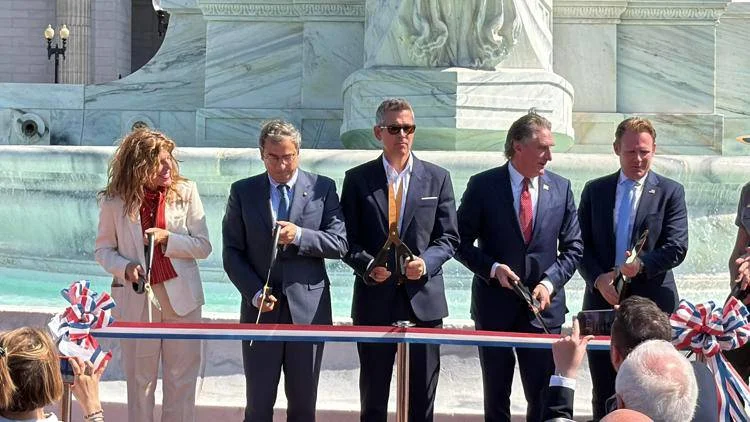
Then it’s time to cut the tape. The ministra invited the present to join the countdown, and for a few seconds, inside a palace that speaks all the languages of the world, the United Nations counted in Italian: “Three, two, one”. The exhibition was open. “If we all work together to go in the same direction,” Locatelli said just before, “we can change in the best not only Italy, but all the world”. At the Palazzo di Vetro, he promised, await the Italian delegation three intense days.
L’articolo Italy brings the Charter of Solfagnano proviene da IlNewyorkese.