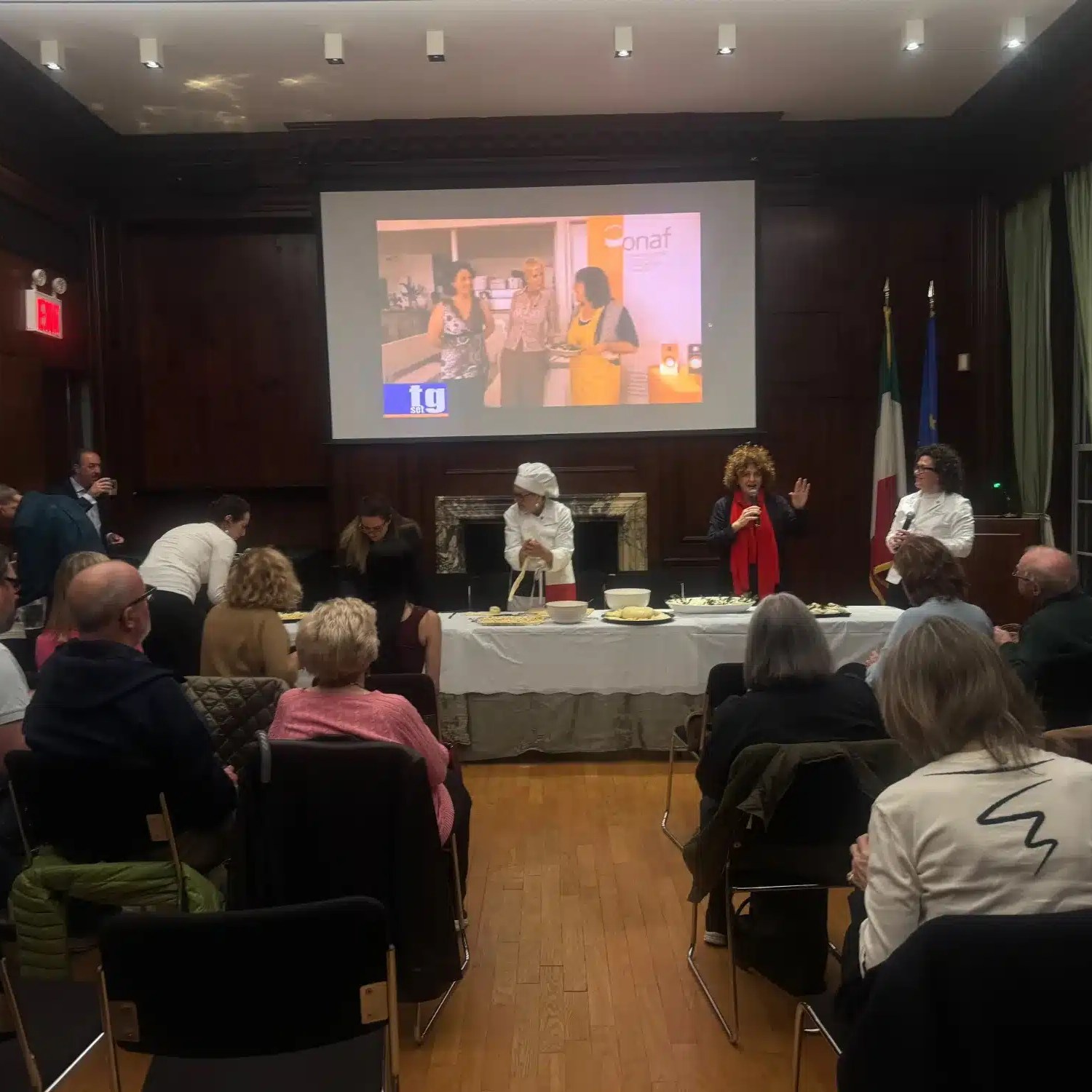
During the celebration of the culture of Cilento was held the first International Day of the Mediterranean Diet organized by the Italian Cultural Institute of New York City on November 18. In collaboration with the Permanent Representation of Italy at the United Nations and the Centro Studi sulla Diete Mediterranea “Angelo Vassallo”, the event is part of the new series of Masterclass “La pasta non basta” that explores Italian cuisine through its ingredients, technique and culture.
Together with Stefano Pisani, mayor of Pollica, and Sara Roversi, founder of the Future Food Institute, three Ambassadors of the Mediterranean Diet shared their experience and gave a look at the Italian cuisine that goes well beyond its traditional dishes. In a place like New York, where food trends often change and practical considerations determine daily choices, the evening offered a new perspective on our relationship with food.
The Mediterranean way of eating has not only become a model of cuisine but also an entire lifestyle that revolves around seasonality, biodiversity, community and the valorization of natural resources. It is essential for this type of analysis to learn how to recognize the history behind each ingredient, its growers, communities and tradition.
Giovanna Voria, farmer and cook of Agriturismo Corbella di Cicerale, told her commitment to rediscovering and protecting the local varieties of chickpeas, a path started over 20 years ago. Through a seasonal salad based on legumes, cereals, pomegranate, aromatic herbs and extra virgin olive oil, it has shown how simple ingredients can give life to a gastronomic experience full of flavors and meanings. Among these, black chickpeas, a symbol of good omen according to a tradition handed down by the mother.
Silvia Chirico, house at the family farm Tenuta Chirico, in Ascea, has placed the attention on the relationship between agricultural heritage and innovation. His work with milk and extra virgin olive oil reflects the deep link between Cilentana gastronomy and its territory. Cristian Santomauro, founder of L’Ammaccata in Casal Velino, presented an entrepreneurial reality born from the rediscovery of the traditional Cilentana pizza, inspired by the techniques learned by grandmother.
From the cultivation of ancient grain varieties to the grinding of cereals directly inside its pizzeria, Santomauro demonstrates how the gastronomic heritage can become an engine of contemporary entrepreneurship. During the evening, collaboration with over 120 farmers was highlighted, an example of the positive economic and social impact that food companies can generate in rural communities.
During the evening, participants were invited to try the traditional preparation of the cavatelli, a type of pasta modeled entirely by hand. Working the dough, cutting it into small pieces and modeling each with the fingertips, the guests rediscovered a technique handed down from generation to generation.
An opportunity to remember how some of the most valuable expressions of Italian culture do not require sophisticated technologies or expensive ingredients, but rather time, knowledge and sharing. To make the exhibition “La pasta non basta” particularly significant was its ability to connect gastronomy to reflections on sustainability, entrepreneurship and the development of the territory.