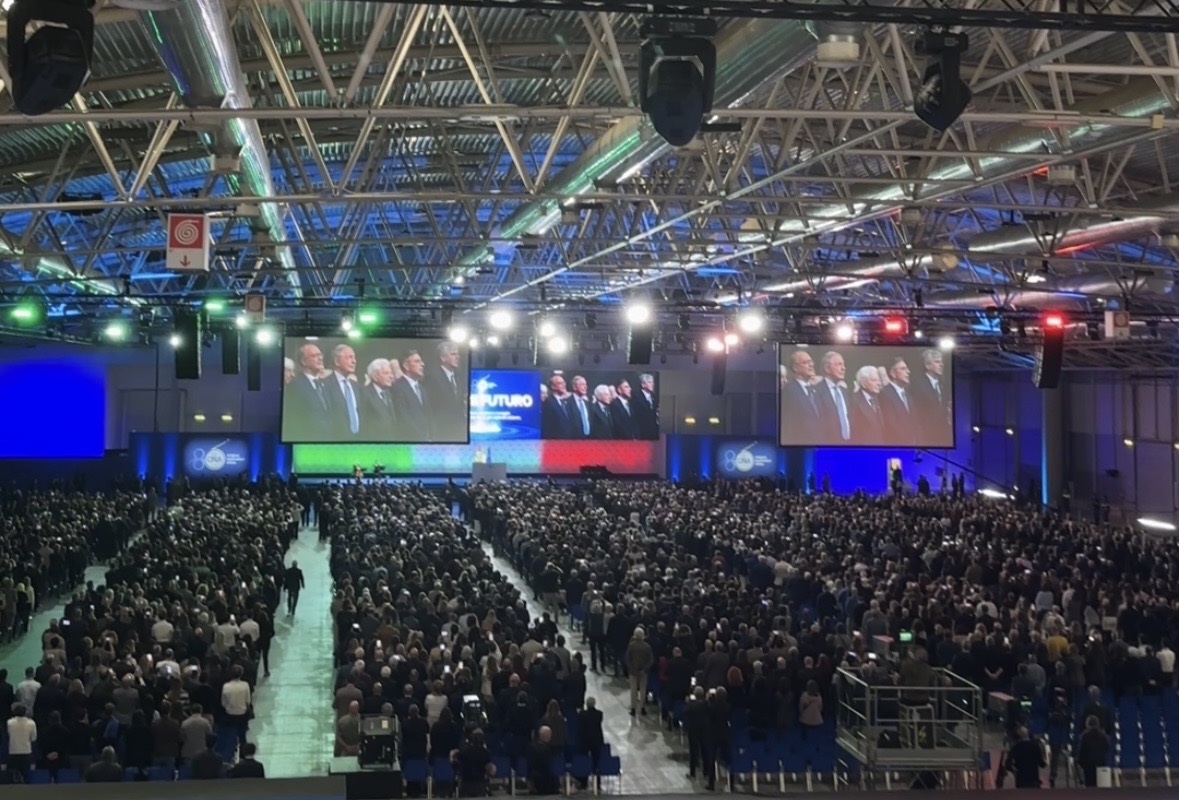
ROMA (ITALPRESS) – Eighty years of history, business, work and contribution to the economic and social growth of Italy. The CNA today celebrates its 80th anniversary with the National Assembly, an event that brings together the world of crafts and small and medium-sized enterprises, institutions and representatives of civil society. At the heart of the day, the future of artisan companies, between innovation, competitiveness, high energy, access to credit, training and generational spare parts. An opportunity to take stock of the challenges of a sector which is a fundamental component of the Italian production system and, as the President of the Republic Sergio Mattarella recalled, is an essential element of the identity and cohesion of the country.
To open the day the national president of the CNA, Dario Costantini, who relaunched the need to update the framework law on the handicrafts, stopped in 1985. “After more than forty years we can finally update the framework law on craftsmanship. It is a reform that we strongly demanded and that will allow artisan companies to grow, innovate and assume without losing their identity,” he said. A reform that will accompany the transformations of the production system, allowing companies to use new technologies and participate in international chains without sacrificing their specificity.
Among the priorities indicated by President CNA is the cost of energy. The total expenditure of Italian families and enterprises in 2026 will exceed 200 billion euros. “Energy is an industrial priority, even before a cost item”, stressed Constantine, calling for a structural reduction of costs, tools that also allow small enterprises to produce energy autonomously and a European strategy capable of transforming the energy transition into an opportunity of competitiveness and not a disadvantage.
Another central node is that of work. In the next five years small enterprises will need about 750 thousand workers, especially technicians and qualified figures. A difficulty that is reflected in the fact that a three-year venture fails to find candidates. In the last decade Italy has lost more than 500 thousand young people between 15 and 34 years and, without a change of trend, by 2045 could be about two million less. From here the request to strengthen orientation, training and apprenticeship, also through the project “Artigiani in classe”, realized with the ministry of Education. Costantini also recalled the theme of generational replacement: almost 315 thousand are the holders of individual enterprises that are at least 70 years and over a million companies called to address the problem of succession. The Confederation calls for tax policies that favour the transfer of companies to young people, employees or other entrepreneurs who want to ensure continuity. “The tax rules must be simple, stable and certain”, is the principle indicated by President CNA.
In the course of the intervention, the project for the realization in Egypt of the first school dedicated to the formation of young people to be included in the Italian craft companies, within the professional corridors. The initiative, developed with the involvement of the Italian Government, Egyptian institutions and the European Union, aims to build a direct link between training and needs of companies. “It’s a new way to think about the relationship between training, work and immigration,” explained Constantine. On the credit front, President CNA recalled that bank loans to small businesses fell by 23% in four years.
“The credit must not be a privilege. It must be an opportunity for those who have ideas, skills and courage to do business”, he said, asking to strengthen the Confidi and raise Artisans.
The assembly took part in the president of the Republic Sergio Mattarella, who addressed the Confederation the best wishes for the eighty years from the foundation, recalling the contribution offered by the NAC to the construction of the Republic in the post-war period. “Eighty years like the Republic,” the Head of State began. “Even the NAC has contributed to building the Republic after the devastation of the war, with participation from the bottom, combining associative experiences, cooperating to free Italian society from the guilds of corporateism to which fascism had condemned it, making free creativity, giving value to Italian work, making protagonist entrepreneurship in the territories, supporting together economic growth and social cohesion”.
“The vitality of the social fabric is a crucial component of the freedom and democracy of a country,” said Mattarella. “Vitality means plurality of actors, spaces and capacities of initiative, freedom to design and undertake, to be interlocutors of public powers, not to depend on them.” The President recalled the role of craftsmanship in Italian history: “It was an important carrier in Italy’s race along these decades, from reconstruction to the country’s uplift in development, quality, well-being. Handicraft is an authentic expression of the history of Italy, the engine for the development of crafts and skills, the spread of markets, the formation of cities.”.
“ Skills, knowledge, creative skills have been transmitted from generation to generation,” Mattarella continued, underlining that “innovation has always been on the agenda, even when transformations slowly progressed.” The Italian craftsmanship, he added, has become “a conscious force of its own peculiar characters, which contribute to the wealth and success of the same made in Italy”. The sector has over 2 million and 600 thousand employees and more than one million and 100 thousand enterprises. Mattarella also recalled the value of Article 45 of the Constitution, which states that “the law provides for the protection and development of crafts”. “Entrepreneurship biodiversity, we would say with today’s language, is a guarantee of freedom and, at the same time, a door open to the different actors who can become levers of development,” said the head of the state. Then the call to young people: “Your sector deserves particular attention to the entry of young people. The demographic imbalance is causing considerable dismay on many levels. We must correct the trends that project on the long term forecasts to say little negative. Crafts can give a lot in this strategy.”.
“It is necessary to encourage training, to recognize value and role to the master craftsman, to encourage the apprenticeship, also by making workshops a school,” added Mattarella, expressing appreciation for the CNA project dedicated to the training of workers abroad available to arrive in Italy. The President then recalled the contribution of immigrant workers: “In many cases, the presence of immigrants involved in craft activities contributes to keeping alive crafts and services necessary to the territories, which would otherwise risk disappearance.” And again: “The craftsmanship is a defence of the territory and supports its autonomy, originality and also beauty”.
On the edge of the initiative, the Minister for Public Administration Paolo Zangrillo, who reiterated the government’s attention to the artisan sector, calling it “the clearest, purest, most genuine expression of Made in Italy”. The small and medium-sized enterprises, it has emphasized, represent a fundamental part of the national productive fabric and are able to combine tradition and innovation. Zangrillo also recalled the work done together with the NAC on the face of administrative simplification and the savings obtained from companies thanks to the interventions realized. The minister also addressed the issue of security for law enforcement, setting it a priority that is following together with other members of the government: “We have prepared an amendment to the budgetary law that we are defining in detail with the Ministry of Finance. I hope you go to port. I am very confident, very optimistic,” he said.
– photo xc7/Italpress –
(ITALPRESS).