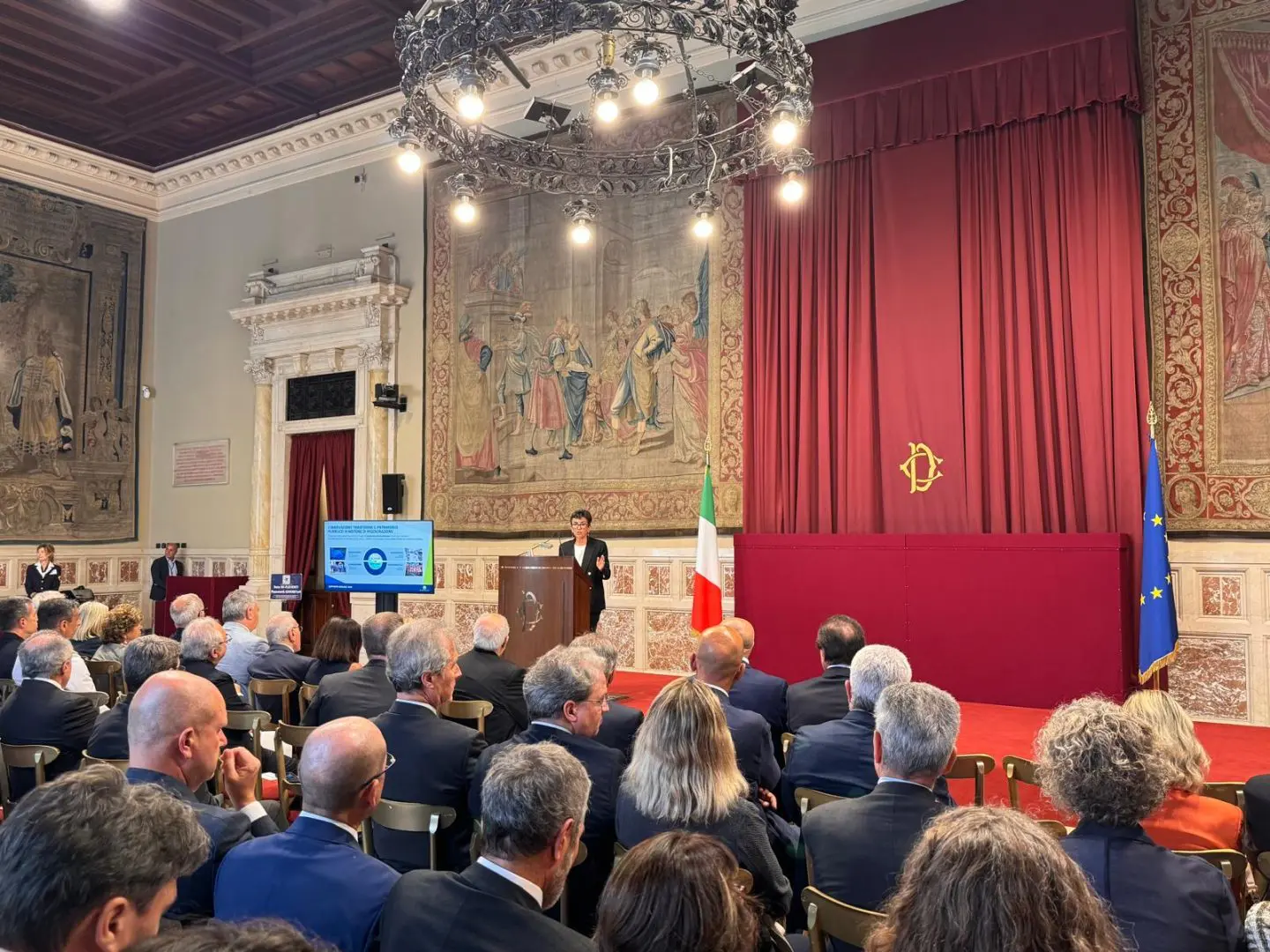
ROMA (ITALPRESS) – The real estate of the state includes 45,415 properties, for an estimated total value of 63,2 billion euros. It is 44 million square meters of buildings, including barracks, offices, prisons, historic buildings and museums, and 1.3 billion square meters of areas, natural reserves, forests and land. These are some of the data analysed in the Annual Report 2026 presented today by the Director of the Demanio Agency, Alessandra dal Verme, in the Sala della Regina di Montecitorio in the presence of institutions and stakeholders, to which the Vice President of the Chamber of Deputies, Fabio Rampelli and the Vice Minister of Economy and Finance, Maurizio Leo.
The Annual Report, which reached the fourth edition, shows the main results obtained at 2025 and illustrates a selection of interventions initiated and concluded that tell the action of the Agency in its renewed vision, which places the person at the centre. The public property is seen in a wider dimension, that of the city and the territory to which it is part, to give answers to the new needs expressed by the community: the Public Administrations, which need modern and efficient spaces; the citizens who enjoy services; Entities of the territory, as protagonists of the processes of regeneration. A wealth to manage and value that represents memory, identity and infrastructure for the future of the country. Among the results: 5.1 billion euros of investments have been activated, of which one fifth already realized; the interventions concluded have increased of 172% regarding 2022 (+255% from 2021) passing from approximately 89 billion euros to 242 billion euros; the number of the interventions started has increased from 2022 of 55%, reaching 619 interventions to January 2026; the value of the interventions started with resources of other administrations has grown up to 1,6 billion.
In the OICE ranking, the Agency is the first BIM contracting station. The plan of rationalization of the logistics of public administrations has led to cumulative savings of spending for liabilities of 144 million euros per regime from 2026 (24 million euros in 2025). At the same time, in 2025, the promotion initiatives attracted 120 million euros of private investments, confirming the growing market interest in the projects promoted by the Agency.
“The process of transformation initiated by the Demanio Agency towards a regenerative management of the state’s real estate, is now structured. The public property returns to be seen as an active tool of the country, the development of the territories and the creation of value for the community,” says the Director of the Demanio Agency, Alessandra dal Verme. “The main components of this transformation are the centrality of the person, the knowledge of the properties and the territory that hosts them, the method of sharing and public-public and public-private participation. Advanced technologies, quality in design, shared languages and measurable actions are the factors that feed knowledge and innovative management of the state’s real estate. The public heritage, understood and lived by the communities to which it belongs, thus becomes a motor of regeneration and generates lasting value.”.
One of the main tools of this transformation is the City of Public Property Plan, an innovation method for an integrated planning of interventions on public property with the territorial entities, with the Administrations and other interested institutions, with the Universities. It is the response of the Demanio Agency to changes in context that concern the environmental dimension (from climate crisis, to the theme of energy and green spaces), the social dimension (from demographic changes, new ways of living and relationships, to attractive services for young people and students) and the economic dimension, with opportunities for work and development.
In the context of analysis of the context of the city, its needs and vocations, we define the destinations of use, environmental and energy requirements, the impacts of social and cultural character of the property, in accordance with the urban planning instrumentation in force or in variance. It identifies the role that good assumes in urban regeneration and in the new relations of the city to bring value to people, territories and future generations. On 30 June 2026 37 Plans were signed, with the aim of reaching 65 by 2028. The Plans involve 439 buildings to be regenerated, equal to 5,1 million square meters of gross surface, with 26% of properties to be allocated to functional mix, of which is part the new social type residentiality, and 10 million square meters of green areas. The expected changes will generate important economic and social impacts: 18 billion euros of estimated economic impact, over 65.000 employed in the yard and an overall employment impact estimated in over 97,500 units.
On the social level there are over 6,700 new beds for student housing, more than 1,800 new housing units for social housing, a potential increase of 2.1 million users for cultural activities and about 12 million square meters of discoveries redeveloped for social activities, relationships and recreation. The Report devotes a focus to design aimed at adapting PA logistics to the evolution of working methods and changing organizational needs of administrations. The objective is that of an open public office, socially inclusive, technologically evolved and oriented to the regeneration of the existing building heritage to strengthen the role of the administration as a modern workplace and service for the community. Among the pilot cases are the new headquarters of the Regional Direction Emilia-Romagna of the Demanio Agency in the former Cinema Embassy of Bologna, today equipped with about 220 sensors and actuators on an area of 1,500 square meters; the future headquarters of the Ministry of Environment and Energy in viale Boston in Rome, designed as the first ministerial building with structure bearing in wood and management BIM of the entire life cycle of the new building.
A second focus is devoted to the regeneration of large estate shops. The Report recalls urban interventions on former barracks, complex prisons, military areas, hospitals and large dismissed patricians, with 57 interventions under development or execution, 2.9 billion euros of allocated resources and 1.8 million square meters of regenerated heritage. Among the projects described are the Ex Carcere of Perugia, destined to become a Citadel of Justice; in Bologna the Ex Caserma STAVECO and the Ex Caserma STAMOTO, the latter candidate for the international competition of architecture and urban design Reinventing Cities, the Ex Arsenale of Pavia, which will be transformed into an integrated administrative pole; among the sports complexes: the “Green City works for health, research and training Particular attention is paid to the care of the historical and cultural heritage, which includes, in 2025, 4,607 goods in use to public administrations and 3.009 goods entrusted to qualified or private public subjects. The Agency’s interventions on this asset concern restoration, energy efficiency and regeneration with the aim of extending the life of good over time and giving maximum benefit to citizens. There are 168 ongoing projects of design or execution, with 2.3 billion euros of total allocated resources and 1.1 million square meters of regenerated heritage.
Among the examples are the safety and restoration of the Basilica of San Miniato al Monte in Florence, in collaboration with the Ministry of Culture and the Superintendence of Florence, financed with 3.6 million euros of funds PNRR, an example of an open construction site; the Basilica of Santa Maria degli Angeli and the Martyrs in Rome, the first intervention of energy efficiency and lighting on a Church of State, in collaboration with the Ministry of Culture and the Special Superintendence of Rome The Archivi Programme is also signalled, conceived in collaboration with the Ministry of Culture – Directorate General Archives, to transform the State Archives into open cultural poles and make them become places of people and the meeting. A chapter of the Report is dedicated to the regeneration of natural and landscape heritage, in accordance with Article 9 of the Constitution and with the aim of combining environmental protection, sustainable development and reactivation of local economies. Among the projects illustrated are the Saline di Tarquinia, a cultural and natural ecosystem of 150 hectares in which production history, biodiversity and collective memory are interwoven; the Mining Theme Park of Maiella, which involves 14 Municipalities and 7 institutions and institutions. The planned interventions are 30 and 6 pilot projects; the Ernic Cities, with four municipalities involved and a historical heritage spread over 410 square kilometers; and the Greenway of the former Circumetnea Railway in Catania, a 4.5-kilometre route financed with 36 million euros with Funds FUA and PON Metro, one of the interventions of the Piano Città degli Immobili Pubblici di Catania.
Sustainability and security are a qualification of the Agency’s action. 78 ESG indicators were monitored in 2025, with 85% of targets achieved. The interventions produced a reduction in CO2 emissions by 66%, an average decrease in energy consumption by 68% compared to the situation before interventions and a reduction in soil consumption by 12%. The Agency is the first public body to have adopted a voluntary sustainability report aligned with CSRD European standards and besieged by an independent entity. The programme is also dedicated to the prevention of seismic risk and energy requalification: about 3,000 properties are affected by seismic audits, with 2,700 activities concluded, 310 buildings involved in energy requalification and seismic adjustment. In 2025, 67,000 square meters of public spaces were secured. As part of the strategy for the valorisation of public real estate, it is important to promote cooperation between the public and private sector, to convey skills and investments on the re-functionalization of public property and thus to promote the creation of economic and social value.
In 2025, 2 PPP bands were published, 2 Reinventing Cities bands were awarded and 120 million Euros were attracted to the market. Operations include temporary use, long-term concessions up to 50 years and free commuters. Among the cases described are Palazzo del Senato in Milan, with new functions open to the public; the former Borbonico Polverificio in Scafati, the subject of a PPP proposal on a private initiative; the “Green City for Health, Research and Training” of Tor Vergata in Rome; the Tabacchi Manufacture in Turin; the former Barracks IV of Monza; the land for the production of renewable energy; and the winning projects of Bologna Reventinotti Technological and digital innovation crosses all areas of activity of the Agency. In 2025 180 digitization projects were developed, recording a growth of 18% of ICT services compared to the previous year. The Report highlights the role of BIM, Digital Twins, smart building, cybersecurity and artificial intelligence in knowledge, design, management and enhancement of public property.
– Photo press office Demanio Agency –
(ITALPRESS).