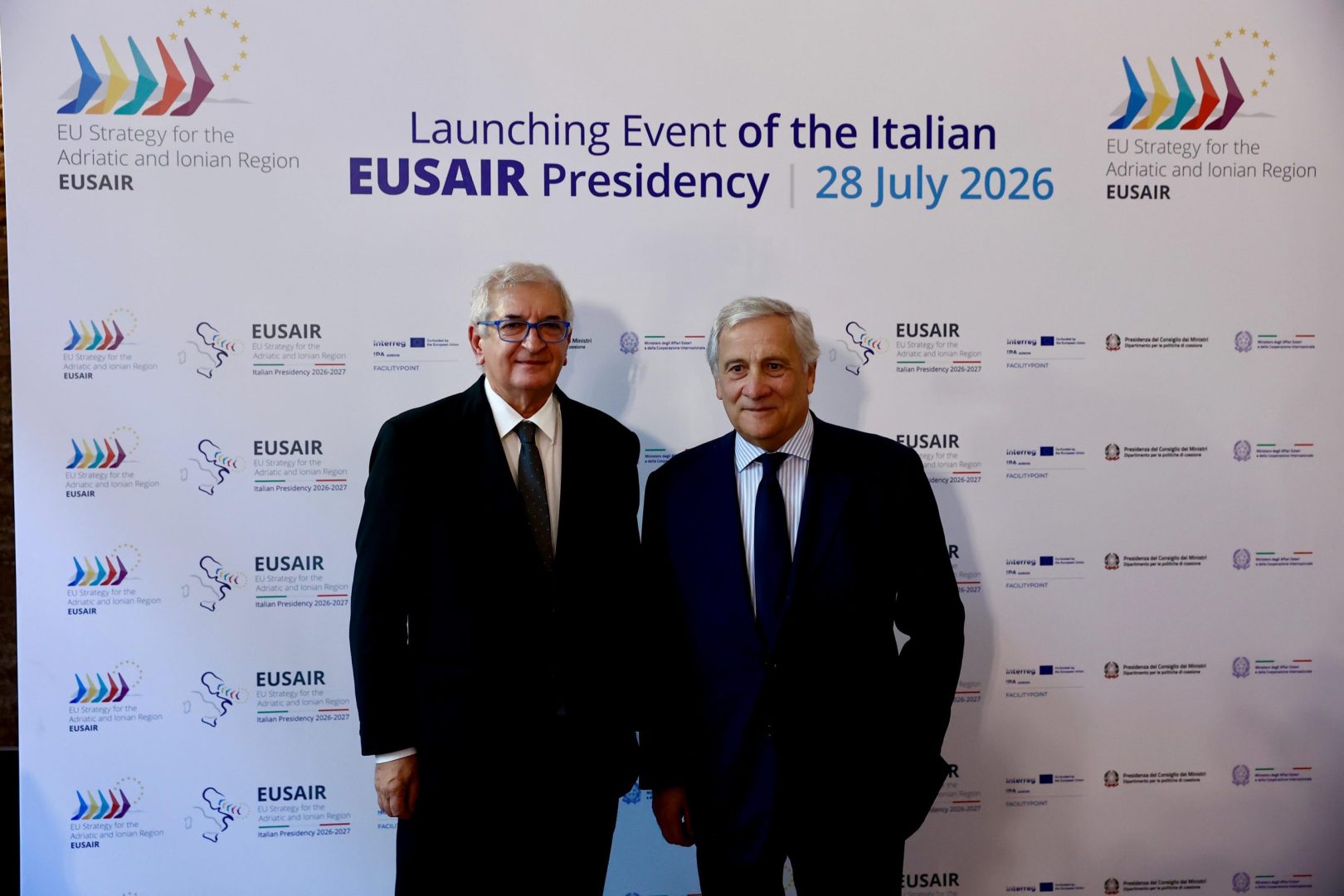
ROMA (ITALPRESS) – The launch event of the Italian Presidency of the European Union Strategy for the Adriatic-Ion Region (EUSAIR), entitled “Identity, cohesion, European integration, was held today at the headquarters of Unioncamere in Rome. The initiative, moderated by journalist RAI Annamaria Esposito, opened the Italian presidency semester of the macroregional strategy involving the countries of the Adriatic-Ionian area with the aim of strengthening cooperation, development and the path of European integration.
To open the work were the institutional greetings of the Secretary General of Unioncamere Giuseppe Tripoli, who highlighted the role of the chamber system, present in a capillary way on the territory, in supporting the enterprises and accompany them in the paths of international growth. Tripoli recalled the importance of collaboration with the Ministry of Foreign Affairs to help above all small businesses that want to start exporting, underlining how the link between institutions and productive world is fundamental to create new economic opportunities. In his speech he also recalled the history of the Horti Sallustiani, a place that hosted the event, underlining its symbolic value and recalling how Unioncamere actively participated in the EUSAIR Forum with the aim of contributing to the creation of an economic integration space in support of small and medium-sized enterprises.
Tommaso Foti, Minister for European Affairs, the PNRR and the Cohesion Policies, recalled that the EUSAIR Strategy is a path built over the years and called to respond to an international context deeply changed from 2014 to today. Foti paid attention to the main challenges of macroregion: climate change, state of law defense, digital transformation, energy and transport issues. A particular focus was devoted to the demographic theme, with the ageing of the population and the depopulation of some areas, phenomena that risk creating difficulties in the availability of workers and skills. On the issue of internal areas, the Minister stressed the importance of ensuring that people can stay in their territories: “Everyone has the right to live in the territory in which he was born, must be an act of freedom the fact of having to leave the territory of origin, not an act of constriction”. Foti also reiterated the strategic role of the Adriatic-Ion region in the new European policy.
Raffaele Fitto, Executive Vice-President of the European Commission and European Commissioner for Regional Policy and Cohesion, Regional Development and the City. “The Adriatic-Ion macroregional strategy is the strategy with the largest number of participating states in Europe. In the coming months we could enter a more stringent phase, able to define this path more clearly,” he said. Fitto explained that the EUSAIR Strategy brings together the countries of the Adriatic Sea and the Ionian Sea with the aim of promoting cooperation, sustainable development and greater integration among the territories. The Executive Vice-President stressed the need to relate the objectives of the Italian strategy with the choices that the European Union is carrying out, recalling also the increase of a billion euros intended for strengthening the related programmes. At the heart of the intervention, the modernization of European cohesion policy, which will have to be more flexible to address new needs and to review current programmes. Fitto recalled the need to increase the involvement of the territories and recalled the work of the European Commission on new strategies dedicated to islands and coastal areas, territorial disparities, demographic crisis and internal areas. A new European strategy on tourism also includes future initiatives.
To close institutional interventions was Antonio Tajani, Vice-President of the Council of Ministers and Minister for Foreign Affairs and International Cooperation, who placed at the heart of his speech the strengthening of the Italian presence in the Balkans and the support for the internationalization of enterprises. “Reinforcing exports and setting up the camera model means strengthening our country’s action and involving the largest number of companies,” said Tajani, highlighting the role of the Chambers of Commerce in accompanying companies on foreign markets. The minister has defined the strengthening of the Italian presence in the Balkans as a central element of Italian foreign policy, stressing the importance of supporting countries that have experienced communist dictatorship in the past and which today need to consolidate relations with Italy and with the European Union. Tajani reiterated the goal of encouraging the European path of countries that are not yet part of the EU and of enhancing the projects that link the Balkans to Italy. In his speech he also stressed the interest in developing increasingly strong economic relations both with neighbouring countries and with farther markets, such as India, enhancing the quality of Italian products and the role of Made in Italy on international markets.
– photo Ministry of Foreign Affairs –
(ITALPRESS).