ROMA (ITALPRESS) – Private health continues to strengthen its role within the Italian health system, supported by increased demand for assistance and aging of the population.
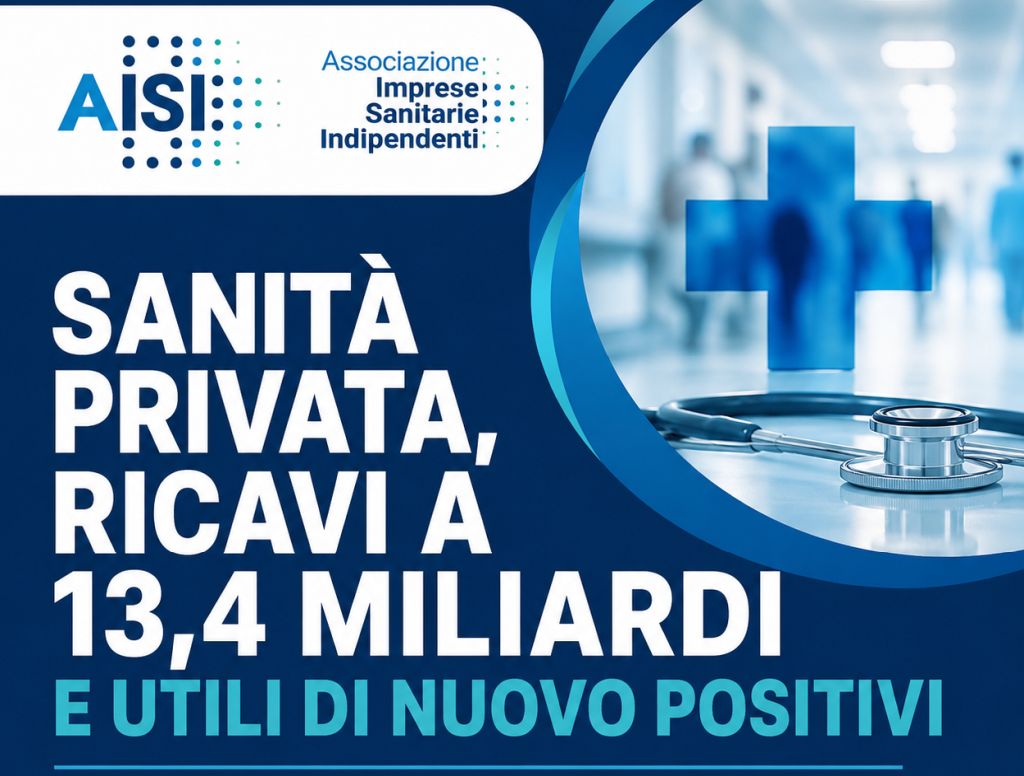
The update of the report of the Mediobanca Study Area on the main operators of the sector takes a growing sector: in 2024 the aggregate turnover of the main operators has reached 13,4 billion euros, with an increase of 5.5% regarding 2023 and 22% regarding 2019. For 2025 there is a further increase of 3.7%, mainly driven by care to the elderly (+7.9%), followed by hospital assistance (+3.9%), diagnostics (+2.8%) and rehabilitation (+2.6%).
“The data confirms that private health is an increasingly important component of the response to citizens’ health needs,” says Karin Saccomanno, president of AISI – Independent Health Business Association. “The growth of turnover, return to profits and increase in employment demonstrate the industry’s ability to invest, innovate and ensure welfare continuity. The strong development of care for the elderly is not a conjunctural phenomenon, but the direct consequence of the country’s deep demographic changes. This is why we call for a long-term national planning that gives stability to the system, promotes investment and recognizes the role of private health in responding to citizens’ health needs. »
The analysis also highlights how, compared to the period prior to the pandemic, are mainly structures dedicated to care for the elderly to record the most significant growth (+25.9%), favoured by the increase in the employment rate of the beds and the opening of new structures. They follow diagnostics (+22.9%) and hospital assistance (+22.8%), while rehabilitation grows by 10.1%. The EBIT margin also continues to recover profitability: the EBIT margin passes from 3.1% of 2023 to 3.6% in 2024, while remaining below 5.4% recorded in 2019. The aggregate profit returns positive, at 34.6 million euros, while the ROI dates back to 4.7%, still less than 6.3% of the pre-Covid era.
“Return to profit and recovery of profit are important signs, but they also point out that the sector has not fully recovered the economic balances before the pandemic,” says Giovanni Onesti, general manager of AISI. “We cannot read these numbers only as budgetary results. They tell a sector that continues to invest while operating in a context characterized by increasing costs, strong pressure on demand and need for continuous organizational and technological adjustments. It is essential to build a stable regulatory framework that promotes investment, reduces territorial inequalities and make cooperation between all components of the healthcare system more effective, with the aim of guaranteeing citizens timely, appropriate and quality care”.
The report emphasizes that the ageing of the population will continue to feed the demand for assistance in the coming decades. The over 65 share is expected to move from 24.5% of the population in 2024 to 34.1% by 2062. In parallel, public health expenditure is expected to be stable around 6.4% of GDP between 2026 and 2029, while it will increase the weight of health on primary current expenditure, from 15.4% of 2025 to 15.7% in 2027.
In addition to this, private health expenditure which in 2025 amounted to 78 billion euros, also fueled by the persistent difficulties of access to care. In 2024 almost one out of ten citizens gave up health benefits for economic reasons or due to waiting lists. However, Agenas data remains encouraging, which in the first half of 2026 record more than 1.6 million specialist visits and diagnostic examinations issued within the time limit than in the same period of 2025, although with differences still marked between the different areas of the country.
“A private health expenditure close to 78 billion euros and a ten-dollar citizen forced to give up treatment represents indicators that impose a reflection on the evolution of the Italian health system”, says Fabio Vivaldi, secretary general of AISI. “The answer cannot be to oppose public and private health. On the contrary, it is necessary to strengthen the overall capacity of the system to take care of citizens, investing in personnel, digitalisation, technological innovation, prevention and modernization of structures. The growth of employment shows that the sector continues to create qualified work and professional skills, essential elements to address the increase of chronic pathologies and non-autosufficiency.”.
In 2024 the sector also exceeded 102 thousand employees, with an increase of 17.5% compared to 2019, confirming its ability to generate qualified employment and to support investments in professional skills. For AISI this data shows that private health is called to play an increasingly important role in ensuring the sustainability of the Italian healthcare system.
For the Association it is now indispensable to start a national programming that accompanies the growth of health demand, promotes investments, ensure stable rules and reduce territorial inequalities in access to performance. The progressive aging of the population, the increase in chronicity and the continued growth of welfare demand make it evident that the real challenge is not to choose between public and private health, but to put both components in the condition of collaborating effectively to guarantee citizens increasingly timely, safe, innovative and quality care.
– Photo: Locandina Aisi –
(ITALPRESS).