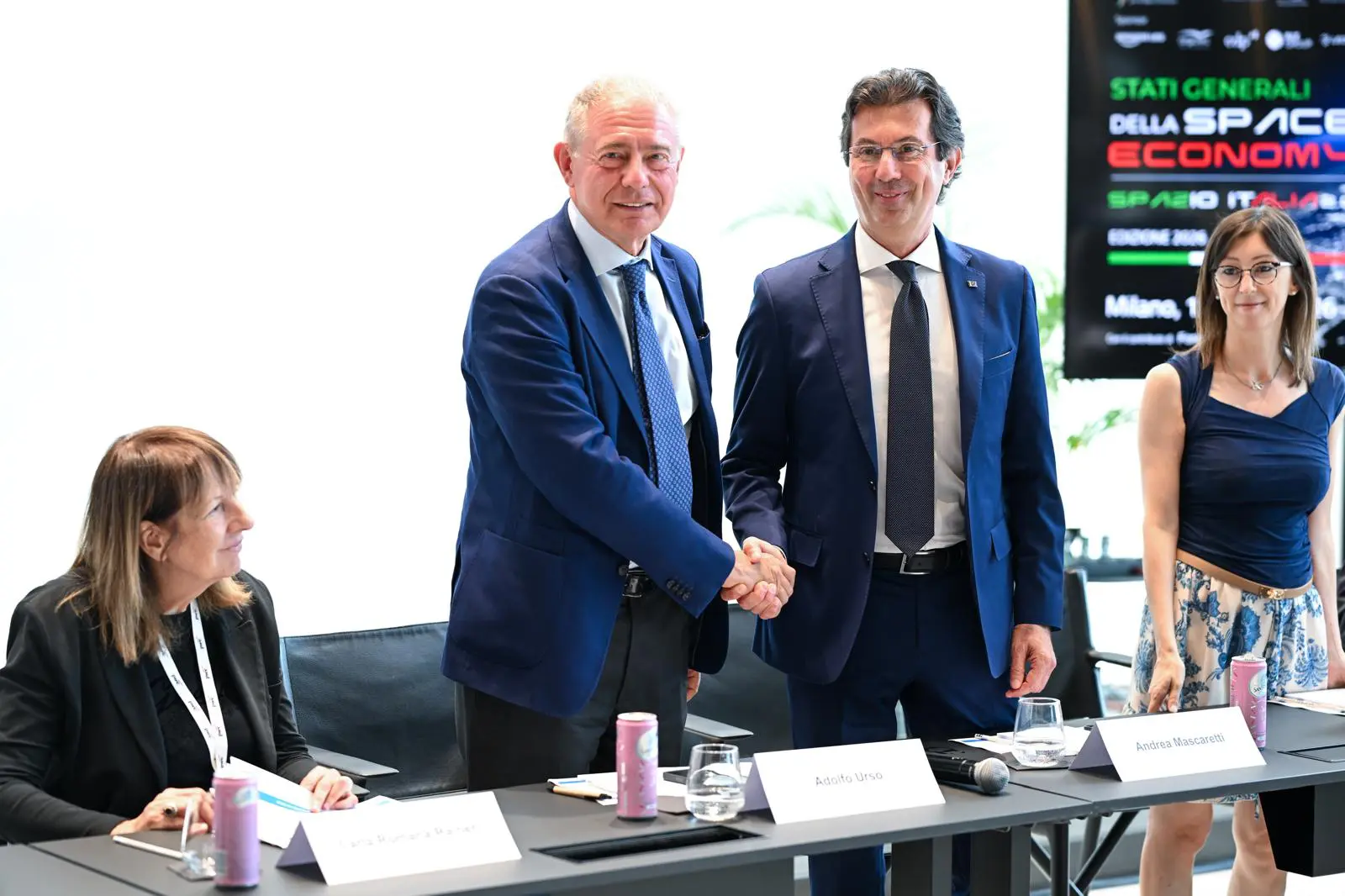
MILANO (ITALPRESS) – The Strategic Table on Finance and Investments for the Italian Space Economy was held in Milan, in the presence of the Minister of Enterprise and Made in Italy, Sen. Adolfo Urso, Minister of Economy and Finance, Giancarlo Giorgetti, representatives of Parliament, the Government, AIAD, ASAS and AIPAS representing the national space industry, Confindustria, the banking system, finance, investment funds and leading industry operators. The Minister of Economy and Finance Giancarlo Giorgetti concluded his work in a closed-door session. The initiative was promoted and organized by the Parliamentary Intergroup for Space Economy together with the Italian Space Agency, with the support of COMINT and UPSA, with the sponsorship of Regione Lombardia and Assolombarda, with the support of Inrete – Institutional Relations and Communication and SDA Bocconi SEE Lab and with the contribution of Fondazione PwC.
The General States of the Italian Space Economy, held at the Libeskind Tower in Milan, home to PwC, confirm the main national moment of comparison on the perspectives of the Italian Space Economy. The meeting is one of the stages of Space Italy 2.0 – General States of Space Economy 2026 and has been promoted with the aim of starting a comparison between Parliament, Government, national space industry, financial and economic system and institutions to define, through a shared vision, new financial, regulatory and industrial policy tools useful to support in the next decade the broadest implementation of Italian spatial policies, the full participation of Italy to the main international space programs with ESA, NASA and the independent space agencies.
The comparison is part of a strong expansion of the Italian Space Economy. Between 2021 and 2024 the turnover of the space supply grew from 1,9 to 3.1 billion euros, while the occupied increased from 5,900 to 8,900 units. The international projection of the sector is also growing: the export of aerospace increased by 23.3% compared to 2022 and foreign investments by 37.1%. In 2025 the Italian market for Earth Observation services reached 340 million euros, with an increase of 73% compared to 2022, higher than that of the European market (+65%). Globally, the economy of space is destined to achieve revenues of 1.790 billion dollars by 2035 and represents one of the sectors with the highest multiplier effect of investments: according to ESA, each euro invested in space programs can generate up to 4 euros of economic value and attract up to 2,8 euros of additional private investments.
In the course of the discussion, it emerged as the Space Economy represents today more than ever, a strategic sector that integrates advanced manufacturing, digital, scientific research and innovation, generating increasingly relevant applications for telecommunications, Earth observation, mobility, defense, environmental sustainability and critical infrastructure management. An industrial and technological heritage that sees Italy among the protagonists in Europe and which requires a shared vision between institutions, enterprises and financial system to ensure its competitiveness in the future. To introduce the morning of work, with an institutional greeting, was Andrea Mascaretti, President of the Parliamentary Intergroup for the Space Economy, who reiterated the value of the General States as a place of permanent confrontation between politics, industry and stakeholders of the sector, with the aim to accompany the growth of the Italian space supply through a shared national strategy.
“We are at work to build new tools to support Italian strategic policies and to support the development of the national commercial market of the Space Economy – said Mascaretti –. The Space is now one of the main factors of economic competitiveness, technological innovation and strategic security. This is why we wanted to gather around the same table Government, space industry, financial system and the world of the economy, so that they can share together with the parliaments a common vision on the challenges that await our country in the next ten years. The objective of the initiative is twofold. On the one hand, support an Italian space industry which is already one of the excellences of our production system and which, in a phase of extraordinary evolution of the world-wide sector, must continue to grow and compete at the highest international levels. On the other hand, accompanies and accelerates the development of the Italian Space Economy market, promoting the expansion of activities carried out by private operators and the emergence of new industrial and entrepreneurial opportunities. In the last twenty years, the United States has shown that the progressive opening of the private investment sector has generated a profound transformation of the economy of space. Increased competition, more innovation, faster development times, cost reduction and an industrial ecosystem capable of attracting capital, creating highly qualified jobs and developing services that today are part of the daily life of citizens, businesses and public administrations. With the Italian Space Economy Act of 2025, our country has a modern regulatory framework and one of the most advanced in Europe. Today we are called to a further step: to identify all together, Government, Parliament, industry and financial system, new tools able to accompany an ever faster growth of the sector, to support in the long term Italian spatial strategic policies and to promote the development of the national commercial market of the Space Economy.
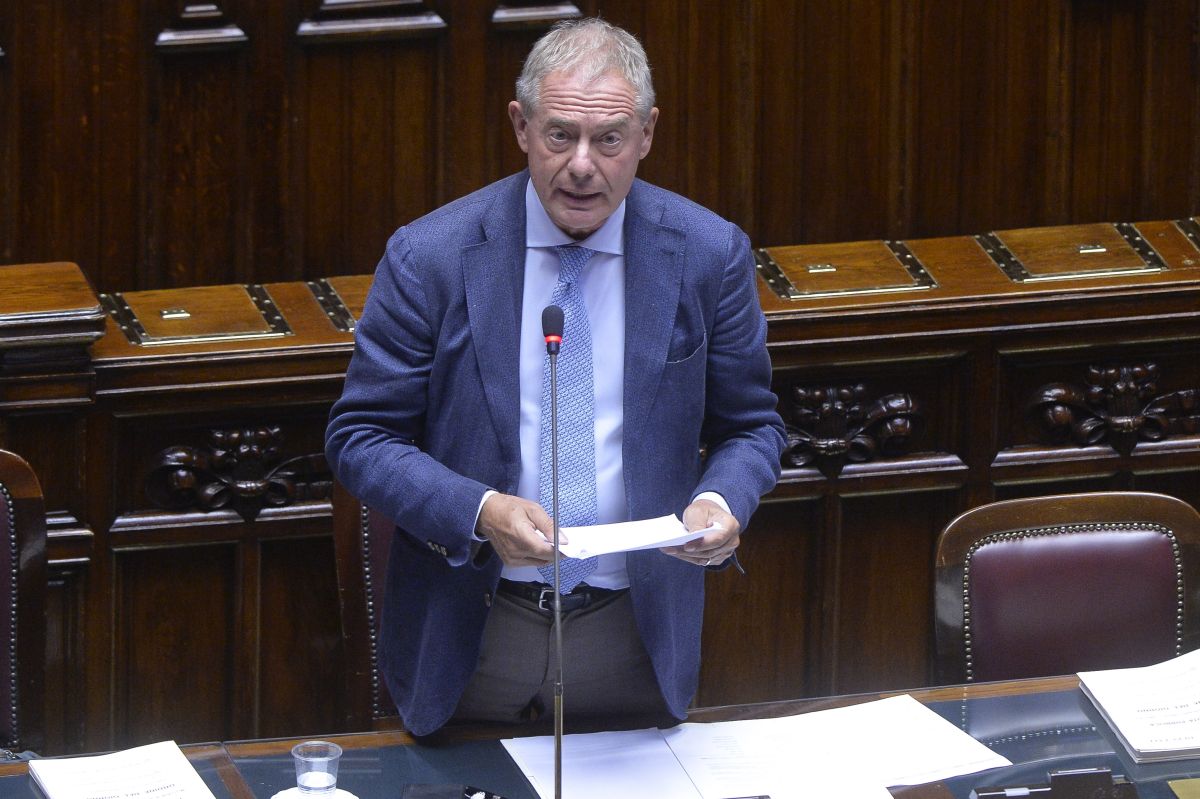
To open the work with an intervention on government investment and national spatial industrial policy was Sen. Adolfo Urso, Minister of Enterprises and Made in Italy and Authority delegated for spatial policies, who stressed the value of Space as a strategic sector for Italy, highlighting the need to support the growth of the Italian supply chain and valorise the heritage of competences present in the country. For Adolfo Urso, Minister of Enterprise and Made in Italy, “Italy is consolidating its role among the protagonists of the European Space Economy. The government has bet from the beginning on the sector, with several measures over 10 billion euros and also enhancing the resources of the PNRR, which have already allowed the realization of four Space Factory and the birth of a network of 16 industrial districts distributed throughout the country. The space unites Italy: from North to South we are building an increasingly strong and competitive supply chain, capable of transforming research, innovation and advanced manufacturing into growth, qualified employment and technological autonomy. The choice to gather in Rome, next 15 December, under the Italian Presidency, the European Space Agency Ministerial to reprogram some financial interventions in the light of the new international context confirms the centrality of our Country in Europe and its vocation to be the protagonist of the new space adventure of humanity. It is now essential to support public investment in greater mobilization of private capital, to support the development of the sector and to seize the opportunities of an expanding market. The route is traced: consolidate a national chain increasingly innovative and competitive, strengthening the technological sovereignty and the ability of Italy to lead the challenges of the new economy of space”.
At the meeting was also attended by Attilio Fontana, President of the Lombardy Region, who highlighted the role of Lombardy as one of the main European poles of aerospace and innovation. Lombardy, thanks to the presence of companies, universities, research centres and highly qualified skills, is in fact a natural laboratory for the development of the Space Economy and for the construction of new synergies between productive system, financial system and institutions. “Luxembourg strongly believes in the Space Economy and in the need to continue to support a strategic chain for the competitiveness of the country – said Fontana -. For this reason we look with great interest in the creation of an Innovation and Development Area dedicated to the sector, which would allow to set up the excellences already present on the territory, starting from the area of Varese, where a unique heritage of enterprises, skills and industrial capacity is concentrated. The goal is to create an increasingly integrated ecosystem, able to foster collaboration between companies, universities and research centers, accelerating innovation, investments and development. We welcome, therefore, with satisfaction the openness manifested today by the Government on this path: it is an important signal, that we expect can be translated quickly in an operating confrontation with the territories, to strengthen one of the main European aerospace poles and fully grasp the opportunities offered by the new economy of space”.
The representatives of some of the companies that support and participate in the General States of the Space Economy, from the round table to which they took part emerged that the growth of the Space Economy today requires greater integration between industry, financial world, research and institutions, together with the ability to transform Italian technological excellence into new products, services and market opportunities. For Massimo Claudio Comparini, Managing Director of Leonardo’s Space Division, “the space economy is entering a new phase in which the value will be increasingly linked to the services, data and applications made possible by the spatial infrastructures that we today realize. In this perspective Leonardo has, for example, invested half a billion euros in a proprietary constellation of Earth observation, an interconnected system and with ability to supercalculate on board, and in the strengthening of its Space Division, along with the skills of Telespazio and Thales Alenia Space Italy, with a focus also on exploration, for example through the program for the module of the first house on the Moon and for a future network of navigation and lunar communication. Italy has a high-quality industrial and technological chain: the challenge is to make the collaboration between large companies, SMEs, startups and research centers increasingly close, and to foster the contamination and convergence of spatial innovation with digital technologies, Artificial Intelligence, super computing. Today there is also a growing awareness, by the financial and industrial world, that investing in space means investing in competitiveness, innovation and development. Italy has all the elements to play a leading role globally.”.
According to David Avino CEO and Founder Argotec, “Space is entering a new phase of its evolution: we no longer talk only about satellite constellations, but of data-driven solutions capable of transforming data into information with a high added value. In this new era, the core of industrial trajectory is represented by dual-use native technologies and the ability to process data directly in orbit, providing end users with information in near real-time. These strategic assets are essential for Public Administration, Civil Protection, Defense and the private sector because they allow critical decisions with greater promptness, precision and effectiveness. In Argotec, we work every day to develop spatial systems that transform data into operational capacity, an invisible engine, but vital for the security, sustainability and competitiveness of our country. Italy has all the industrial and technological capabilities to play a central role in this new scenario. However, it is necessary to create an ecosystem capable of attracting international investments and capital to compete globally.”.
“We are happy to host the General States of the Space Economy to help out the future of a sector destined to play an increasingly central role in the competitiveness of the country. The space economy is a powerful innovation enabler, with cross-references on many industrial and technological sectors – says Alessandro Grandinetti, Partner Markets & Clients Leader of PwC Italia -. Italy has demonstrated a pioneering vision, becoming the first country to have adopted an organic law dedicated to the theme: an important signal that strengthens the national position in a sector with a high strategic value. Within the framework of the values of Fondazione PwC Italia we believe in the importance of dialogue between the public and the private sector to accompany the growth of this ecosystem and transform innovation into concrete opportunities for the economic and social system”.
‘Thales Alenia Space believes and invests strongly in its supply chain, integrating more than 250 small and medium Italian companies into the value chain, promoting for years national excellence, as also demonstrates our active participation in regional aerospace districts – said Ornella Bombaci, Director of the Competence Centre System Engineering Thales Alenia Space Italy -; just to name a few: Piedmont, Lombardy and Abruzzo. The National Resumption and Resilience Plan has certainly given new impetus to strengthen national skills in the space economy, but our company has always invested in infrastructure and technology, as demonstrated by the Space Smart Factory and by new flagship programs in the Earth Observation as the IRIDE constellation. For Roberto Aceti, CEO of OHB Italia, ‘General States of Space Economy are an important opportunity to build a shared vision of the future of space in Italy. Today our country can count on an industrial, scientific and technological chain among the most advanced in Europe, with skills ranging from Earth observation to space exploration, from telecommunications to security. The challenge is to transform this heritage into a long-term strategy capable of strengthening national competitiveness, supporting European strategic autonomy and generating value for the entire economic system. As OHB Italia we are proud to contribute to this journey, providing our experience as the first contractors of some of the most important European and Italian space missions.
“The challenge of the space economy is no longer to develop new technologies but to transform innovation into permanent industrial capacities, operational services and competitive advantage. The experiences we are developing in RINA show that this is possible when research, intellectual property, public and private capital work in continuity with the market – explained Daniele Calderoni Parronchi, Chief Strategy & Innovation of RINA -. The true indicator of success is not the number of projects financed but the ability to accompany technologies from the laboratory to industrial applications. Only in this way does innovation generate economic growth, competitiveness and lasting value for the country.”.
– Press Office Photos Intergroup Speaker for Space Economy –
(ITALPRESS).