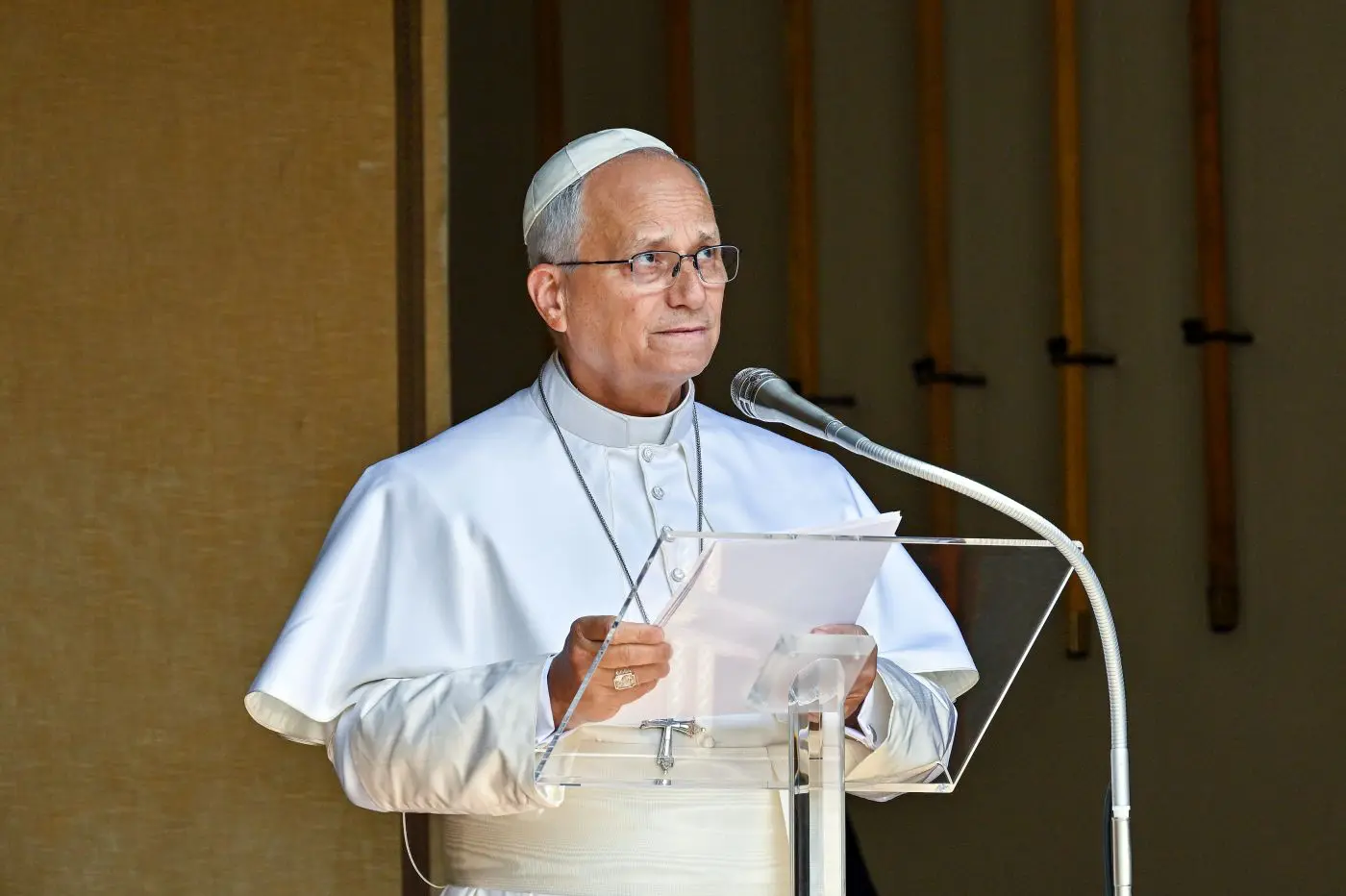
SAN MARINO (ITALPRESS) – “I am very pleased to visit your country, which boasts the primacy of being the oldest Republic of the world, with a tradition dating back to the beginning of the 4th century. I cordially thank the Captains Reggents for the courteous invitation and for the reserved welcome, also witnessed by the words they addressed me on behalf of all citizens. My visit takes place in the wake of those of St. John Paul II, in 1982, and Benedict XVI, in 2011, and intends to confirm the deep bond that unites the Titan to the Apostolic See. An ancient link for long historical coexistence, but at the same time recent if we think that only a century ago, in April 1926, diplomatic relations between the Holy See and the Serenissima Republic of San Marino were formalized.” Thus Pope Leo XIV in his address to the authorities and civil society, during his pastoral visit to the Republic of San Marino.
“In its long history – he emphasizes -, your Republic has perpetually made the words that we could define the spiritual testament of its Founder: “Relinquo vos liberos ab utroque homine”, whose synthesis appears clear in the motto Libertas. One word, but what density! In the context of the history of a people and a state, it certainly expresses the aspiration to self-determination, not to depend on other political authorities. But at the same time, Libertas means much more, and on this I would like to dwell briefly with you.’.
“First of all – Pope Leo continues – I wish to emphasize that there is no real civil freedom without personal freedom, that is, without respect and promotion of the dignity of the human person, of which freedom is an essential component. This freedom is ultimately given and guaranteed by God whose voice resounds in the consciousness of every human being. Promoting freedom involves defending the spaces of consciousness. And here the thought goes to the many men and women who, in every age and in every place, are martyrs of freedom because they bear witness to the primacy of conscience. Saludly formed by the search for truth, they are fully responsible for their decisions and therefore free from any bond that is not that, precisely of the creature, that binds them to God. Exemplary in this is St. Thomas Moro, Patron of Governors and Politicians. Even today, in many parts of the world, there are people who remain faithful to their conscience even in contexts of strong adversity, witnesses of true freedom, that which comes from being children and daughters of God. With admiration we express our solidarity to those who, at this moment, pay in person for not having betrayed their conscience.
‘Moreover – punctuality – freedom is realized in gift, communion, encounter and dialogue. It is like a plant that grows and produces branches and leaves to offer all oxygen, shadow, perfume, fruits and new seeds. And how could it be otherwise, since it flows from the source that is Love One and Three? Perhaps this theological reference may seem excessive, but I believe that today it is necessary, in the face of the idolatry that spoils at the root those political and economic projects that arise in the name of freedom, but in reality they are slaves of idols and power.
‘In the Christian vision, freedom and communion are or fall together – he continues. Many saints and saints have begun experiences of community life in which people express their freedom in obedience to a rule, based on the Gospel. In your case it is always a reason of particular interest that at the origin of your community there are men like San Marino and San Leo, who we can define free and peaceful city builders. Their work can be interpreted according to the biblical icon of the reconstruction of Jerusalem propitiated by Prophet Nehemiah. It is the ‘positive’ image, opposite that of the tower of Babele, which guides the reflection of the Encyclical Magnifica humanitas . The work of Nehemiah is animated by prayer, involves families and all the people, builds the bonds before the stones; the style is communion, not uniformity, “the harmony that arises when each one assumes his own part and all the people recognizes that his strength comes from the Lord”.
“So I like to think about the work undertaken by your Founders, which is well reflected in the laboriousness and the ingenuity of this people and this land. Libertas, for you, also means a commitment never less than an active and positive participation in the construction of peace. Concerning this aspect, I express my deep appreciation and I find a special consonance with the attitude of the Holy See. For this reason we share the esteem for diplomacy and multilateralism, as privileged ways to cultivate international relations and promote the understanding between the Nations. Against impulsive communications, aggressive rhetoricals and the logic of power that mark our time, the vocation of diplomacy is to foster dialogue with all, including interlocutors considered more “discomodations” or that they would not feel legitimate to negotiate, using up to the very end humility and patience to seize the most tender signs of good will of the conflicting parties, so as to start a peace.”.
‘This visit – similar to what happened in the Principality of Monaco – invites me to underline the peculiar value of a small state, “to measure of man”, in which it is possible to experience the proximity of politics to the needs of citizens and, therefore, a more effective democracy, even more animated by the Christian inspiration – emphasizes the Pontiff. Therefore, the Republic of San Marino can be a “laboratory” of good politics, where, without derogating from the secularity of the State, one can draw on the principles of Catholic social doctrine: the search for the common good, the universal destination of goods, the harmony of subsidiarity and solidarity, social justice. This commitment is even more precious today, when the Association Agreement with the European Union is being implemented and your Republic will be able to relate permanently, albeit in a special way, with a complex reality, which will benefit from your contribution. Going even deeper, the main objective to which to tend in this ‘laboratory’ is the care of the human. A community like yours, in fact, at the same time rich in traditional values and at the pace with technological times, can effectively pursue this goal, through a care that translates into the protection of every life, at every stage, from conception to natural death. “The quality of a civilization is measured not by the power of its means, but by the care it can offer, by the ability to recognize the other as a face and not as a function. The ability to take care of each other is an important dimension of our human being. […] Technology can also support mutual care among people, for example if it offers tools that help to predict and organize, but without executing the freedom and judgment of the human being, subject of relationships and responsible for decisions.”.
“This cure of the other has appeared a distinctive note of San Marino history since its dawns. As it has been noted, it has turned out to be in the tradition of hospitality, which has never come less along the centuries towards those who suffer and is in the test. Recently, it has shown itself with the support and hospitality to the Ukrainian people, especially at the beginning of the conflict, as well as in the commitment to international humanitarian law at a historical moment in which it appears daily disrespected if not even trampled – Pope Leo concludes. This sensitivity is also the fruit of the Christian tradition of this country and of the constant and positive collaboration between the political authorities and the Bishop in the search for the common good. Therefore, I am particularly grateful for your commitment and witness and encourage you to continue all, rulers, citizens and ecclesial communities, the courageous and far-sighted commitment to the dignity of every human person and of the common good. To each of you, I renew the expression of my joy for this visit to the Republic of San Marino and I invoke upon all the blessing of the Lord.
-Photo IPA Agency-
(ITALPRESS).