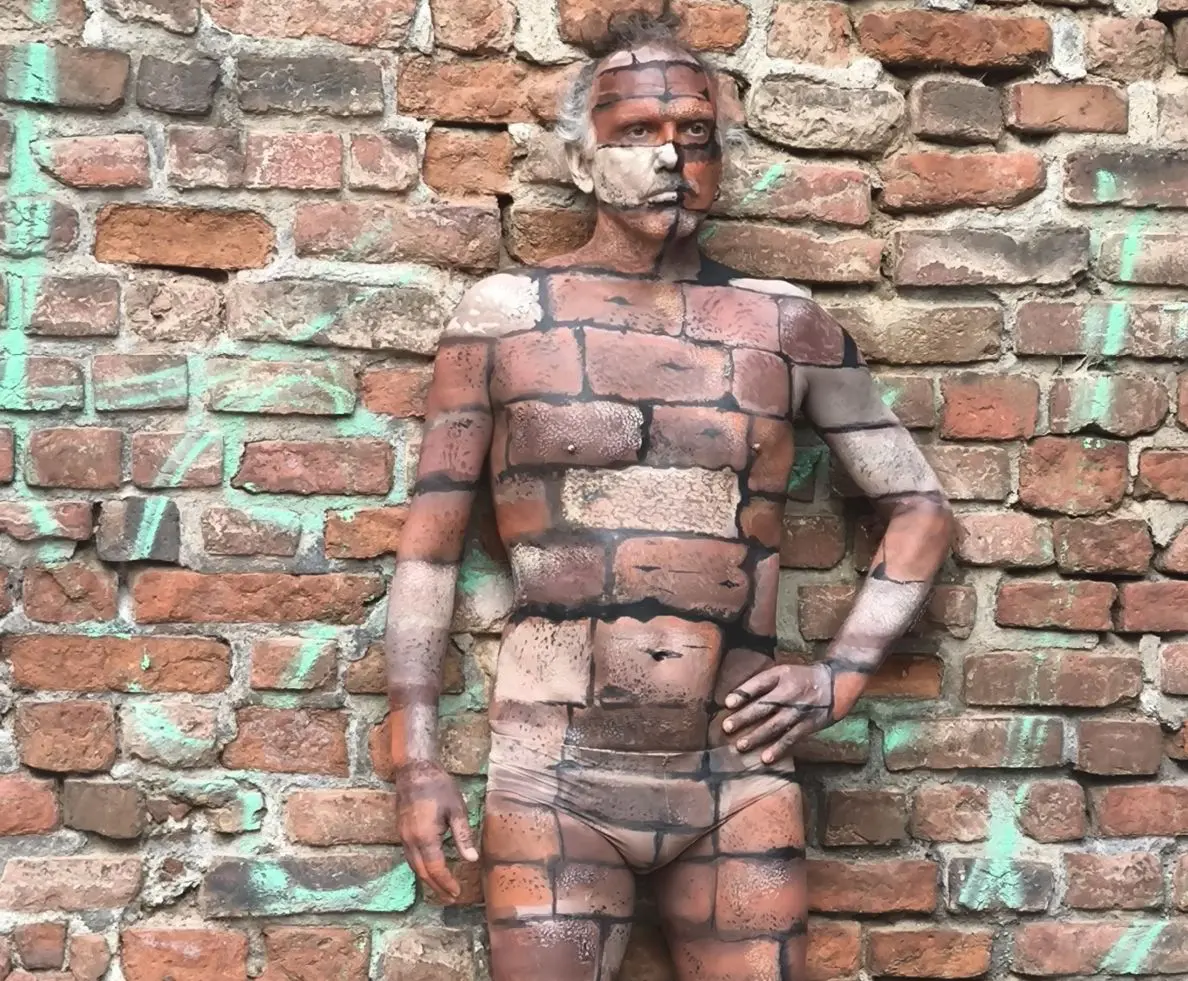
MILAN (ITALPRESS) – The Columns of San Lorenzo in Milan, among the passers-by, a figure seems to dissolve in the landscape. It is a street artist, painted to merge with the surrounding architecture until it becomes almost indistinguishable. It is not just an exercise of urban camouflage. It is an initiative that tells the deception of the IgG4-related disease: a rare pathology that can involve different organs, present itself with apparently disconnected manifestations and be exchanged for other conditions. For this reason she is nicknamed by the specialists “the great imitator”. From here it takes form “NON M’IngG4nno. IgG4-related disease. Know it to recognize it”, awareness campaign promoted by Amgen, a global leader in pharmaceutical biotechnology, with ANMAR – National Association of Rheumatic Diseases – and APMARR – National Association of People with Reumatological and Rare Diseases, with the patronage of FIR – Italian Foundation of Rene and SIR – Italian Society of Reumatology. Rare and immuno-mediated, IgG4-related disease, or IgG4-RD, has been recognized as a distinct clinical entity only in the last two decades. It is a systemic and chronic pathology that can involve one or more organs at the same time or in different stages. The estimated prevalence is about 5 cases every 100,000 inhabitants. The disease, more common in men, most frequently affects people between 50 and 70 years, while manifesting itself at any age.6 The causes of the disease are not yet fully clarified. Over time, persistent inflammation can promote fibrosis formation and compromise the function of the organs involved. “The most accredited hypothesis is that environmental factors, such as chronic exposure to metal powders or microorganism infections still unknown, lead to persistent inflammation in the affected organs,” explains Emanuel Della Torre, Reumatologist, Allergologue and Immunologist of the San Raffaele Hospital in Milan. “IgG4 antibodies that give the name to the disease would represent, in this context, an attempt of our body, unfortunately not effective, to turn off inflammation rather than the true cause of the disease.” The disease can involve pancreas, liver and gallstones, salivary and tear glands, eye sockets, kidneys, aorta and other body districts. To describe his heterogeneity, specialists distinguish four main clinical phenotypes: pancreato-hepato-biliare, retroperitoneale, head-neck and systemic. Signs and symptoms depend on the organ involved and may be little specific: tiredness, pain, swelling may appear as distinct problems, without immediately showing a single origin. It is precisely from the ability of the IgG4-related disease to be confused with other conditions that the sense of “NON M’IngG4nno” arises: an invitation to increase the knowledge of a rare and unknown pathology and its different manifestations. The campaign continues on www.malattiaigg4correlata.it, information platform created with the contribution of a scientific committee of experts and patient associations partner of the initiative, with content and resources useful on pathology, its manifestations and the diagnostic path. “IgG4-related disease is a rare and complex pathology, which can manifest in very different ways and affect multiple organs. This heterogeneity can make the path to diagnosis complicated,” comments Katia Massaroni, Medical Director of Amgen Italy. “It is therefore important to foster dialogue among the various specialists and also to promote close collaboration between patient associations – continues Massaroni. It is from the desire to relate skills, experiences and different perspectives that the “Non m’IngG4anno” campaign is born: an initiative with which we want to help increase the knowledge of the disease and offer useful information to promote comparison with the specialists of reference”miles with other pathologies, the IgG4-correlata disease can be confused with different conditions. A study reports that 60% of patients had initially received an incorrect diagnosis of malignant tumor, more often than lymphoma (47%) or pancreas tumor (30%). “In the presence of a mass that mainly involves pancreas, but also liver and gallstones, in 90-95% of cases it is a tumor and only in 5-10% of an inflammation,” explains Prof. Luca Frulloni, Gastroenterologist of the Integrated University Hospitaller Company of Verona. “Cylinically, it is not possible to distinguish a tumor from the IgG4-related disease: the diagnosis is based on radiological and biopsy investigations of the lesion.” Diagnosis is not based on a single examination. It requires the integration of the patient’s clinical history, blood tests, image investigations and, when necessary, biopsy.5 The diagnostic and disease classification criteria have only been defined in recent years. For these reasons it is not unusual that the path to diagnosis may take even more than two years. Diagnostic delay can have important consequences: when the disease imitates a neoplasia, it can also lead to unnecessary surgery.6 Just for the variety of its manifestations, the IgG4-related disease requires a multidisciplinary approach. “ The comparison between rheumatologists, pathologists, radiologists and other organ specialists is essential for a correct and timely framement, as it is a rare and systemic condition that can mimic other pathologies often more frequent or affect more body districts”, says Dr. Francesco Ferro, Reumatologist of the University Hospitaller Pisana. For many people, the path to diagnosis is marked by visits and consultations with different specialists, before the connection between apparently independent manifestations emerges. An uncertainty that can affect everyday life, work and family and social relationships. “ When symptoms are different and seemingly disconnected, the path to diagnosis can generate disorientation, fear and a strong sense of loneliness,” says Antonella Celano, President APMARR, National Association of People with Reumatological and Rare Diseases. “It is essential that the person be heard in his entirety and accompanied in a coordinated path. Associations can play an important role in informing, orienting and making people feel less lonely.” “Associations can welcome, listen and guide”, adds Silvia Tonolo, President ANMAR, National Association of Rheumatic Diseases “helping patients and caregiver to identify centers and reference specialists and offer correct information. They can also collect needs and criticality and bring them to the attention of clinicians and institutions. A disease can be rare, but the person who lives it must not become invisible.” IgG4-related disease requires time monitoring, because the inflammatory process can cause permanent damage to the organs involved. “Reaching the diagnosis is essential because organ damage can progress silently,” concludes Gaetano La Manna Nefrologo, IRCCS Policlinico Di Sant’Orsola, Bologna. “If the inflammation persists, it can leave room for fibrosis, i.e. a scarce damage not always reversible. Recognising renal involvement promptly enables the most appropriate therapeutic path. -photo press office campaign “Non M’IngG4nno – (ITALPRESS).