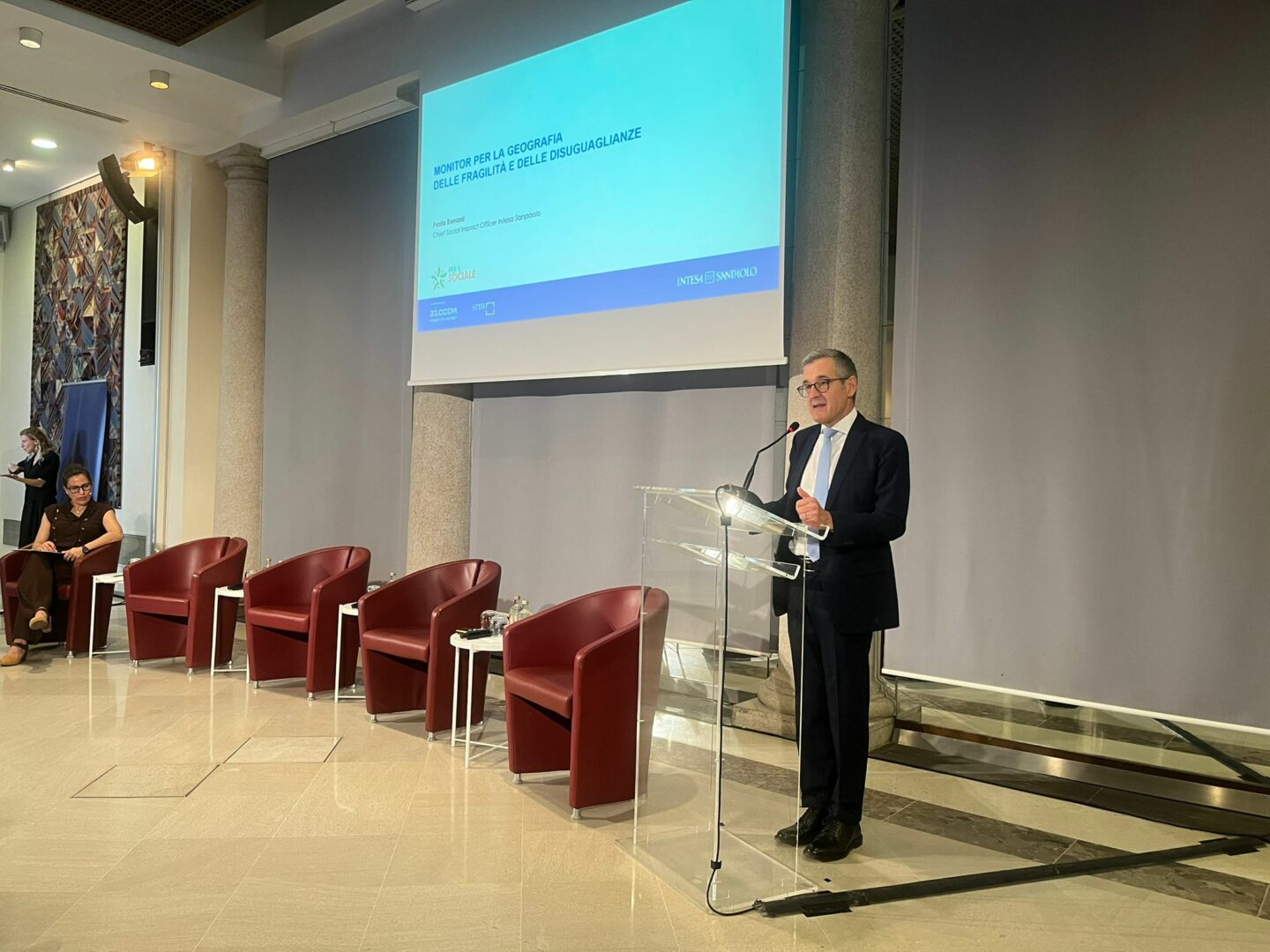
MILAN (ITALPRESS) – The centrality of human capital as the main factor of territorial growth. In the territories in which employment, economic activity, incomes and services are growing, in fact, virtuous dynamics of development and social cohesion, while high levels of youth unemployment and a strong presence of young NEETs are associated with lower civic participation and reduced economic and social attractiveness. This is the framework outlined by the “Monitor for Geography of Fragments and Inequalities”, the new research project promoted by Intesa Sanpaolo for Social, in collaboration with AICCON Research Center, SRM – Studies and Research for the Mezzogiorno and the Research Department of Intesa Sanpaolo.
The study aims at analyzing the multidimensional character of fragility, no longer attributable to the only income of the territories, but to an interweaving of economic, demographic, employment and social factors. The Monitor systematically analyzes the Italian territorial dynamics at the provincial level, through an information base articulated in about 150 indicators, organized in 11 domains and 37 dimensions, ranging from work to income, from health to education, from social inclusion to quality of services, to environmental and productive components.
“The Monitor confirms how inequalities are complex and non-linear phenomena, capable of manifesting differently from territory to territory – said Paolo Bonassi, Chief Social Impact Officer Intesa Sanpaolo -. In this perspective, Intesa Sanpaolo, with its ability to combine the economic and social dimension, wants to play an empowering role in building answers aimed at the real needs of communities and people. Monitor analyses will be useful to guide the Bank’s action. With an evolutionary and open vocation, Intesa Sanpaolo makes it available to institutions, companies and social actors in the Third Sector to help create social value and promote an increasingly significant impact.”
The study highlights the positive relationship between employment and welfare is not necessarily linear. However, in low-density areas with older population, the presence of work does not automatically translate into a better quality of life. Territorial dispersion, access difficulties and lower levels of prevention limit the positive impact of employment, even in traditionally virtuous territories. On the contrary, in more structured contexts, synergy between work, health services, prevention and demographic dynamics contributes to strengthening overall well-being. Moreover, legality and security do not automatically evolve with economic development.
At the territorial level, while confirming the gap known between North and South, an articulated reality emerges, in which positive data are shared in peripheral or depressed territories and vulnerability areas within the economically more developed provinces finding that development trajectories are not static and that targeted interventions can also help reduce existing differences.
Among the most innovative aspects of the study is the imbalance between the needs of the territories and the capacity to respond to the services: health systems not always consistent with the needs of the local communities, lack of childcare services that limit women’s employment and the failure of the socio-assisted offer intended for the elderly.
Particularly innovative is the reading “for differential”, which relates the needs of the territories with the available resources. This analysis highlights imbalances between demand and provision of services in key areas such as health, childcare, educational inclusion and care for the elderly. These imbalances also affect traditionally virtuous territoriesi create a more complex and less predictable “geography of fragility”.
– Photo f50/Italpress –
(ITALPRESS).