I went back to dinner at Le Parisien, 33rd Street and Lexington Avenue, Murray Hill, the neighborhood where I’ve been living for almost 16 years. It is a small French restaurant that always manages to transport me into space and time until a small bistro on the Seine, crowded with Parisian accents and watered with good regional wine. Tonight I have ordered what I always order: escargots, the mussels to share and, to follow, a steak frites that here know how to do as you must. The management has changed over the years (it is mainly understood by an authenticity that perhaps has been a bit thin) but the atmosphere remains the right one, with the noise of the cutlery on the white plates and the submerged voice of the tables nearby.
It was precisely during this dinner that the question was born that accompanies the stage of the World Tour in New York this month: where is France, in New York? The most obvious answer lies in the perhaps most famous gift that has ever been made to the city: the Statue of Liberty, which since 1886 welcomes with its torch anyone arriving by sea, gift of the French people to the American people and on which we will return, at the end of this journey. But if we now try to look for France in the folds of the city beyond the port, things get a little complicated.
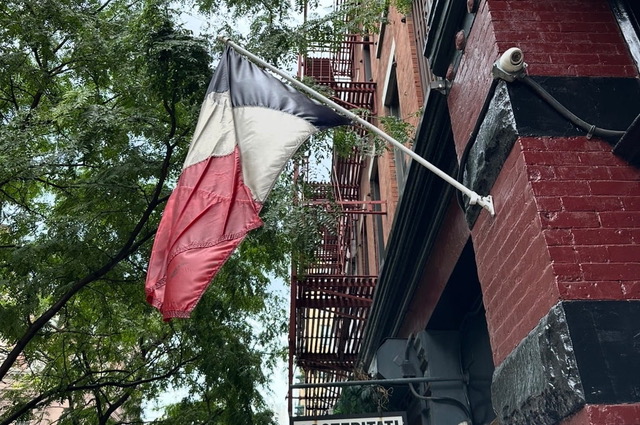
It does not exist today, unlike what happens for other countries I have already told you, a real French neighborhood: no net perimeter made of banners and flags in which to stick with the certainty of finding what you are looking for. This does not mean that it has always been like this. In the 1970s and 1990s, a real French neighborhood occupied what we know today as SoHo, a big way between Washington Square South and Grand Street, West Broadway and Greene Street. Here a large French community, consisting largely of exiles arrived after the Paris Commune of 1871, lived among bakeries, butchers, cafes and small restaurants in the basement. In the early 20th century the community climbed further north, towards Chelsea, where it reached about twenty-six thousand residents and endowed with solid institutions such as the church of Saint Vincent de Paul, the French Hospital and the Jeanne D’Arc Residence for young women alone, away from home and in need of a safe roof. But already within the Second World War that community had largely dispersed, and unlike Little Italy or Chinatown, kept alive by waves of migration never really interrupted, no new French neighborhood has more reconstituted in its place.
Yet, the French in New York are not very few: it is estimated that today in the city there are more than sixty thousand French citizens, and that people who speak French exceed eighty thousand. I decided then that this stage of our World Tour would not have been the usual walk in a neighborhood, but a real treasure hunt: a route made of scattered stages, each a small clue of a French presence that for almost a century no longer has a unique address from which to start, and that for this reason it should be looked more closely.
The first clue, in fact, a perimeter still has it: it is what two French cousins, Léa and Marianne Perret, renamed “Little Paris”, between Nolita and Chinatown, along Centre Street, in the stretch between Broome and Grand Street. The two founders of Coucou French Classes, the language school that of this small movement became the headquarters, started in the spring of 2019 a petition for an official recognition of the street section, and for July 14, 2021 they installed on the facades of the palaces the hand-painted signs with the new name, almost to want to recure by emotional decree what history had paraded. It is no coincidence that they chose this corner of the city: the French roots, tell them themselves, sink until the 17th century, when these lands belonged to the Huguenot family of the Bayards and it is still more or less the same land of the 19th century French quarter which I told you a little ago, remembered today by the imposing neoclassical building of 1909 to 240 of Centre Street, the former headquarters of the NYPD, which inspired its architects.
Around this address we have gathered in recent years some signs that deserve a stop. Maman, the famous bakery that today has grown to count more than thirty-seven offices between the United States and Canada – at the expense of its authenticity – was born here, at 239 Centre Street, in October 2014, by the Canadian Elisa Marshall and the French Benjamin Sormonte. Not far away, La Compagnie des Vins Surnaturels remains an elegant and collected wine shop, with proposals of small Mediterranean dishes to accompany a glass chosen with care; and Clic, a space curated between contemporary photography and objects of French taste, completes this small triangle of Paris found. More than a real neighborhood is just a road but without doubt with very high Paris concentration!
The second clue should be sought, however, far further north, on Fifth Avenue, inside the walls of Payne Whitney Mansion. This is an Italian Renaissance-style palace built between 1902 and 1909 by Stanford White as a wedding gift for William Payne Whitney, after alternating events to the French government in 1952 and today the seat of the Cultural Services of the French Embassy, known as Villa Albertine. On the second and third floor, since September 2014, Albertine is located, the French and English bilingual library that for those who like me love to get lost among the shelves remains one of the most precious stops of the city: over fourteen thousand titles kept under a ceiling painted with zodiac motifs and celestial murals, in a dark wood environment redesigned by the French designer Jacques Garcia, where for a moment it is forgotten to be two steps from Central Park and not.
Just outside, on the wall of the garden overlooking the Fifth Avenue, to complete the magic of this place, there is a real cloak: a bronze statue of the Little Prince, a little more than a meter high, work of the French sculptor Jean-Marc de Pas and inaugurated in September 2023 to celebrate the eighteenth anniversary of the book of Antoine de Saint-Exupéry, which right in New York – and Long Island, where he wrote – from 1940 to 1943.
The third clue should be sought, instead, at 22 East 60th Street, where from 1925 is based what is called Alliance New York. Its roots sank in 1898, when the Alliance Française opened its headquarters in New York. In 1971 that story merged with that of the French Institute, founded in 1911, giving rise to the institution that for generations of New Yorkers, and Italians like me, curious of different languages and cultures, was synonymous with French cinema, exhibitions, library and language courses. Every year, around 14 July, L’Alliance comes out of its walls and closes the 60th Street stretch in front of the Bastille Day seat during which stalls, music and good food turn for an afternoon one block of the Upper East Side into a miniature version of a French country party.
A last clue, perhaps more unexpected, that has attracted the attention of football fans especially during the world that just ended in New York, is the flagship store of the Paris Saint-Germain, which according to the club is the largest official store in the world dedicated to its colors. He opened at the end of 2023 at 535 Fifth Avenue and every day attracts crowds of fans who buy personalized shirts and gadgets of all kinds. It is contemporary France, that of sports and global marketing, which is accompanied without too much compliments to France more literary than the Albertine or to the collection of Little Paris. I like to think that this, in its own way, is an authentic clue: the identity of a country, in a city like New York, never tells itself about a single register.
And then, of course, the table: here France in New York stops being a hidden clue and becomes almost an obvious, so many are the bistros and brasserie that claim French origins in every corner of the city: from Le Veau d’Or on the Upper East Side that boasts the title of the first French bistro in New York in Le Coucou, a landmark for high catering. But there is an address among all I can’t but talk about, because it is French not only in the menu but in the blood: Raoul’s, at 180 Prince Street, opened on December 8, 1975 by the Alsace brothers Serge and Guy Raoul, whose grandmother Helen had run the original Raoul’s in Alsace during the Second World War. Fifty years after the place is still a family: today Karim Raoul, the son of Serge, and on the facade still camping, without the need for translations, the words “Restaurant Français”, as a promise maintained from generation to generation. Despite the fact that French catering deserves an article in itself, and even more than one, I could finally quote my two addresses of the heart, as well as Le Parisien who inspired this article. They are both in the West Village: Buvette, at 42 Grove Street, tiny gastrothèque where the marble counter and lit candles recreate the atmosphere of a Parisian bistro; and Petite Boucherie, at 99 Seventh Avenue South, inside the walls that once housed the legendary Circle Repertory Theater, today the realm of steaks, seafood and French pastries, from Madeleine to Paris-Brest.
To close the circle of this treasure hunt she returns, the Statue of Liberty: the greatest and most obvious clue, that to which we don’t think almost as much as “a piece of France”, so much has become herself the symbol of the city of New York. It was built to celebrate the centenary of the independence of the United States, and it is Frédéric-Auguste Bartholdi who designed its forms, from the crown to the table with the date of 4 July 1776 engraved on it; instead it was another Frenchman, Gustave Eiffel, who engineered the internal structure in iron that still today allows the copper coating to move without breaking, as a heart that continues to beat under an immovable skin.
With this stage we add a new stamp to the passport of our World Tour in New York, between hand painted signs, star ceilings and hidden clues around the corner. If you missed your previous bets, you can recover them to continue traveling among the thousand souls of this city. There are still many new destinations to discover together, a clue and a taste at a time. Thanks for coming all the way here and the next treasure hunt!
L’articolo From <i>Murray Hill</i> to <i>Piccolo Principe</i>: a French treasure hunt proviene da IlNewyorkese.