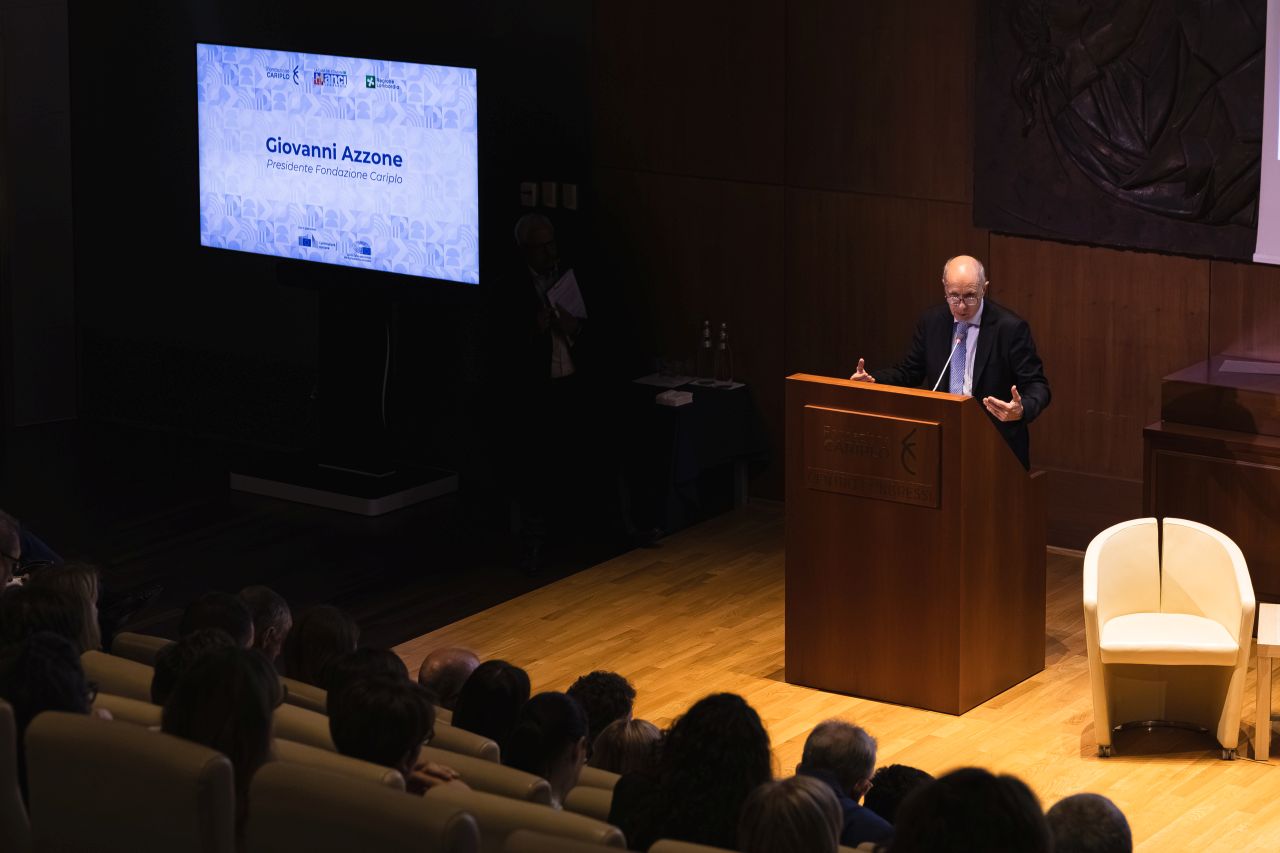
MILAN (ITALPRESS) – The management of European resources for the period 2028-2034 and the possible relapses on territories, third sector and public policies were at the center of the conference “The Future of European Programming – Towards the European budget 2028-2034”, promoted by Fondazione Cariplo, Regione Lombardia and Anci Lombardia. The initiative, carried out with the support of the European Commission and the European Parliament, is at a crucial moment for the EU, engaged in the definition of the new Multiannual Financial Framework 2028-2034, which will determine not only the amount and destination of resources, but also the address of European policies and the balance between European, national and territorial level. The proposals currently under discussion could, in fact, introduce significant innovations in the fields of cohesion, welfare, the environment, culture, research and competitiveness, with effects on how to allocate and manage resources and on the balance between Member States and local authorities. Hence the need to increase knowledge and awareness on the scope of the reforms under discussion and promote the development of appropriate preparation strategies. During the conference, the speeches by Nicola De Michelis (Direction General Regional Policy and Urban of the European Commission), Luca Jahier (European Economic and Social Committee), Luciano Monti (University LUISS), Marianna D’Angelo (Ministry of Labour and Social Policies), Luca Menesini and Vasco Alves Cordeiro (Committee of the Regions) contributed to clarify the main aspects of EU programming. Some of the main novelties introduced by the draft budget presented in July 2025 by the European Commission – a proposal that provides for a completely new architecture than the current financial framework 2021-2027. Among the most important innovations: the strong simplification of the budget, through the combination of several programmes and funds in more integrated and flexible instruments and the introduction of the national and regional partnership plans, inspired by the model of the PNRR and based on a performance-based approach, which provide for each Member State the adoption of a unitary plan agreed with the European Commission. “The comparison on the next European budget comes in a particularly complex phase for Europe – said Giovanni Azzone, president of Fondazione Cariplo –, called to bridge the competitiveness gap with other areas of the world and, at the same time, to preserve its social model. The new programming model will require a change of perspective: it will no longer be a matter of participating in already defined programmes, but of actively contributing to the construction of the National and Regional Plans of partnership, developing appropriate strategic skills and capacities”. For Valeria Negrini, Vice-President of Fondazione Cariplo, “serve new forms of collaboration between public, private and philanthropy to increase the impact of policies and respond effectively to social and economic challenges. It is necessary to redefine the role of partnerships to ensure full involvement of civil society organisations, the Third Sector and the social economy, the choice of priorities, programming and resource management and the implementation of programmes and evaluation mechanisms.” “We strongly ask for an amendment to the next European budget – said Raffaele Cattaneo, undersecretary to the Presidency with delegation to the international and European relations of the Lombardy Region –, the proposal of the EU Commission reduces the resources for cohesion policies and centralizes its management. On the contrary, it should recognize the ruolor fundamental of regional and local institutions. The local regions and administrations, in fact, thanks to their heritage of expertise and deep knowledge of the territories, represent the institutional level that more effectively enhances the local excellences – including those of the third sector – and promotes interventions and quality projects, really close to citizens and their needs, in a subsidiary key. This approach contributes to European competitiveness. There will be no major centralized funds at European level to bridge the competitiveness gap, which is likely to weaken the role of Europe in the international scenario, but the capacity of territorial institutions to combine local development, cohesion and growth of the entire continent.” Finally, according to Mauro Guerra, President Anci Lombardia, “the future of the European budget is directly concerned with municipalities and territories, which represent the first level of proximity with citizens, businesses and local communities. The new European programming will strengthen the partnership principle and fully recognise the role of local authorities in defining strategic priorities, building national and regional plans and implementing European policies. At a time when Europe is called to combine competitiveness, social cohesion and sustainability, it is essential that local autonomy be considered not only actuators but protagonists of the European decision-making process.” The current phase is a decisive phase of negotiation: in 2026 the real political confrontation on the architecture and governance of the new budget opened, with some margins of negotiation. Parliament has already expressed its position, bringing to the negotiating table a proposal that calls for an increase in resources to support the ambitious objectives of the EU, a more participatory governance with a greater role of territorial actors and a review of the priorities of European policies. A crucial issue remains at the heart of the European debate: how to support the new priorities of the Union – from competitiveness to security and defence – without reorganizing historical financing policies, such as cohesion policy, which are the key? In this context, territorial actors can play a decisive role, helping to represent the local needs of civil society organizations, the Third Sector and the social economy, actively participating in the definition of National and Regional Partnership Plans.
– Photo press office Fondazione Cariplo – (ITALPRESS).