
ROMA (ITALPRESS) – In 2026 the average level of the Edufin Index is confirmed at 56 points out of 100, under the sufficiency threshold fixed at 60 on a scale from 0 to 100. Financial and insurance literacy remains altogether low: the gap between those who know and act concretely in the conscious management of their finances and those who do not. 39% of Italians (4 out of 10) reach or exceed the sufficiency threshold, while 51% are in the middle range (Edufin level between 41 and 59 out of 100) and 10% remain in the financial illiteracy area (Edufin level equal to or less than 40 out of 100). The framework is substantially stable compared to 2025 and confirms the need to transform knowledge into more aware behaviors.
It has emerged on the occasion of the fifth edition of Edufin Index, the Observatory on awareness and financial and insurance behaviour of Italians, whose results have been made known by Fondazione Alleanza, in memory of Mario Gasbarri, with the scientific collaboration of SDA Bocconi School of Management.
The research was presented today in Rome, during an event sponsored by the Ministry of Enterprises and Made in Italy, the Ministry of Economy and Finance, the Ministry of Education and Merit and recognized in the official calendar of the Month of Financial Education 2026 promoted by the Committee for the programming and coordination of financial education activities.
The Observatory relates the financial and insurance knowledge of Italians with their behaviour. The research has also analyzed the skills of the population in the financial and insurance field, deepening the relationship between financial literacy and well-being, as well as the financial socialization of young people in the family.
The 2026 edition introduces the novelty of the distinction between investors (the Italians who in the last 24 months have been able to save and invest in financial instruments) and not investors. The first, equal to 73% of the population, reach on average the sufficiency, with a score of 60/100. Non-investors, the remaining 27%, stop at 46/100 instead. Among those investing are higher levels of awareness and those related to financial behaviour.
Overall, the Edufin Index stands at 58 points between men and 54 women, with a gender gap of 4 points, compared to 5 of 2025. On the generation front, the index is 57 points between 45-64enni and 52 between 18-24enni, with a gap of 5 points, reducing compared to 6 of 2025.
Among investors, however, the gap between adults and young people reaches 7 points, highlighting the role of experience gained in financial and insurance decisions.
Giancarlo Fancel, Country Manager and CEO of Generali Italia said: ‘Financial education is an essential leverage of well-being, resilience and development. It is not only an individual competence, but a collective resource that strengthens the capacity of families, enterprises and communities to face the challenges of the present and future. As Generali, we want to continue to act together with institutions to create greater awareness that can result in more effective choices, ability to plan, heritage protection and financial security. For a stronger country, inclusive and able to look to the future with confidence.”
Marco Oddone, CEO of Alleanza Assicurazioni commented: “The results presented today highlight an important element: experience and participation in financial choices are associated with higher skills. For this reason, as the Alliance, together with our Network, we want to make financial education increasingly concrete and accessible, bringing it to the territories, schools and daily life of people. Since 2020 we have involved 550 thousand citizens in over 10 thousand events and will continue investirand the ability of our Consultants to transform knowledge into conscious behaviors. Knowing is not enough, financial and insurance education produces value when it helps people choose, act and look to the future with greater security.”
From research to action on the territory: Alliance commitment to financial and insurance education In the face of the scenario highlighted by the report, Alliance Assicurazioni strengthens its commitment to make financial and insurance education accessible and widespread. Since 2020, the National Financial Education and Insurance Plan has involved 550.000 people through over 10,000 educational events in the territory, reaching 100 million social contacts every year through educational content. In addition, with the project “Financial Education at School” realized together with AIEF, in recent years, about 500 institutions have been involved with over 35,000 students.
In this direction it also fits “Remit your future in the right direction”, the campaign of trade marketing and local visibility of Alleanza that involves 24 Italian cities and that on 29 and 30 October stops in Rome, in Piazza Sant’Emerenziana. An initiative that brings Alleanza and its Consultants directly to the squares to bring people closer to the themes of protection, security, savings, investments and banking services and stimulate greater awareness regarding the choices for their future.
Two years after the previous study, the indicator of financial socialization of young people (show how they acquire and develop values, attitudes, knowledge and financial behavior in the family) climbs to 66/100, six more points than 20242. Acquisitions and daily expenses can represent opportunities to broaden the comparison from the present to the future, progressively introducing the themes of savings, risk, protection and planning. 91% of parents declare to speak with children of money and money management. The most addressed topics are money for the desired purchases, indicated by 59%, and spending decisions, to 46%. There are savings decisions, at 37%, the family budget, at 36%, economic and financial news, at 21%, and investments and insurance, both at 20%.
Autonomous management of small sums is a concrete opportunity for learning, but there are differences between boys and girls: it regularly receives 33% of males and 26% of females. To expand the family dialogue from the consumption of the present to the planning of the future is therefore a decisive step to strengthen autonomy and awareness.
Insufficient psycho-financial well-being: above all the uncertainty about the future The edition 2026 deepens for the first time the relationship between financial literacy and well-being. The general well-being of Italians is at 59/100, just below the sufficiency threshold (60/100). According to the report, the framework for psycho-financial well-being remains more fragile (the indicator that measures how safe you feel with your money and able to manage them) which stops at 51/100. It is above all the little serenity towards the future to weigh negatively on the relationship of the Italians with their own finances.
Financial and insurance literacy positively impacts citizens’ well-being when it turns into a capacity to act.
Edufin Award “Women Who Count”: the call for nominations On the occasion of the event, Generali Italia and Fondazione Alleanza, with the Scientific Committee Edufin Index and the technical and editorial support of Rame, launched the Edufin Index Award “Women Who Count”, with the aim of recognizing and supporting the realities that work concretely on financial education and the economic autonomy of women.
Third Sector bodies registered with RUNTS, social promotion associations, voluntary organisations, foundations and social cooperatives already established and with registered office in Italy may submit their application until 20 December 2026. The applications will be evaluated by the Edufin Index Scientific Committee on the basis of five key criteria: concrete impact, territorial rooting, inclusiveness, replicability and consistency with the objectives of the Prize.
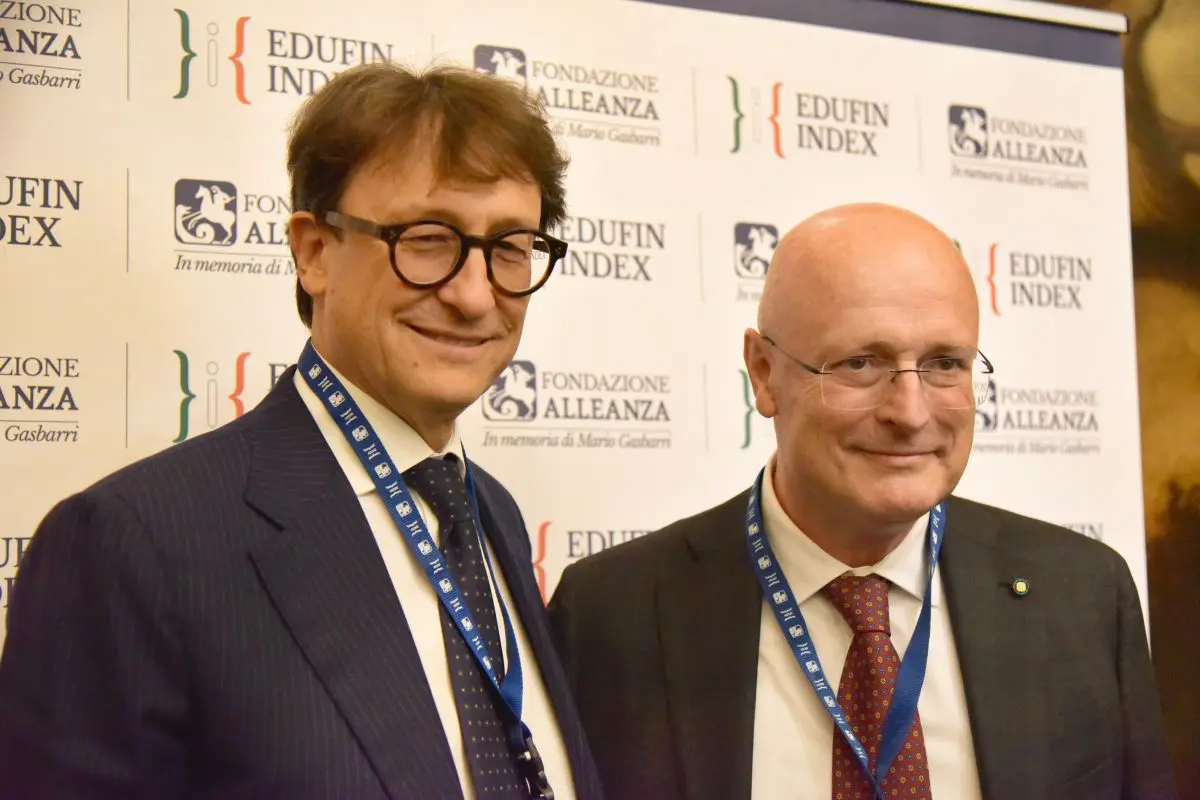
– press office photos Alliance Insurance –
(ITALPRESS).