ROMA (ITALPRESS) – Italian agribusiness consolidates the results of recent years and strengthens its driving role in the national economy, confirming itself as one of the most dynamic and competitive components of the country’s production system. Despite a difficult international scenario, marked by geopolitical tensions and new trade barriers, the sector continues to grow, invest and conquer space on foreign markets, also thanks to the support of national policies and resources mobilized through the National Resumption and Resilience Plan.
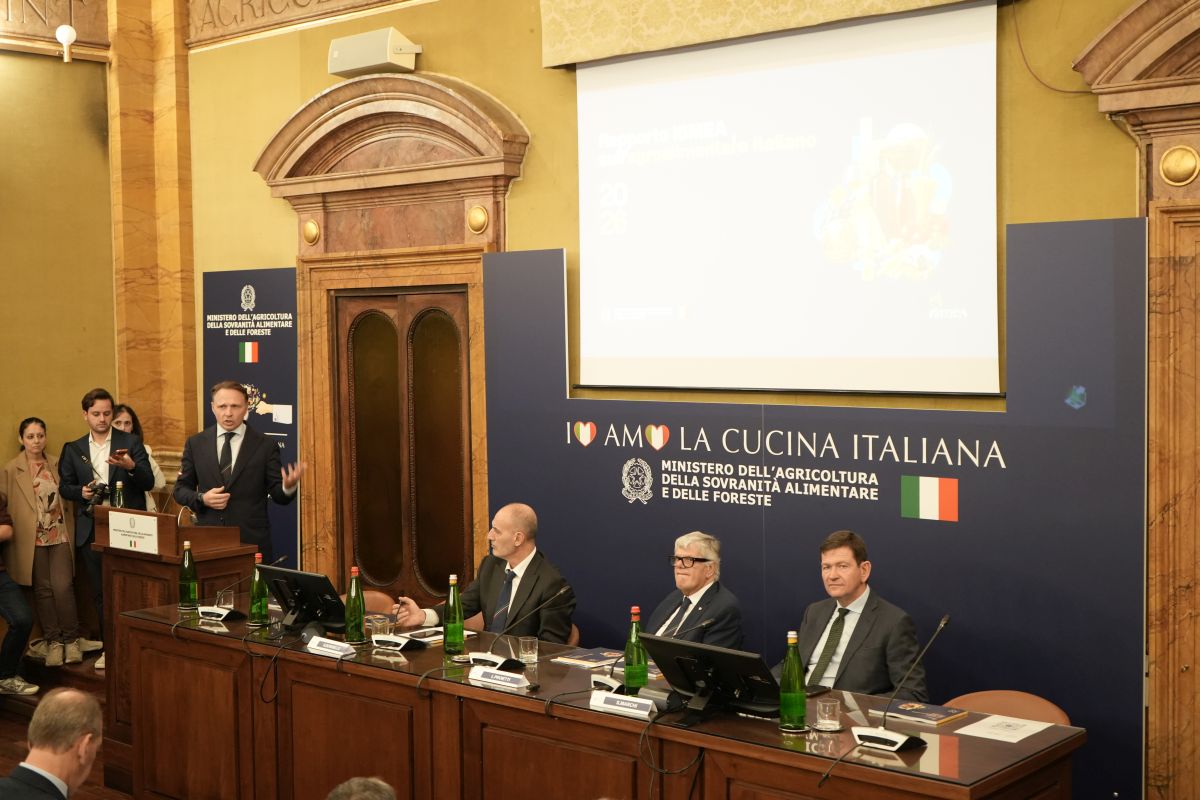
This is the picture that emerges from the ISMEA Report on Italian agribusiness 2026, presented today in Rome, at the Ministry of Agriculture, Food Sovereignty and Forests, in the presence of Minister Francesco Lollobrigida and the leaders of the main agricultural organizations and the world of cooperation.
Based on Istat data updated in September, in 2025 the added value of Italian agribusiness, considering agriculture and food industry, reached 89 billion euros, equal to 4.4% of GDP, recording a real growth (+1.2%) more than double compared to that of the national economy (+0.5%). A dynamic supported by both the industrial component (+1.5%) and the agricultural forestry and fisheries sector (+0.8%), which once again testifies the great qualities of resilience of the system and the ability to generate value even in complex economic conditions, marked by the instability of markets and climate change.
The weight of food on the Italian economy is even more significant considering the entire supply chain. According to a well-established assessment, it reaches about 8% of GDP including distribution and catering and reaches 15% if you also consider logistics, transport and intermediation. Italy also confirms its European agricultural added value leadership, with over 43 billion euros and a 16.9% share on the total of the European Union. The food industry also strengthens its position, placing third place in Europe with 41.5 billion added value and maintaining absolute primacy positions in strategic sectors such as pasta and wine.
Positive signs also come from employment, investment and agricultural income. Agriculture workers exceed one million, while those in the food industry reach 500 thousand, both growing compared to 2024. Agricultural investments rose to €13.1 billion, an increase of 5.1% compared to 2024, confirming a propensity to invest higher than the average of the national economy. In the period 2016-2024, the last available range for comparison Eurostat, the growth of Italian agricultural investments was 18.8%, compared with 4.3% of the European average. Positive also the trend of agricultural income per unit of work, which in 2025 grew in Italy by 6.6% compared to the previous year. By widening the comparison to the last five years Italian growth reaches 50.8%, more than double compared to the EU average (+21.4%).
A strong stimulus to national production continues to come from international markets. In 2025 exports reached the new record of 72.5 billion euros, up 5% compared to 2024. A result that consolidates a path of structural expansion that in the last decade has seen the growth of agri-food exports to an average annual rate of 7.3%, higher than that of the total domestic exports, bringing 9% to 11% the weight of agri-food on the total sales abroad of Italy. On the internal market, the total food expenditure of Italian families, including consumption outside the house, reached in 2025 the 305 billion euros, with an increase of 3.2%. A dynamic sustained not only by the prices, but also by a recovery of the volumes purchased and by an increasing demand for the quality and health of the productions.
“The data of the Report confirms the solidity of the Italian agribusiness and its ability to continue to generate wealth, employment and investments also in a particularly complex international context – jointly declare President ISMEA Livio Proietti and General Manager Sergio Marchi – The most significant figure is that we are not only faced with an increase in economic results, but also of the fundamentals of the sector: increased investments, increased employment and improved. This adds the ability of our companies to consolidate their presence on international markets, where agribusiness continues to gain weight compared to other sectors of the economy. These results testify to the competitiveness of the system, thanks also to the large investments put in the field by the Government, but which recall the need to continue to strengthen the organization of the supply chains and the ability to distribute the value generated more and more equally, to benefit above all the agricultural component”.
To strengthen the competitive capacity of the Italian agribusiness and to accompany its structural transformation has contributed a particularly incisive framework of public policies. Over the past three years, the Meloni Government has mobilized more than € 17.5 billion in support of the primary sector, aimed at promoting investments, technological innovation, sustainability, generational replacement and strengthening of production chains. A central role was played by the remodelling of the PNRR, which led the resources allocated to the primary sector from 3.6 to 8.8 billion euros, exceeding 10 billion also considering the National Complementary Plan. Among the most significant interventions are the Parco Agrisolare, with a budget of approximately 3.2 billion euros and the Contratto di Filiera Rotative Fund, the PNRR measure implemented by ISMEA on behalf of the MASAF, to which the Report dedicates a specific deepening. At 30 June 2026, 221 are the supply contracts eligible for financing, for approximately €6.3 billion of investments activated, in the face of 2.9 billion concessions granted, effectively completing all available resources. The programmes involve a total of 3,430 subjects and concern the entire national territory, with particular attention to the Mezzogiorno, which is intended 53.7% of the facilities. The measure is confirmed as an important source for the modernization of the production system: more than 80% of the investments are attributable to environmental sustainability, efficiency in the use of resources and energy transition. Also significant is the contribution to the organic sector, with 65 programmes and around 1.4 billion euros of investments.
The event saw the introductory interventions of Raffaele Borriello, Chief of Cabinet of MASAF, and Livio Proietti, President ISMEA. The presentation of the data of the Report by the Director of ISMEA Sergio Marchi, followed two round tables dedicated to the main challenges of the sector and the role of cooperation, with the participation of the presidents of the four major agricultural organizations: Ettore Prandini (Coldiretti), Massimiliano Giansanti (ConfAgricoltura), Cristiano Fini (CIA-Agricoltori Italiani) and Tommaso Battista (Copagri). Raffaele Drei, President of Confcooperative Agri-Food and Fisheries, Sara Guidelli, Managing Director of Legacoop Agro-Food, and Biagio Pecorino, President of AGCI Agro-Food and Ittico. The event also included the participation of the Minister Francesco Lollobrigida and a deepening of the PNRR by Fabio Del Bravo, ISMEA manager of the Trade and Market Analysis Directorate, and Marco Lupo, Head of the Department of Food Sovereignty of MASAF. He moderated journalist Isabella Ceccarini.
“The data – says the Minister of Agriculture of Food Sovereignty and Forests Francesco Lollobrigida – certify the work we have done in recent years and tell a reverse trend for Italian agriculture compared to the past. For the second consecutive year we are the first agricultural economy in Europe for added value, in front of France and Germany, with 46.6 billion euros. Export reaches 72.5 billion and farmers’ income has grown by 50% since 2020. These are important results, but for us every point of arrival is a new starting point. The Meloni government has chosen to put agriculture back to the centre, supporting a sector that is stronger, more competitive and continues to ensure quality production and environmental protection. We did so in an extremely complex geopolitical framework, managing to maintain Italian agriculture in favorable conditions even compared to most European countries. The fact that the weight of the agricultural economy has grown almost triple compared to the national GDP, confirms that the road taken is the right one”.
For President ISMEA Livio Proietti “with the achievement of the 30th of June of all the targets foreseen by the PNRR, ISMEA has carried out a fundamental phase in the implementation of the Contracts of Filiera, making available to the productive system the entire allocation of resources allocated. The results give the measure of the scope of the intervention: 221 supply contracts, more than 3,400 stakeholders involved, 3,9 billion euros of concessions granted, between lost-funded contributions and facilitated loans, which have activated 6,3 billion investments, with a leverage effect of 1,61. Particularly significant is the result achieved in the Mezzogiorno, to which is destined 53.7% of the benefits, well beyond the minimum quota of 40% previewed from the PNRR. The interventions affect all the Italian regions and a wide range of production chains, with a particularly important presence of the fruit and vegetable and zootechnical sectors, which together represent the 2/3 of the programmes financed. But the scope of the measure will be especially measured in the coming years, when investments will gradually enter into their stage of implementation. The peak is expected in 2027, with an investment volume of 12.7% of the estimated gross agricultural fixed investment and 4.1% of the agricultural added value. A major impetus, intended to support the modernization of the supply chains, efficiency and environmental sustainability well beyond the time horizon of the PNRR”.
– Photo mec/Italpress –
(ITALPRESS).