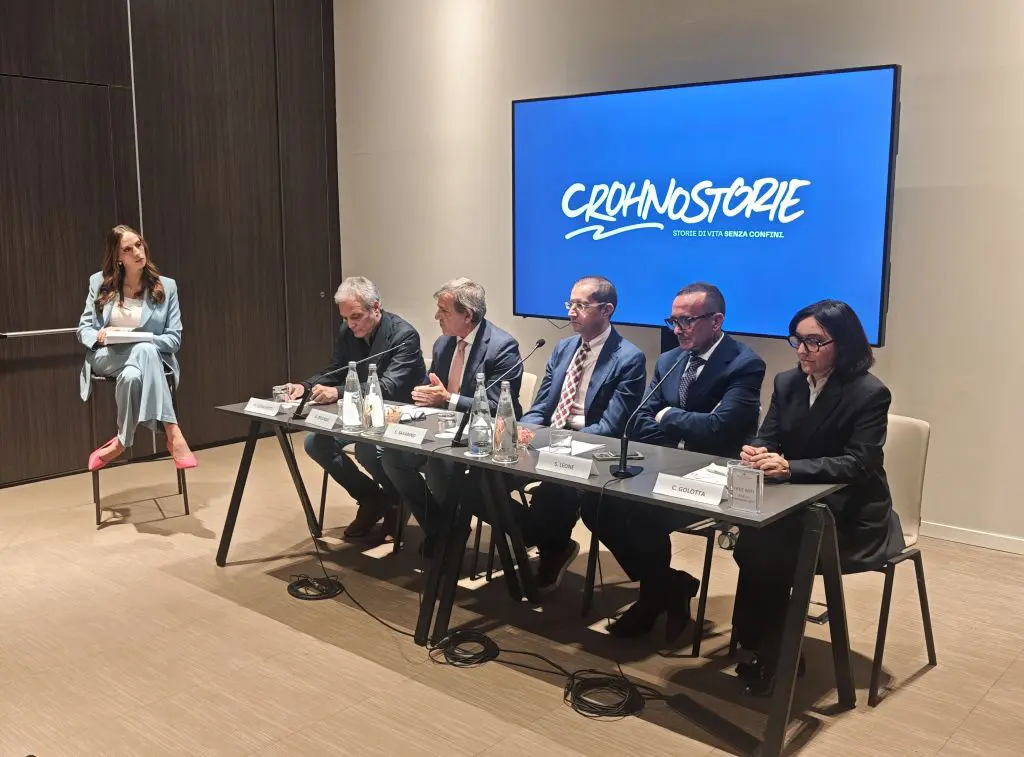
MILAN (ITALPRESS) – The “Crohnostorie – Stories of life without borders”, the campaign promoted by AbbVie, in collaboration with AMICI Italia ETS and IG-IBD, which aims to raise awareness about Crohn’s disease, telling the reality of those who are affected and the impact it has on daily life. Once in the second edition, the campaign focuses on a video spot of about two minutes that returns all the sense of a live experience. The protagonist is a man who lives a simple and intimate moment of everyday life: embraced to his companion on the couch, watch a movie. In the final it moves, not for the film they are watching, but for the joy of having been able to fully experience that moment, without the interruptions of the disease. Starting from this message, the “Crohnostorie” campaign has a dual objective: on the one hand, to increase awareness of public opinion on the daily implications and quality of life of those who live with pathology; on the other, to offer patients informative and educational tools that help them to play an active role in the management of their health. There are about 250,000 people living with chronic intestinal inflammatory diseases (MICI) in our country, of which about 150,000 with Crohn’s disease and 100,000 with ulcerative colitis. It is a condition that can affect any part of the gastrointestinal apparatus and which has a chronic-recidictive pattern, with an alternation of remission and reacutization periods, and which is more frequently diagnosed between 20 and 30 years. Among the most common symptoms are persistent diarrhea, abdominal pain, loss of appetite and weight, which may occur with variable intensity. It is a pathology that causes a disability often invisible, but with a strong impact on the daily life and quality of patients. ‘Crohn’s disease is a chronic inflammation of the intestine that can affect any part of the digestive system, even if it is more frequently located in the last part of the small intestine (ileo) or in the colon, with a symptomatology that often frightens patients and their families. Many people tend to resign themselves to a quality of life altered and compromised by debilitating symptoms – such as abdominal pain, chronic diarrhea, evacuative urgency and chronic fatigue – with heavy repercussions on psychological well-being, social life and work – says Paolo Gionchetti, Professor of Internal Medicine, University of Bologna, SSD Director of Inflammatory Chronic Inflammatory Diseases, Bologna IRCCS In recent years we have witnessed a real revolution in the management of the disease, but it is essential to continue to spread the knowledge of the alarm bells so that patients turn promptly to the gastroenterologò specialist.The symptoms of Crohn’s disease are unpredictable and weigh significantly on the daily life of patients in the physical, emotional and economic profile. This confirms some investigations conducted in Italy and Europe on MICI, according to which about 71 percent of the people involved live with the constant concern for the reacutization of the pathology. 40 per cent was forced to reorganize their professional lives, while 67 per cent is required to check in advance the presence of toilets before participating in an event. To confirm how wide the margin of improvement is still is the data of IBD-PODCAST, observational study promoted by AbbVie in 17 Italian centers and published on Digestive and Liver Disease. According to international criteria STRIDE-II, 53 percent of patients with Crohn’s disease do not achieve optimal control of the disease. Yet only 8.8 percent of patients with MICI consider their disease not againstlate. Non-optimal control also weighs on the job: in patients with uncontrolled disease the loss of productivity reaches 30,5 percent, against 18 percent of those with the disease under control. ‘For those who live with Crohn’s disease, freedom can have the face of a simple thing: go out without looking for a bath, accept an invitation without fear, make a project without thinking first of all that could prevent it – says Salvo Leone, Managing Director AMICI Italia ETS, National Association for Chronic Inflammation Diseases of the intestine -. They are gestures that many give for discount and that, for us, can mean reconquering a piece of one’s life. Pain, tiredness and renunciations are real, even when others do not see them. For this reason, every person must be able to listen and speak to his own gastroenterologist about everything that the disease is taking away from them, even of the most difficult needs to tell. It is also from here that the goals of care are built. As AMICI Italia we work so that each person can find support and access to care, and can return to giving space to their desires. Because behind every diagnosis there is a life that asks to be lived. Advances in scientific research and the introduction of organic drugs have marked an important step in the management of pathology. While remaining a chronic condition, the current therapeutic options allow to go beyond the simple control of symptoms, introducing in clinical practice the concept of remission of disease, as recalls Professor Ambrogio Orlando, Director of UOSD Inflammation Diseases Chronics of the Intestine (MICI) at the Hospitaller Company Reunited Villa Sofia-Cervello, Palermo: ‘When we talk about chronic inflammatory diseases and especially Crohn, it is essential to treat the condition holistically. This is especially true if we think of remission: today the goal is not only the absence of symptoms and healing of the mucosa, which remain fundamental, but a 360-degree concept that focuses on the overall well-being of the patient and the normalization of biological parameters of inflammation. To assess this integrated clinical state, different indicators are combined. Although it is a recent frontier, the use of the latest therapies is already demonstrating the effectiveness of this global approach, allowing us to accurately measure the proportion of patients who reach a complete remission and will last. Of the same opinion Edoardo Vincenzo Savarino, Associate Professor of Gastroenterology at the University of Padua and Secretary General of IG-IBD: ‘In the treatment of MICI we are witnessing a paradigm shift towards a customization of therapies. If in the past there was only one control of symptoms, today the primary objective is the overall management of pathology and the concrete improvement of the quality of life of the patient. This requires strong therapeutic customization: through early diagnostic profiling and the identification of adverse predictive factors, we can define strategies tailored to the clinical and biological profile of each individual. The availability of new therapeutic options and biomarkers’ search for response predictives guide us towards a future where we can not only select the ideal therapy for each patient, but also develop combined approaches to maximize long term benefits. With the campaign “Crohnostorie” AbbVie aims to tell without filters the experiences of those who live with the disease, enhancing a complex everyday life, made of pain, fatigue and embarrassment, but also rich in resilience, adaptation and hope. Through a choral narrative in which each testimony becomes fundamental to increase collective sensitivity, the campaign uses thein collaboration with scientific societies to make a correct information on symptoms. The shared goal is to convey a positive and concrete message: today, a timely and adequate management of pathology allows patients to find a good quality of life. ‘AbbVie has a commitment of more than twenty years in the field of gastroenterology – says Caterina Golotta, Medical Director of AbbVie Italia -. In this path we have developed increasingly effective therapeutic solutions and a high safety profile, with the priority objective of making available to doctors and patients innovative options that can transform the quality of life of people. Italy plays a central role in our research and development activity: we count almost 80 active studies in about 400 centres on the territory, ranging from interventional trials for the development of new molecules to observational studies aimed at creating evidence of value in everyday clinical practice. The IBD-PODCAST study, which we promoted in 17 Italian centers, tells us that there is still a lot to do: about one patient with Crohn’s disease on two does not have an optimal control of the disease and is often not fully aware of it. ‘They are data that push us to do more, along with clinicians and associations. This is why the campaign wants to open up a space of possibilities: to help people recognize the compromises that the disease imposes, to talk to their gastroenterologist and to understand what goals of care are now persecutable in their case. Because returning to live a simple moment, to the end, can be the beginning of a new age, he concludes.
– photo press office AbbVie –(ITALPRESS).