
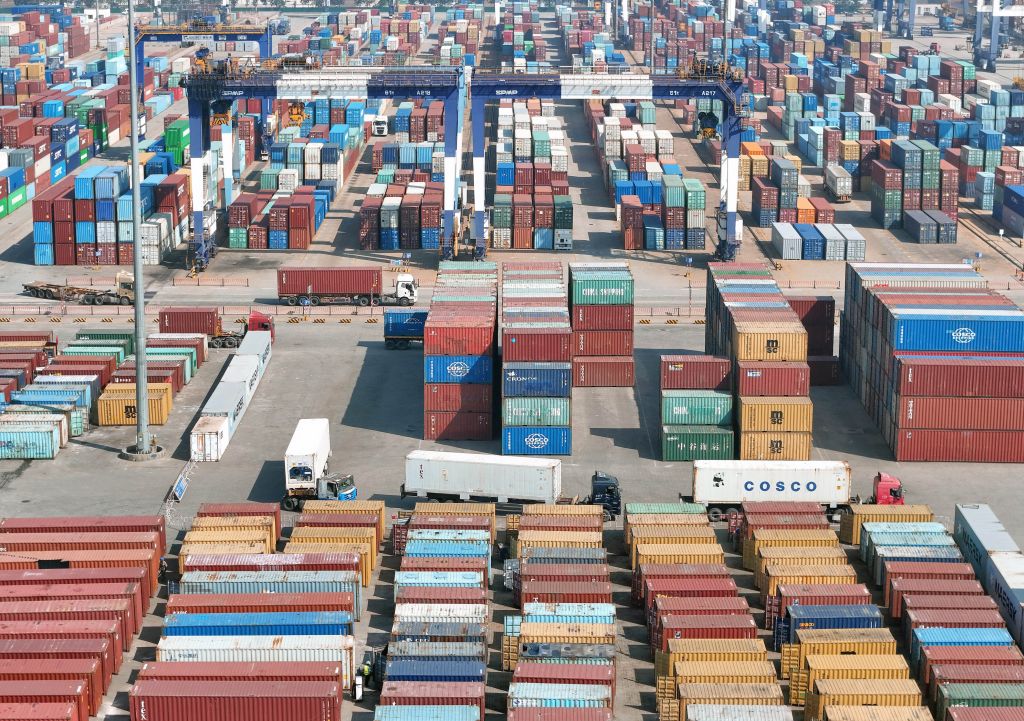
ROMA (ITALPRESS) – There is an “invisible” but vital economy that moves billions and weighs on the Italian GDP: it is the transport and logistics sector, which moves goods and people. According to official statistical channels worth 86 billion, equal to 4.8% of the national GDP. But this is a partial photograph, which is likely to understimate its true strategic weight. The real one, in fact, is 341 billion added value activated in the entire economy, equal to 19% of the national GDP. This is the wealth that Italy would lose without the transport system.
To make clarity about this reality is the study “Relevance of transport and logistics in Italy” of Federporta, in collaboration with the study center of Confindustria, presented today in Rome during the annual assembly. To grasp the real scope of the sector, the study adopts a three-level structure that exceeds the limits of official statistics.
The official statistical perimeter (September H): it records only the transport and logistics services sold on the market to third parties (catalogati, like every economic activity, through the codes Ateco, 49-53), pairs to 86 billion (4.8% of GDP). The expanded industrial system: it integrates the logistics in its own account managed internally by the enterprises, the carburetors, the maintenance of the means, the rental, the infrastructure and the organization of the trips for the only share attributable to the transport and the logistics reaching a direct value of 184 billion (10.3% of the GDP). The impact on the economy: by applying the method of hypothetical extraction to the input-output tables, it assesses the dependence of the whole country on the system, measuring the wealth that Italy would lose without the system of transport, pairs precisely to 341 billion (19% of GDP) between direct, indirect and induced effects.
In this context, it is shown that logistics, with 202 billion, equal to 59% of the overall impact, cannot therefore be placed at the end of the production process: it is the main component of the economic impact activated by the system and must be recognized as leverage of industrial policy. Another important point: the analysis has calculated the impact that the supply chain has on the labour market and the result is that the employment volume is 19.5% of the total national employment. Altogether 4,67 million FTE employees (4,672 thousand units of work equivalent full-time), calculated by adding direct, indirect and induced effects.
For Paolo Colombo, president of the Federportation, “these are important numbers that impose a change of perspective: the mobility of people and the mobility of goods can no longer be considered ancillary activity or a simple cost to compress, but a leverage of industrial policy and the competitiveness of the Country”.
– Photo Ipa Agency –
(ITALPRESS).