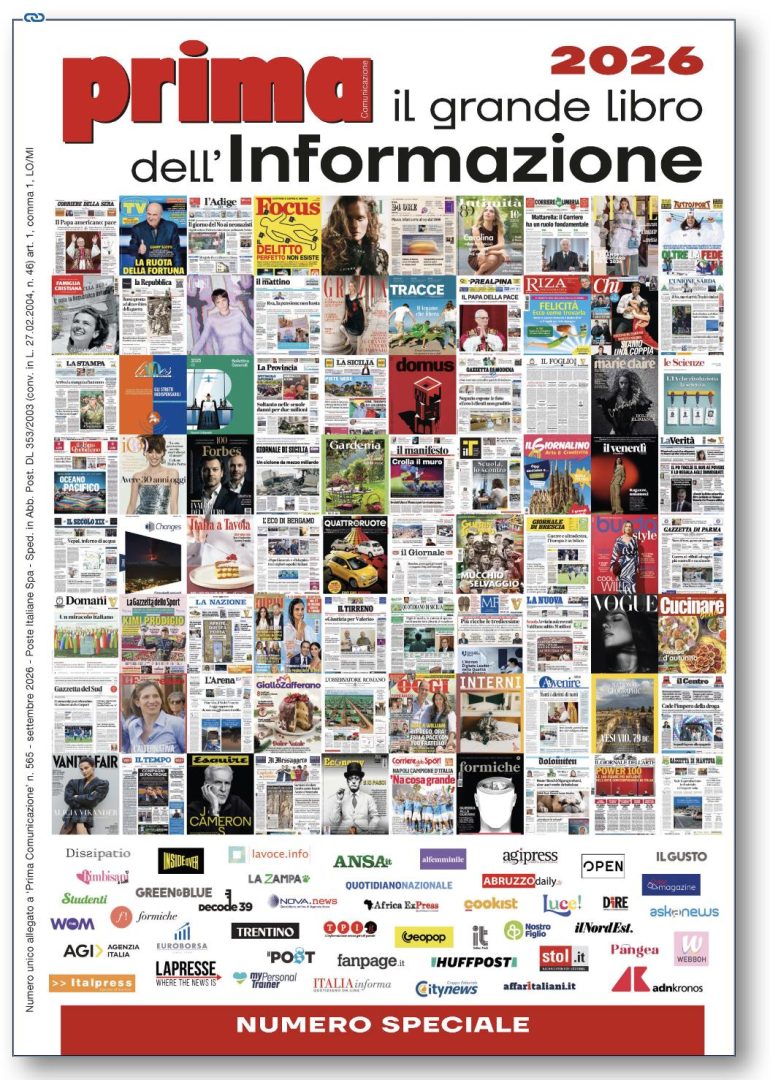
ROMA (ITALPRESS) – 332 pages, 270 papers and online, 147 portraits of directors, 127 publishers, 66 dealers, 1.078 names. These are the numbers of the Great Book of Information 2026 that tells the protagonists, the properties, the publications and the settings of Italian information.
The volume, annexed to the September-October number of First Communication, dedicates 107 pages to the newspapers, giving total 126 publications, of which 19 through synthetic cards with essential data; 28 pages per week, with 46 heads, of which 18 in synthetic cards; 45 pages per month, with 98 publications, including 53 in synthetic cards.
A census that allows you to read not only the history of newspapers, who directs them, but who owns them, who collects advertising and how organizations, strategies and business models are changing.
The 2026 edition comes in fact in one of the phases of greater structural transformation and owner of the Italian publishing. At the fall of paper copies, revenues and traditional advertising investments, publishers are responding with a new dynamism: integration between digital cards and platforms, increasing use of data and development of membership and community, organization of great events capable of creating new opportunities for meeting with readers, companies and investors.
In a phase marked by geopolitical tensions and the global battle for information control, publishing thus shows its nature as a strategic infrastructure for the economy, politics and society.
The Great Book tells the new resiko of the properties: from the arrival in Catania of the Italian-American entrepreneur Salvatore Palella, that in 2025 has found La Sicilia, to the strong acceleration of 2026, with the passage, in March, of Republic and of the Group GEDI from Exor of John Elkann to Antenna Group of Theodore Kyriakou, followed by the acquisition of the Press from the SAE Group and the moves of Leonardo Maria Del Vecchio.
Operations that do not represent simple change of shareholders, but open new industrial and editorial strategies.
Meanwhile, some of the great Italian information institutions rediscover and enhance their history. Corriere della Sera, Il Sole 24 Ore and Il Messaggero celebrate important anniversaries with events, exhibitions, initiatives and specials: the historical heritage of the publications also becomes an instrument of relationship with the public and of building the identity of the brand.
But perhaps the most interesting signal is the attempt of publishing to get out of a long defensive season.
“In recent years publishers have remained in defense, focused only on reducing copies and increasing costs. Today we must change step, go to the attack and build a new business model”, is the stance of Gabriele Benedetto, CEO of QN Media, expressed at the TEHA Forum in Cernobbio, commenting on the Position Paper ‘Valore Sistema Editoria: a new industrial agenda for the Italian information system in support of competitiveness, cohesion and democratic quality of the country’.
The counter-attack publishing with new weapons: data and artificial intelligence, offer customization, subscriptions and memberships, events, videos and above all direct control of the relationship with readers, to reduce dependence on the algorithms of large international platforms.
And there are not only great newspapers. The Great Book of Information 2026 records a strong vitality even in the periodical world: numerous publications have been presented on the market after important restylings, historical brands seek new publics, publishers experience courageous turns to sites, social networks and new digital languages.
A complex panorama, lively, moving and anything but resigned. The Great Book of Information 2026 photographed him through his protagonists: 370 tested, 180 portraits of directors, 127 publishers and 1,0778 names to understand who he does, who directs, who owns and where Italian information is going.
-Photos First Communication
(ITALPRESS).