by Stefano Vaccara
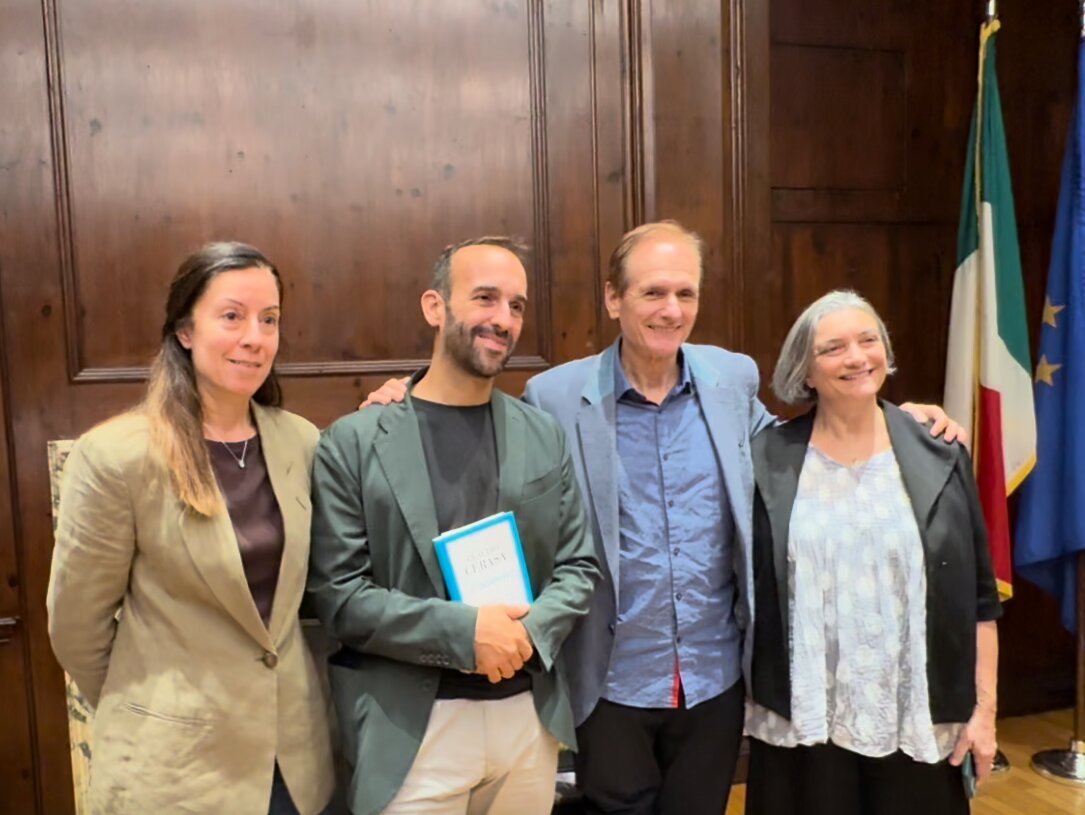
NEW YORK (UNITED STATES) (ITALPRESS) – An antidote to the “lagna culture” and the belief that the world is inevitably destined to go worse. Claudio Cerasa, director of Il Foglio, presented at the Italian Institute of Culture in New York, directed by Claudio Pagliara, his latest book “The Antidote. Freedom, environment, technology. Optimistic Manifesto against the dictatorship of catastrophe, published by Silvio Berlusconi Editore. “It is a fist to the culture of the wood, to the idea that the world is destined to go ever worse and that there are no solutions in front of complex problems,” Cerasa explained in Italpress. “Pessimists look for scapegoats, optimists seek solutions.”.
In the debate with Pagliara and with a thick and attentive public – among which a very careful and prodigal of questions Ambassador Giorgio Marrapodi, permanent representative of Italy to the UN – the director of the Foglio tried above all to explain the reasons for his optimism. Not a naive optimism or a way, but what could be defined as a “data optimism”: numbers and statistics on Italy and Europe that, according to Cerasa, often tell a reality very different from the dominant perception and offer reasons to look to the future with greater confidence. It is precisely the contrast between perception and reality one of the guiding threads of the book.
Optimism also on artificial intelligence. “AI is neither good nor bad. It’s like electricity, it can be used well or badly,” Cerasa said, recalling that underestimating its dangers would be a mistake, but adding that “the most serious risk is not risking, staying back, not experimenting”. Cerasa also told the Foglio experiment, which publishes a weekly insert made entirely with artificial intelligence: a workshop that, he explained, allows to touch with hand limits and defects of technology, but also to discover its potential and advantages in journalistic work.
More complex is the speech on America. Cerasa admits to knowing it less than Europe and distinguishes above all between short and long periods. In the short term the concern prevails for a country led by a policy that, in its reading, leverages fear. In the long run the optimist returns: “America remains an incredible democracy, remains the most vital country in the world” and through political competition, he says, he will be able to produce alternatives. Even the disorder caused by the trumpian politics, according to Cerasa, can generate antibodies. In Europe, he observed, even the dexts are looking for autonomous roads compared to the Trump model. In short, for the director of the Foglio being optimistic does not mean to ignore wars, crisis and fears. It means trying to measure them with facts. And above all seek solutions instead of just telling the catastrophe.
– photo xo9/Italpress –
(ITALPRESS).