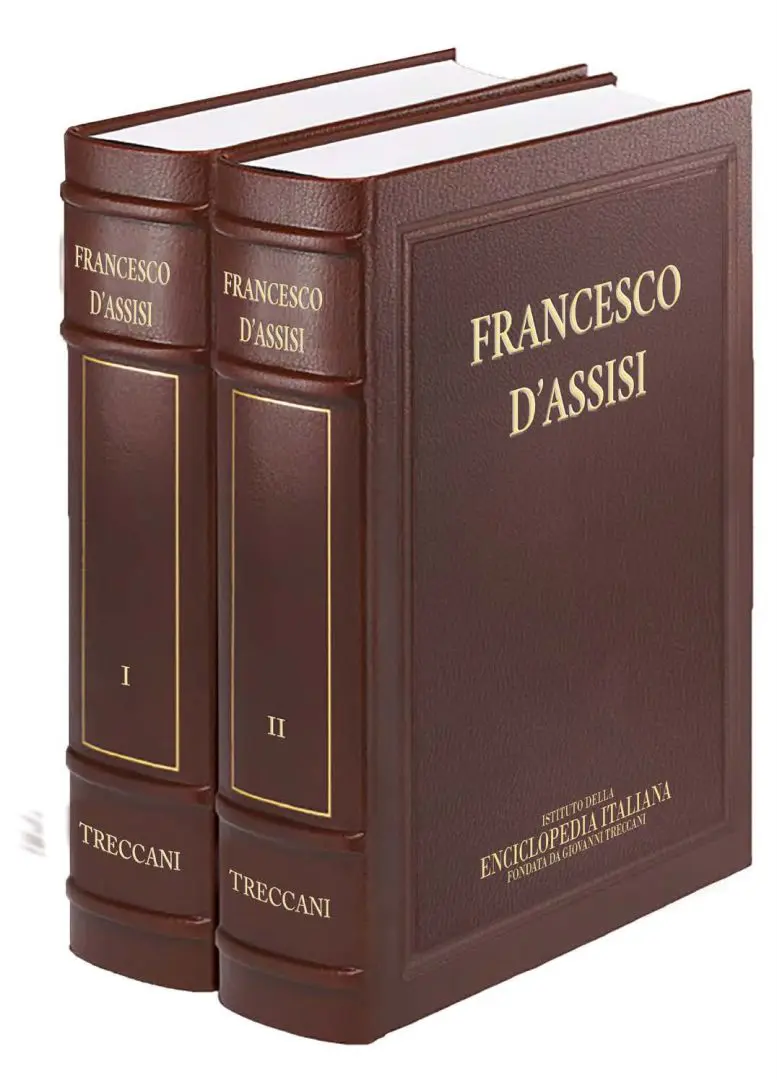
ROMA (ITALPRESS) – In the year of the eighth centenary of the transit of Saint Francis of Assisi (1226-2026), the Institute of Italian Encyclopedia Treccani presents the Franciscan Encyclopedia, a rigorous and up-to-date reconstruction of Francis, his message and extraordinary legacy in the contemporary world, in two volumes of over 1400 pages. Accompanying the work the reproduction in facsimile of the manuscript Antonianum 1, which preserves the Legend of Bonaventura da Bagnoregio, recognized as an official biography since the 13th century. Published on the occasion of the anniversary of the death of Francis of Assisi (1226) and in view of the anniversary of his canonization (1228), the Franciscan Encyclopedia is directed by Attilio Bartoli Langeli, Sofia Boesch Gajano, Luciano Canfora, Isabelle Heullant-Donat, Alberto Melloni, André Vauchez and Gabriella Zarri, with the scientific coordination of Nunzio Bianchi and Filippo scholars The work returns the portrait of a ‘Francis plural’ and is configured as a complete instrument of thought on the Saint and his spiritual and cultural heritage.
The figure of Francis is investigated, through more than 400 alphabetical dilemmas, along the extraordinary trajectory of his inheritance from the 13th century to the present day and is illustrated through the formation and development of Franciscanism as a historical and institutional phenomenon: from the initial fraternitas to the birth of the Order of Friars Minor and the progressive articulation of the different Franciscan families (Conventuals, Observants, Capuchins); This is how the image of Francis of Assisi is reconstructed by the complex evolution of a movement that has profoundly engraved in the history of Europe and the world. Particular attention is paid to the sources, starting from the Scritti di Francesco, up to the accumulation of the Franciscan bio-agiographies during the Middle Ages, from the first official Legends (Tommaso da Celano, Bonaventura da Bagnoregio) to the various three-fourth century compilations and devotional collections such as the Fioretti, up to the modern biographies. The work also follows the literary and cultural fortune of Francis, from Dante Alighieri to the contemporary age, including emblematic examples of narrative and symbolic reception of the Franciscan model, such as the Fra Cristoforo dei Promessi Spoi, a figure that translates into a modern and romance the themes of conversion, penance and evangelical justice.
In constant dialogue with this historical and institutional reconstruction, the Encyclopedia also explores the presence of Francis in the cinematographic context: from the first silent films, such as Enrico Guazzoni’s The Poorle of Assisi (1911) to the great interpretations of the Second World War, including Francesco Giullare di Dio (1950) by Roberto Rossellini, Uccellacci and Birds (1966) by Pier Paolo Pasolini or Brother Sun, sister luna (1972) by Franco Zeffirelli. The music has also been affected by the figure of Francesco, which already appeared in 1964 with the homonymous song played by Rita Pavone, to re-affiorate later in songs by Eros Ramazzotti (Canti, 1990), Angelo Branduardi (the album L’infinitamente piccola, 2000), Mango (Francesco, 2004), by Baustelle (San Francesco, 2010), up to more recent readings like that of Jovanotti, who in 2014 Complete the work the rich and original iconographic kit, which, articulated in about 200 non-text tables divided into thematic sections, documents the variety of the modes and techniques of representation of the figure of the Saint, as well as the materials and supports used – from wood to paper, from stone to gold and silver of the coins – and is an integral part of the Storiographic speech.
The attention to the sources and the Franciscan iconographic tradition, which is one of the central elements of the Franciscan Encyclopedia, finds a further expression in the realization, by the Treccani Institute, of the facsimile that reproduces the manuscript Antonianum 1, preserved at the Library of the Pontifical University Antonianum of Rome, a miscellaneous code of exceptional value whose first part contains the Legend of Bonaventure by Bagnore
The facsimile – embellished by 86 miniatures depicting the episodes of St. Francis’ life and constitute one of the most complete iconographic cycles dedicated to him – is accompanied by a volume of Commentary that collects the essays of the greatest experts in this matter, from the codicological analysis of Attilio Bartoli Langeli to the careful reading of the miniatures of Chiara Frugoni, with an introduction of Daniele Solvi. Made of 1,499 numbered specimens, the facsimile is housed in a wooden case, whose graphic design stands out for the use of Franciscus, the first digital font of the Church, born in 2021 by a typographic research project signed by Studiogusto ” on commission of the General Custody of the Sacred Convent of San Francesco in Assisi. The character draws inspiration from the medieval manuscripts of the Library of the Sacred Convent and the Ancient Municipal Fund and in particular, from the Chartula, the parchment written by St. Francis for Brother Leo.
– photo press office Treccani –
(ITALPRESS).