ROMA (ITALPRESS) – Electricity in Italy more expensive than the main EU countries up to almost 70 euro/MWh, in September the price of gas on the European market TTF recorded an increase of 161.2% compared to September 2025. For trade, tourism and catering more than a billion euros of more costs in the second half and in 2027 would be lost approximately 6.5 billion euros of consumption. These are the main data from an analysis of the energy price dynamics created by Confcommercio in collaboration with the CER and the estimates of the Confcommercio Study Office on the effects of high energy on inflation, consumption and growth.
Italy pays electricity much more than the main European countries and the new shock on the international energy markets is likely to further expand this gap with heavy effects on the household and business bills and on the economy of our country. In September 2026, in fact, the PUN, that is the wholesale price of electricity, has come to mark an increase of 73.3% on the average value of 2025, a particularly high increase that overlaps with a situation of great criticality pre-gress (the current prices are in fact higher than 271.1% to those pre-Covid).
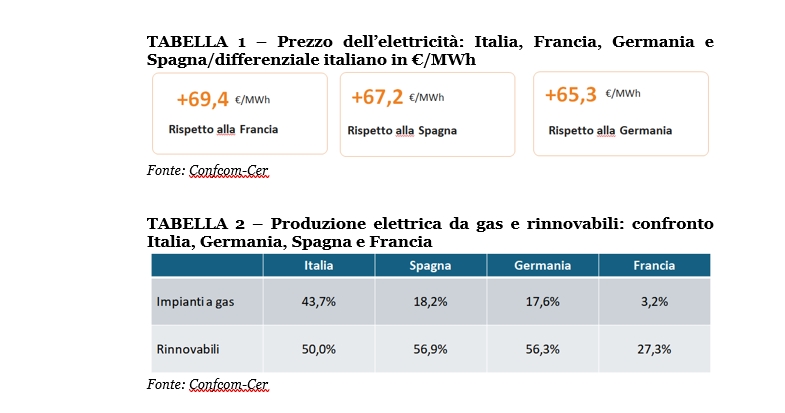
The greatest cost also concerns the other large European countries, but in no case the increases have reached the intensity recorded in Italy where the price of electricity is now higher than 65.3 euros per MWh than Germany, 67.2 euros compared to Spain and 69.4 euros compared to France. A real “energy spread”, which has expanded after the Russian-Ukrainian crisis and which today comes to the forefront with the new surge of international quotations.
In September, the price of gas on the European market TTF recorded an increase of 161.2% compared to September 2025, while oil marked an increase of 55.7% from the beginning of 2026 and a +62.6% compared to a year ago. But dear energy is likely to present an even wider account to the Italian economy. In the most unfavourable energy scenario, with the Brent stably at 140 dollars in 2027, inflation would increase by 0.7 percentage points, while they would lose half point of consumption, 250 euros of real consumption per family, altogether, to approximately 6.5 billion euros, and three tenths of GDP, reporting the country’s growth to the “zero virgola”. For businesses in trade, tourism and catering, the amount of cost in the second half is over a billion euros.
The main reason for the Italian disadvantage – always according to the Confcom-CER analysis – lies in the energy mix and, in particular, in the greater dependence on gas. In 2025, 43.7% of Italian electricity was generated by gas-powered plants, against 18.2% of Spain, 17.6% of Germany and just 3.2% of France. This means that when the European gas price increases, electricity costs grow in Italy more than in other countries. In other words, the shock is equal to all, but its effects are asymmetric: the greater dependence on gas makes Italy more exposed to the fluctuations of international markets and determines higher costs for families and businesses. Also on the front of renewables, Italy is facing a gap: from these sources of energy now comes 50% of Italian electricity, but the share remains less than 56.9% of Spain and 56.3% of Germany.
To this structural weakness is added the European mechanism of formation of the price of electricity, also linked to the cost of the plant necessary to meet the demand that, in Italy, is frequently fed to gas. For this reason, even when it increases production from renewable sources, the electricity price continues to suffer from gas quotations. Finally, the price gap with other countries also affects taxes and charges. In fact, despite their weight on the Italian bill, at the end of 2025, is lower than that of the main European partners, between 2021 and 2025 this component has increased in Italy of 33.9%, while in Spain and Germany has even decreased, respectively of 11.7% and 22.6%. This means that about a third of the increase in the final price of energy recorded in Italy is due to the growth of charges and taxes, thus helping to further expand the gap with other countries.
The impact of the rise in the price of energy – Confcom-CER concludes – is particularly heavy for businesses in commerce, tourism and catering, which during the summer had to increase electricity consumption even for the greater use of air conditioning. In the third trimester of this year the consumption is estimated to increase by 15% compared to the spring quarter and, due to the combined effect of greater consumption and higher prices, in the second half of 2026, for these enterprises is estimated a total cost aggressiveness for electricity bills greater than one billion euros: 494 million for shops, 207 million for restaurants, 164 million for hotels, 111 million for bars and 50 million for GDO. The overall energy expenditure of the companies of the sector could thus reach up to 2.9 billion euros on a quarterly basis, returning to the levels reached only with the energy crisis of 2022 caused by the outbreak of the Russian-Ukrainian conflict.
“The worsening of the international situation and the continued increase in energy costs are putting businesses in serious difficulty and reducing the confidence of families – says Confcommercio’s president Carlo Sangalli – It must be avoided that these increases are completely discarded on bills, with immediate measures and structural interventions, starting from tax incentives for energy efficiency and further intervention on system charges. At the same time, it is necessary to accelerate on renewables and the development of sustainable nuclear energy, reduce dependence on gas, strengthen networks and storage systems and reform the energy price training mechanism. It is also important to promote the diffusion of energy purchase contracts in an aggregate form, in order to guarantee advantageous and stable prices in the long term.” “But we must act immediately, otherwise we will meet a new inflationary season that will drastically reduce the consumption and growth of the country,” he concludes.
– photos taken by Confcom study –
(ITALPRESS).