A novel can win a prize in Italy and remain unknown in the United States. In order to arrive in American bookstores, you must find a publisher willing to buy rights, invest in translation and promote it to a public who has never heard of the author in the vast majority of cases. The recognition obtained in Italy can help to make it read to those who decide what to publish, but also to convince readers to buy it is a passage for nothing discounted.
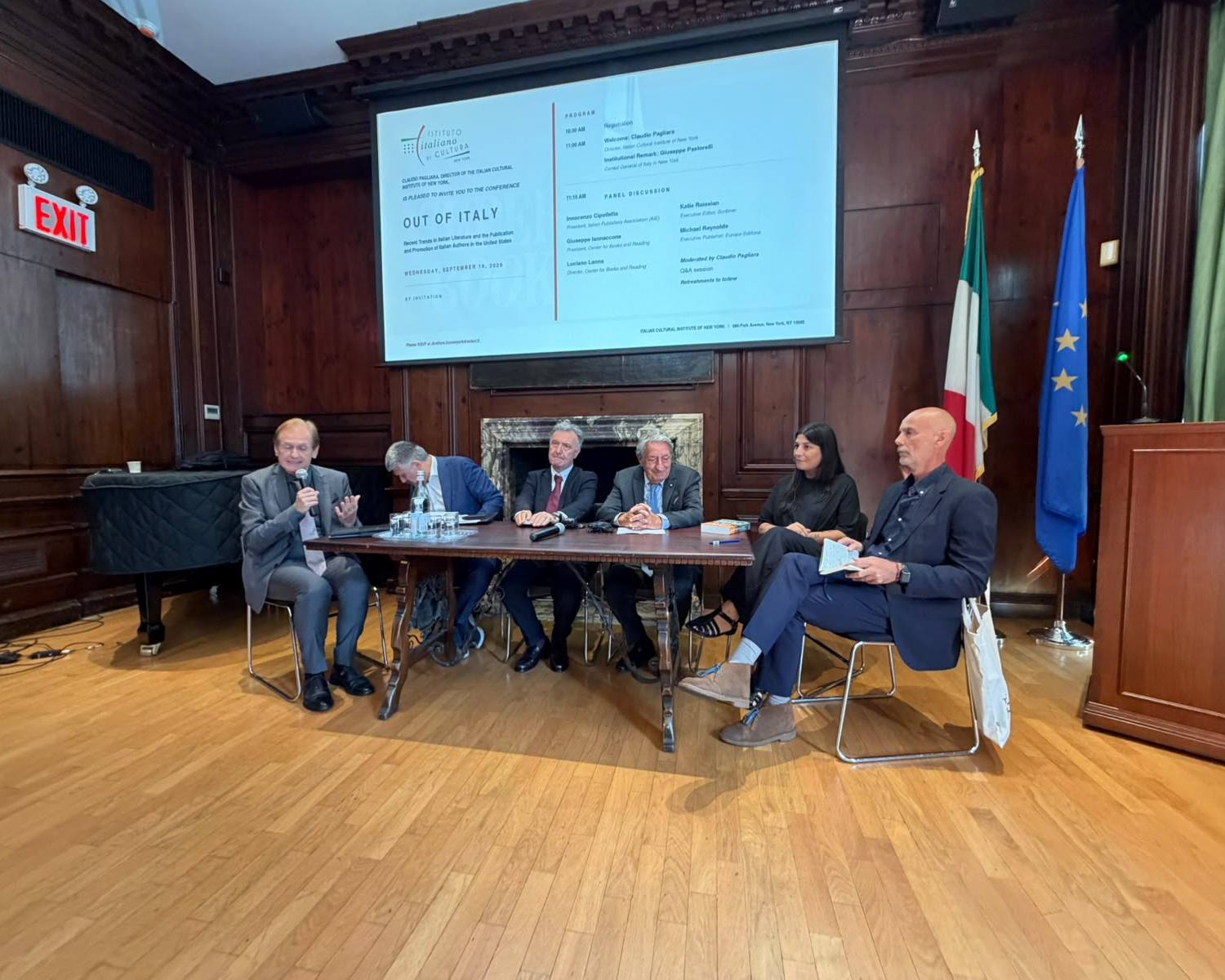
On September 16 at the Italian Institute of Culture in New York, during Out of Italy, a meeting dedicated to the publication and promotion of Italian authors in the United States. In comparison, moderated by the director of the Istituto Claudio Pagliara, Innocenzo Cipolletta, president of the Italian Association Editori, Giuseppe Iannaccone and Luciano Lanna, president and director of the Center for Book and Reading, together with editors Michael Reynolds and Katie Raissian.
The meeting took place on the day of SuperBook’s award, the prize created by the Institute to promote the circulation of Italian literature in the United States and that puts in place $10,000 for translation into English and promotion of the winning book. Anna Mallamo came to the final with the dark I see her and Wanda Marasco with Behind this World.
In discussions on American publishing there is often a percentage: 3 percent, that is, the share of books published in the United States that would be translations from other languages. It is a historical estimate, which has become known as Three Percent, the project of the University of Rochester, born in 2007 to introduce international literature. The figure concerns the set of translated books, including those outside the narrative, although it is not an updated survey of the market nor, of course, the quota reserved to Italian authors. He doesn’t say how many copies sell those books.
This is why Reynolds, from Europa Editions, insisted: increasing the number of translations is not enough, if the published titles do not find an audience. The problem also concerns what happens after the purchase of rights: how a novel is presented, who reviews it, what booksellers recommend it and how long the publisher continues to support it.
The best known case is Elena Ferrante, published in English by Europa Editions. Reynolds, however, invited not to treat his success as a repeatable formula. Looking for another Ferrante means taking an exceptional result as a reference for books that can have very different features, readers and commercial possibilities. A novel can find its own place even without becoming an international phenomenon.
Cipolletta faced the issue on the side of Italian publishers, recalling the imbalance between the presence of American books in Italy and that of Italian books in the United States. His request is to strengthen the cultural initiatives that help the authors make themselves known. The dimensions of the Italian publishing industry, moreover, do not guarantee alone the ability to reach other markets: according to an AIE card published in July, in 2024 the sector was worth 3,23 billion euros of sales.
But what convinces an American publisher to choose a book? Katie Raissian, executive editor of Scribner, brand of the Simon & Schuster group, indicated as a starting point the involvement in the reading. In order to support an unfamiliar author, those who acquire it must be quite convinced of the text to be able to convey that interest also to others: first within the publishing house, then to those who will have to sell it and tell it.
This also serves comp titles, comparison titles used to present a new editorial proposal. Accostating an Italian novel to books already known in the United States allows to explain more quickly to which readers might interest, for the genre, tone or themes. The comparison offers a reference to who has to evaluate the book; it does not ensure that it will get the same commercial results.
Another point of the debate was the work of translators. For an American reader, the voice of an Italian writer passes through the choices of those who translate it: the rhythm of phrases, dialogues, regional expressions, ambiguities. An understandable version can however lose the irony of a passage or make a language uniform that in the original changes depending on the characters.
It is on these choices that also focused discussion on artificial intelligence. Reynolds expressed a position contrary to the replacement of the literary translator with automatic instruments. The raised point concerns the ability to interpret the text, in addition to transferring its meaning: to understand, for example, when a phrase sounds deliberately strange and when correcting it would mean to erase a decision of the author.
L’articolo For Italian literature America is only the beginning proviene da IlNewyorkese.