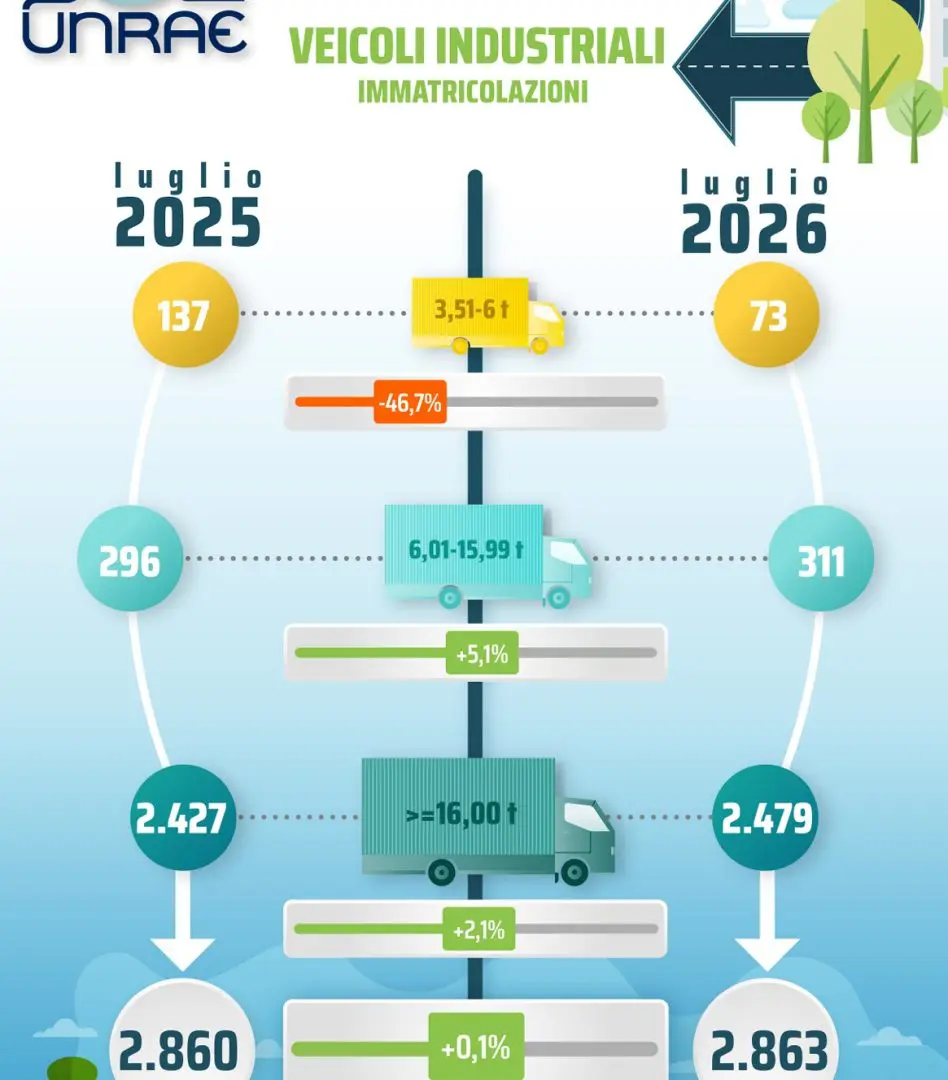
ROMA (ITALPRESS) – In July 2026 the industrial vehicle market with a total mass of more than 3.5 t is maintained substantially stable, with 2.863 registrations compared to 2.860 of July 2025 (+0.1%). In marked bending the light vehicles from 3.51 to 6 t, which descend from 137 to 73 units (-46.7%). On the other hand, the means from 6,01 to 15,99 t, which pass from 296 to 311 units (+5.1%).
Mass heavy vehicles of up to 16 tonnes increase by 2.1%, with 2.479 registrations against 2.427 of 2025. Within the segment, the tanks record a contraction of 11.3%, from 1.071 to 950 units, while road tractors grow by 12.8%, from 1.356 to 1.529 units. In August 2026 the market recorded 1,263 registrations, down by 2.5% compared to 1.296 of the same month of 2025.
The decrease in light vehicles from 3.51 to 6 t, from 64 to 36 units (-43.8%), while the vehicles from 6.01 to 15.99 t fall from 162 to 145 units (-10.5%). In a slight increase the mass vehicles of 16 t or more, with 1.082 registrations against 1.070 of the previous year (+1.1%). In the segment, both wagons rise, from 509 to 517 units (+1.6%), and road tractors, from 561 to 565 units (+0.7%). In the first eight months of 2026, the market reached 19,200 registrations, up 3,0% compared to 18,642 of 2025.
“The market braking in the summer months shows that certainties are needed to invest in fleet renewal. Almost a year after the allocation of resources, we ask that the Multiannual Fund for the road haulage becomes operational as soon as possible. Time is required for access to incentives and contributions, with simple procedures for all companies. The actual availability of support would allow companies to translate investment programs into orders of new vehicles”, says Giovanni Dattoli, President of the Industrial Vehicles Section of UNRAE. “Investments in industrial vehicles engage companies for many years and require equally lasting support policies. Structural and continuous measures, with predictable rules, allow enterprises to evaluate financing solutions and the economic return of the purchase and to plan the replacement of the means according to their operational requirements,” continues Dattoli.
“To this perspective, Italy must be fully adapted to European legislation. The implementation of the Eurovignette Directive, through tolls tailored to CO2 emissions, can recognize the environmental benefit of the most virtuous vehicles even in the costs of their use. Incentives and road pricing must therefore operate consistently, making these means more convenient throughout the entire operating life and favoring more balanced competition conditions for Italian companies in the single market,” concludes Dattoli.
– Unrae-
(ITALPRESS).