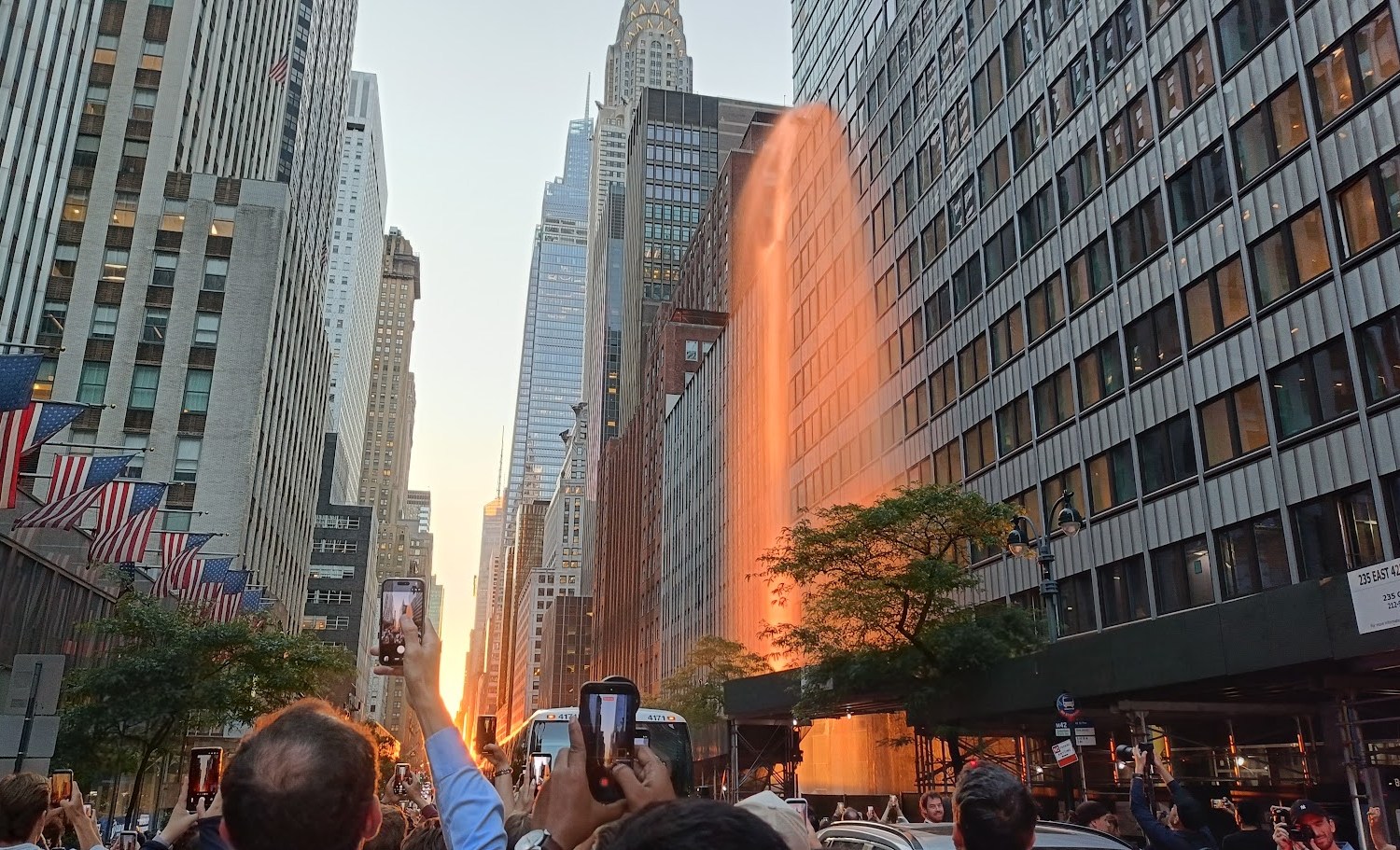
There is an exact moment when the steel architecture of New York ceases to be rigid matter to make pure optical poetry. It happens when the sun’s disk slips towards the Hudson River and the sunset’s fire orange sticks like a clear blade in the perfect lattice of the 42nd Street. Sometimes, then the magic of Manhattanhenge gives an unexpected prodigy: on the right of the road, the nebulized water of an architectural fountain intercepted the flow of solar rays, transforming the concrete canyon into a liquid prism. A waterfall of golden light and orange pulviscle crossed that transparent filter, vaporizing in the air and enveloping the thousands of people with smartphones raised in an almost suspended atmosphere, where the rigour of skyscrapers dissolved for an instant in a rain of warm and unpredictable sparks.
It happened around eight o’clock in the evening of 28 May, that strange and magical moment in which New York stops running and begins to look. It only happens four times a year, but the first date of the season always keeps a special electric charge. On May 28, between the 42nd Avenue canyon and the First Avenue, a stone’s throw from the United Nations Palace, the contemporary version of a pagan rite as ancient as humanity, but trapped in the most famous concrete jungle in the world: Manhattanhenge.
The name, coined by astrophysicist Neil deGrasse Tyson, unites Manhattan to Stonehenge, the English Neolithic site where the sun aligns between monoliths during solstices. In New York the monoliths are the skyscrapers and the perfect road lattice (The Grid), designed in 1811 with an east-west orientation rotated about 29 degrees compared to the geographical north. On May 28, cosmic watchmaking and human architecture were framed at the millimeter: the sun at sunset was placed exactly in the centre of the carriageway, kissing the horizon beyond the Hudson River and flooding the city of a radiant, warm, almost liquid light.
Living this phenomenon from the road, in the midst of the crowd, is an anthropological experience before it is visual. Already from seven o’clock in the afternoon, the intersection between 42st and 1st Avenue was literally assaulted. On the one hand the professionals of the image – photographers with huge machines, heavy cavalry and long teleobjectives like cannons – perched on the stairs of the Tudor City overpass; on the other a human tide of tourists, curious and New Yorkers armed with mobile phones, all hunting the perfect frame to feed the social algorithm.
Because today Manhattanhenge is, first of all, an immense viral phenomenon. On Instagram and TikTok the hashtag bounces from days, transforming an astronomical event into a digital must-have, a visual trophy to show to the world. When the solar disk began to descend, the crowd broke the indugi literally invading the street lanes, incurring traffic. The famous blue MTA buses were surrounded by a wall of backlit screens.
At that point the second inevitable rite of the event took place: the sirens of the NYPD police. The agents, with whistle blows and speakers, have struggled not little to remove the crowd from the center of the asphalt, in the desperate attempt to restart the circulation before the next traffic light, in a continuous iron arm between the reasons of the viability and those of the aesthetics.
Yet, in the midst of that digital frenzy and the sound of clacsons, New York always knows how to reveal its stubborn search for beauty. On May 28, the visual miracle came not only from the sky, but from a lateral detail, almost casual.
On the right of the road, from the top of a modern building, someone began to pump water in the street. Those sprays, projected towards the sky and vaporized by the wind rising from the river, crossed the exact trajectory of the sun rays. In a few seconds, the drops suspended in the air turned into a reflective prism, capturing the fire orange of the sky and projecting it all around as a rain of golden sparks. The photographers turned the goals, the phones changed angle: at that precise moment, Manhattan’s rigid geometry gave way to pure poetry.
New York is not a city designed for grace: it is a vertical gear of concrete, steel, smoke rising from the tombs and sirens explained that they tear the night. Yet, between the asphalt of the Grid and the underground straw of the subways, there is a visceral obsession: the stubborn and almost desperate search for sublime beauty.
A fierce aesthetic that is not revealed in dusty monuments, but in the vertigo of everyday life. It is in the corner of clear light that at eight o’clock in the evening the canyons of Quinta Avenue, transforming the glass of skyscrapers into golden cathedrals. It is in the sudden contrast between the frenetic disorder of Midtown and the solemn silence of the tree-lined avenues of Central Park or in the suspended profile of the Brooklyn Bridge that makes the fog on the East River.
In Manhattan beauty is an act of resistance. It follows on industrial roofs transformed into gardens, water details of fountains that capture the colors of the sunset, or in the face of the human tide that populates the sidewalks of Greenwich Village. New York challenges you to find it in its chaos, remembering at every intersection that the purest charm always arises where the imposing work of man meets the unpredictable poetry of heaven.
When the sun completely disappeared behind the skyscrapers of New Jersey, on the 42nd Street a spontaneous applause, liberating. You look in the eyes, you have placed your smartphones in your pockets and the crowd has dissolved, returning the road to the buses and taxis. New York is back running, but with the awareness, once again, of walking in a picture.
The article The Magic of Manhattanhenge in the crowd of the 42nd Road comes from IlNewyorkese.