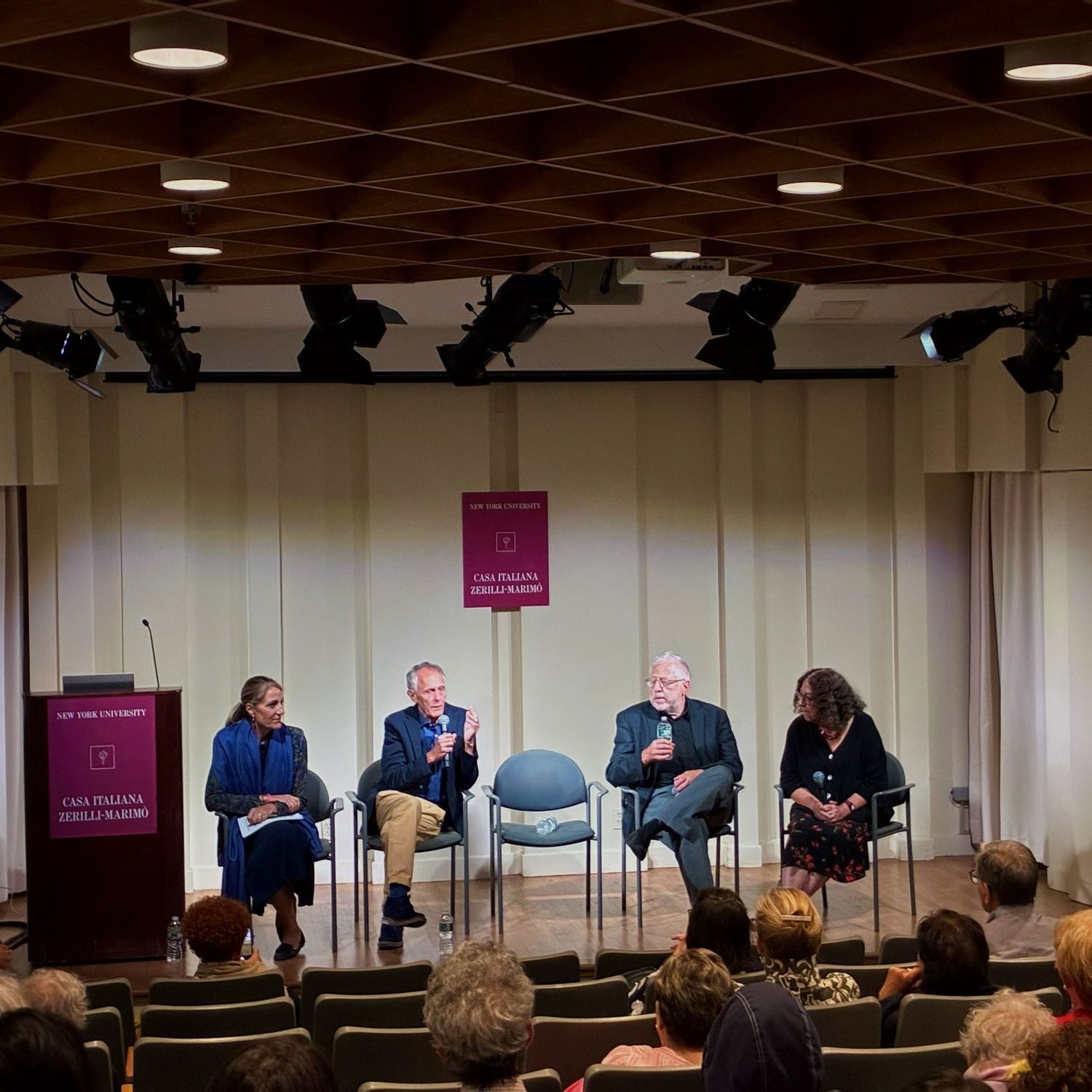
On 9 September, at the Casa Italiana Zerilli Marimò of New York University, the panel “The Many Lives of Pinocchio”, the central moment of “The Carlo Collodi Legacy – New York”, second part of the project Spotlight: Italy on Screen Today New York, conceived and directed artistically by Loredana Commonara. The exhibition arrives after the path dedicated to the Oscar campaign, which between November and December 2025 had brought in New York the support to La Grazia di Paolo Sorrentino, with Toni Servillo, Familia di Francesco Costabile and Sotto le clouds of Gianfranco Rosi. This second stage celebrates the bicentenary of the birth of Carlo Collodi, with the support of the Directorate General Cinema and Audiovisual of the Ministry of Culture, the Consulate General of Italy in New York and the Casa Italiana Zerilli-Marimò, in collaboration with SullaLuna NYC Bookstore. Vanessa Roghi, historian and Tiro at Segno Visiting Fellow in Italian American Studies at NYU, moderated the 9th September meeting. Larry Wolff, Julius Silver Professor of European History, Perri Klass, pediatrician and journalism teacher, David Forgacs, Zerilli Marimò Professor of Contemporary Italian Studies, and Silvia Giulia Ghia, Councillor for Culture, Educational and Youth Policies and the Sport of the 1st City of Rome, each with a different cut on the same basic question: what made Pinocchio capable of remaining half a century.
In the afternoon, he intertwined distant perspectives. Pinocchio spoke of himself as a nineteenth-century project for the construction of the national identity, with the school as a place where Italian children were “made”, and of the 1940 Pinocchio Disney readjustment as a story of Americanization for the children of Italian immigrants in the United States. It also spoke of childhood mortality in the nineteenth century, when up to 40% of children did not reach the five years of life, reading the “biology” of the puppet, his hunger, his ability to heal quickly, as a cultural response to that very real fear. And it has reconstructed the visual evolution of the character, from the first nineteenth century illustrations to the costumes that return identical in postcards, figurines and American theatrical adaptations, including a 1938 Broadway show that would directly influence the Disney film.
To close the panel, with a more personal intervention, was Silvia Giulia Ghia. His speech started from a question that seems obvious and is not at all: “What does Pinocchio look like? ”
“It may seem like an obvious question,” Ghia said. “We all know what Pinocchio looks like. Or at least, we think we know. But if we close our eyes and try to imagine it, each of us will probably see a different Pinocchio. ” It is from this observation that Ghia built the heart of his intervention: “Pinocchio has no definitive iconography. ” Unlike many other great figures of the visual tradition, which once fixed become almost impossible to replace, Pinocchio “ seems to ask each generation to redesign it again”. And it is perhaps this visual instability, he said, to have allowed him to travel so well through different eras, languages and cultures.
From there, Ghia retraced the stages of that journey: from the first illustrations by Enrico Mazzanti in 1883, when “Pinocchio acquires a body” for the first time, up to Chiostri, Mussino, Jacovitti, Mattotti, and finally to the Pinocchio “very different” designed by Disney in 1940, more childish, more reassuring, rereaded through an American cultural sensibility. He then compared the two most recent film versions, that of Luigi Comencini, “profoundly rooted in the landscape, in the faces, in the Italian popular culture”, the first Pinocchio met by many Italians of his generation, and that of Matteo Garrone, who “go back to the matter”, to wood, to the earth, to the fabrics, returning a world in which we constantly perceive the physicality of things.
The most ambitious passage of the speech concerned the question about who really belongs an image capable of becoming universal. Ghia has distinguished between two forms of cultural heritage: the material one, which can be preserved in a museum, and the one made of “images, stories and collective imagination”. Pinocchio, he said, belongs to this second type of inheritance, and for this reason can be considered “an extraordinary example of cultural diplomacy”, like Dante, Leonardo or Caravaggio: a way for Italy to travel around the world without passing only from museums.
But it is in the final part of his intervention that Ghia brought the speech closer to the listener. He spoke of the children of today as of the generation “perhaps more connected than history, yet extraordinarily alone”, exposed soon to addictions, social pressure, digital isolation, to the constant comparison with the lives of others, and to the illusion that everything must arrive quickly and effortlessly. Families under pressure, schools that struggle to keep up: in this scenario, said Ghia, Pinocchio returns surprisingly current, because he too “is constantly attracted by the shortcuts”, believes to those who promise him a easier way, escapes from responsibility, mistakes, trusts the wrong people. “But Pinocchio is not a story about failure,” he said. “It’s a story about the possibility to start over. ” Perhaps, he added, this is precisely the lesson that we can still offer to the youngest: that there are no real shortcuts to become what we are, that freedom also entails responsibility, and that growing requires effort, mistakes, courage, relationships, and above all the ability to start again.
Ghia ended up returning to the question she left. What does Pinocchio look like? The one designed by Mazzanti? Mussino? Disney, Comencini, Garrone? “Maybe none of them,” he said. “Because Pinocchio doesn’t have one face. Every generation feels the need to give it a new one. “ Pinocchio, after almost one hundred and forty years, is still becoming a real child. And we’re still there watching him try.
L’articolo In New York, an afternoon inside the thousand lives of Pinocchio comes from IlNewyorkese.