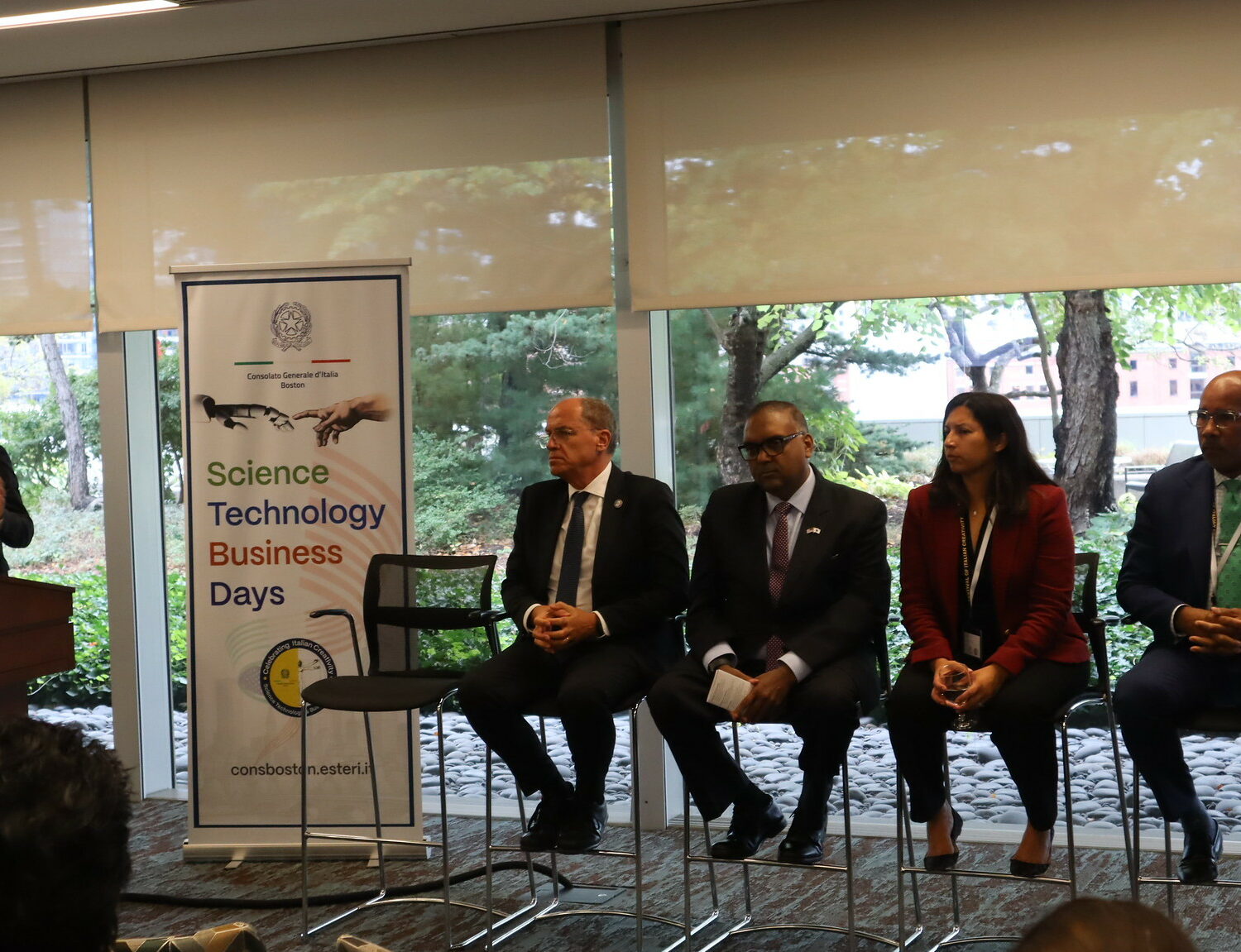
AI and work are not in conflict. This is the message that emerged strongly from the panel “How AI will frame our future”, organized by the Consulate General of Italy in Boston in collaboration with the community Alumni Bocconi. The event was part of the STB Days 2026, the Days of Science, Technology and Business, now a fixed appointment of the Consulate which, for the third consecutive year, brought together from 14 to 16 April the protagonists of the transatlantic ecosystem in a laboratory of ideas and projects with the aim to generate a concrete and lasting impact in the global panorama of innovation. As recalled by the Consul General Arnaldo Minuti in the opening, it was a particularly rich moment of reflection, which allowed to best celebrate the Made in Italy Day 2026.
The panel has seen experts from consulting companies, companies, banks and professional studies on the main trends of artificial intelligence and its evolution in society and the business world. And precisely from this comparison emerges a less alarming and more structured reading of the change in place.
“Since we have the AI, everyone in my team has received a promotion. » Pietro Schena, senior manager of digital intelligence and automation at Mass General Brigham, one of the most advanced hospitals in the world, tears a laugh at the audience. Then, however, it leaves room for reflection: artificial intelligence is not eliminating roles, it is redefining them. Every professional today runs agents, forms them, supervises them. In other words, he becomes manager.
This is the guiding thread of the meeting that brought together five profiles from engineering, health, pharmaceutical, law and space. A cross-border confrontation to understand how AI is transforming organizations, who defines the boundaries and why Italy risks staying back, not only for technological, but cultural reasons. “The correct question is not what the AI does, but what problem we want to solve”. He said Francesco Signoretti, engineering lead of HubSpot in Cambridge, who immediately questioned the dominant approach. SMEs, he explains, do not seek complex technologies, but integrated and immediate tools. The true node is not innovation itself, but the quality of data and their accessibility.
Antonio Corghi, co-founder of BIP for Tech, goes beyond: “Companies try to get AI into existing processes. It’s like using a hammer on something that’s not a nail.” The error, according to him, is structural. The AI should not be adapted to processes, but must become the starting point to rethink them. The model is divided into three pillars: governance, crowd and lab. Governance is the responsibility of the corporate summit. The crowd is the ability of all employees — not only technicians — to use and experiment technology. The lab is the new IT department: no longer a rigid regulatory office, but something more similar to a university research center, which experiments, mistakes, learns.
“Companies try to get AI into existing processes. As if they were using a hammer on something that is not a nail»
— ANTONIO CORGHI, BIP FOR TECH
If Corghi takes care of how organizations adopt AI, Francesca Sacchi takes care of who decides the rules of the game. Specialist in pharmaceutical policy and governance of AI, co-author of the book «Is AI the Perfect Doctor?», sits in the board of directors of the Texas Society of AI in Medicine and has been a parliamentary advisor on AI in Italy. It has a rare point of view: it knows the legislative mechanisms from within, both in Europe and in the United States, and sees them with the eyes of those who must then apply those mechanisms to the biopharmaceutical sector.
His analysis of the transatlantic gap is surgical. In Europe, the GDPR and national regulations guarantee very high privacy protections – but at the cost of a fragmentation that makes it difficult to move data between countries and between sectors. In the United States, the system is different: the federal framework (HIPAA for health, executive presidential orders for AI) leaves much room for specialized agencies, with less democratic accountability but more speed of technical adaptation.
“There is no better system: it is a choice of priorities,” he said. But the real emerging node is the sovereignty of data. Countries are progressively limiting access to their citizens’ information, creating an unequal ecosystem so there will be areas of the world with huge amounts of data and others where even the best researchers will not be able to access it.
“We are writing the rules while we are already playing the game. And every country is doing it in its own way.”
— FRANCESCA SACCHI, SANOFI
Signoretti introduces a crucial distinction: training data and operational data. The first escapes control of companies; the second, those used by AI agents in daily activities, represent the real competitive terrain.
In the hospital context, the impact of AI is already tangible. Schena, coming directly from work, tells concrete cases: automations that manage complex administrative activities, such as medical license control, drastically reducing manual labor. But the most significant data is not about productivity, but well-being. Internal studies show that the use of AI for note-taking did not revolutionize time, but significantly reduced the burnout of doctors. “Sometimes the greatest benefit is not what we expect.” However, there remains a cultural resistance: distrust towards the “black boxes”. In health care, more than elsewhere, a result is not enough. We need to understand the decision-making process.
Paolo Gaudenzi, Scientific Councillor of the Italian Consulate in Boston, intervenes in the panel debate once as a panelist and not as an organizer and moderator of the STB Days, in which he promoted the panel on AI and large organizations. Gaudenzi brings something different: not a case of use, not a metric, but a way of thinking. The AI, he says, cannot be applied without a deep understanding of organizational complexity.
“How much I have understood in these months in Boston, attending MIT scientists and entrepreneurs, is a way to better understand the concept and operativity of AI, a term sometimes pronounced with too much genericity, with the reality of processes and organizations, with the comparison between AI and society. How does it actually happen? And the answer I gave is this: you have to understand the complexity before you unpack it.” The parallel to the space sector is illuminating. A space system with astronauts on board consists of hardware (physical parts) and software (digital processes) but also includes people, processes, resources, rules, objectives.
It is a set of parts that as a whole fulfil the objectives of the mission, e.g. to get the astronauts in front of the hidden side of the Moon and to get them back healthy and safe. It is a system whose complexity is understood only if one proceeds to break it hierarchically, to understand where each part contributes to the whole, at different levels of complexity and aggregation. The space system is made of a launcher, a shuttle, a land system to communicate and, at a later level of decomposition the shuttle is made by the astronauts and the service module and so on decomponing… . The parts alone do not fulfill the goal of the mission but the system is, with all its processes of operations that can also be decomposed in processes via more elementary. Understanding this complexity is the precondition to decide where AI can replace human in operations and where not.
“The same logic applies to a company, for a ministry, for any complex organization. First you must have the global vision of the system. Then you can break down the complexity. Only then can you understand where AI agents can take the place of humans – and where that choice could benefit or cost expensive, paradoxically, in terms of inefficiency or undesired results». It is an invitation to apply the systemic thinking of space engineers to earthly organizations. And, he adds with irony, “an Italian ministry could also be more complicated than a spatial system”.
The concept of digital twin, often perceived as futuristic, is already reality. Weather forecasts, powered by satellite data, are concrete examples of digital twins. And their development will be central to the future of global welfare.
“First you must have the global vision of the system. Then you can unpack it. Only then do you understand where AI agents can replace humans — and where that choice could benefit or cost you dearly»
— PAOLO GAUDENZI, GENERAL CONSOLATO D’ITALIA AT BOSTON.
On the future of the work, the panel converges on one point: it is not a question of substitution, but of evolution. Technical skills remain important, but are no longer sufficient. We need judgment, priority and delegation.
Francesco Signoretti is the optimist declared: “I don’t think engineering works are disappearing. I think they’re changing. What matters is not only technical capacity, but taste, care, ability to prioritize. The best engineers I see are not the ones who can better implement a task: they are the ones who know what to do next. And those who know how to delegate the rest.”.
Francesca Sacchi describes how she uses AI in her daily policy work: before a meeting with a public interlocutor, she asks AI to simulate that point of view, to ask her difficult questions, to find her argumentative weaknesses. “Who uses AI only for boring tasks is losing the best. Those who use it to work better will always be a step forward”.
Antonio Corghi identifies two priorities for the next twelve months: organizational agility – the ability to adapt to a speed of change that no one had foreseen – and hybrid critical thinking. “We need people with blended background: technology, business and, yes, also humanities. Pure engineers tend not to be creative. I have seen colleagues with different formations do things with AI that I would never have imagined”.
Pietro Schena summarizes effectively: “Management skills will become even more important. Managing an AI agent is like having a brilliant but distracted collaborator, who needs precise context, supervision and, above all, someone who does the final reality check. The AI is not wrong as we are wrong – but wrong in ways that we do not expect”.
The final question comes from the public, formulated by Carlo, alumnus Bocconi that moderates the Q&A session: what is the true bottleneck that prevents Italy from developing AI to its potential?
For Corghi, they are the resources, but also the culture. He tells that he proposed the same hackathon in Italy that he had organized in Boston, where C-level professionals and university students had worked side by side, exchanging ideas without hierarchy. “In Italy, my colleagues were afraid to propose this. Fear that CEOs didn’t want to get into play, make mistakes in front of someone less senior. That’s what blocks us, not technology.”.
For Sacchi, it is the excess of regulation, or better, the wrong type of regulation. “In Italy we are very good at doing laws. But sometimes the law becomes an end in itself, not an instrument. We are among the countries with the regulations on access to the most restrictive data in Europe. This slows down research, stops innovation. And there is also a linguistic problem: in English we say venture capital – adventure, risk, excitement. In Italian we say risk capital. The word risk is already in the definition. It is a cultural signal, not only semantic”.
For Signoretti, the picture is not only negative: Italy already has quality samples in AI, startups that know the local market and know how to navigate the normative complexity. “We must not build founding models from scratch, no Italian startup can afford it. But we can build excellent application layers, understand Italian usage cases better than anyone else, and do it better».
Pietro Schena offers the most original key. In a world where large models converge towards similar solutions – Claude, OpenAI, open source – the advantage is no longer in the model, but in the problem you choose to solve.
And maybe, right there, Italy still has something to say.
L’articolo AI and work, the true revolution is the invisible promotion proviene da IlNewyorkese.