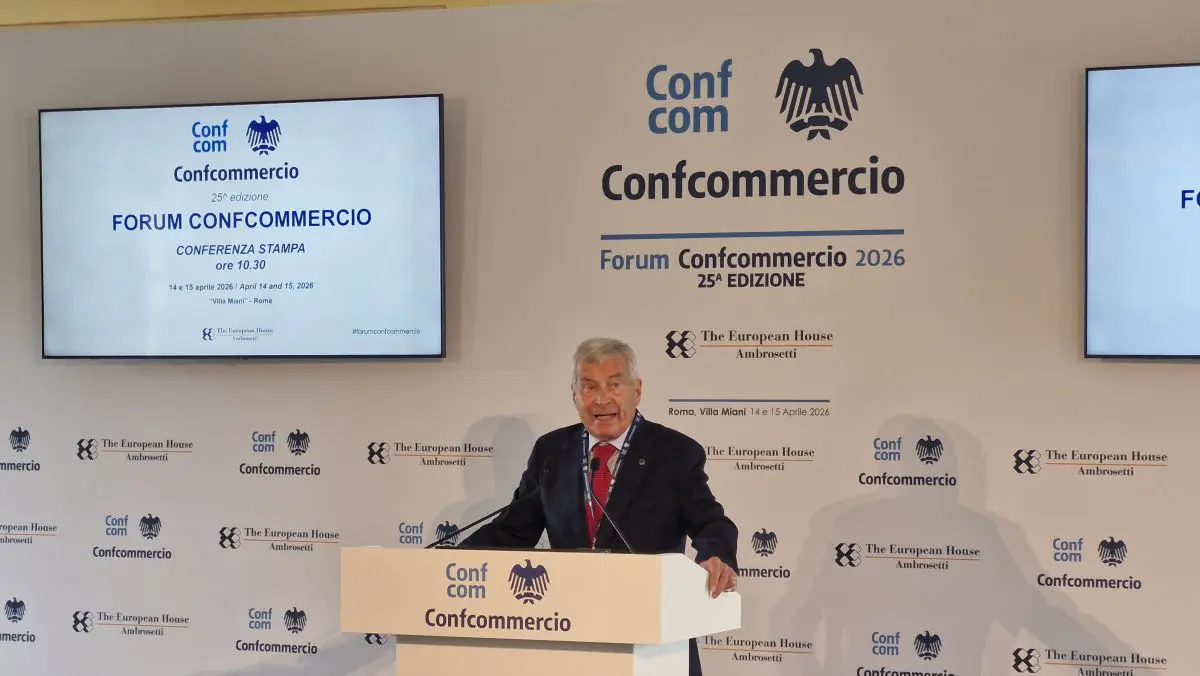
ROMA (ITALPRESS) – On the economic plan, the Italian economy showed “positive signs” before the conflict, with an inflation contained at 1.5%, consumption and GDP in growth and employment at peaks (from July 2024 always above 24 million in employment), but the energy tensions linked to war risk “reducing disposable income and consumption”. This is what emerges from the analysis of the Confcommercio Study Office “The Growth Bet to Overcome the Crisis”, illustrated at the opening of the Confcommercio Forum at Villa Miani. President Carlo Sangalli stressed that “international tensions fuel uncertainty, stop demand and strike above all the companies most tied to the territory and the consumption of families. And when consumption stops, the very heart of our economy stops. There is a need for a new capacity for reaction.”.
Growth estimates, “in the worsening scenario, are just +0.3% for 2026 and +0.4% for 2027”. The overall picture remains marked by a “substantial uncertainty” and “strong concern”: without structural interventions on fisco, work, skills and quality of bargaining, the risk is that of “a new decade of stagnation”, with “permanent effects” on growth, employment and social cohesion. For the Director of the Study Office, Mariano Bella, “with the worsening scenario – and with the price of oil to 100 dollars until February 2027, inflation to December 2026 would reach 6%”. This “empty to say less consumption and less GDP: it would go on the horse of the recession”, with “a growth more than halved than the base scenario, a third compared to the hypothesis without war”. In the most negative scenario, in the two-year period 2026-2027, the estimated loss would come “up to 963 euros per family”, with effects on growth and employment. The slowdown in Italy’s growth, however, is not attributable to international shocks, but to internal structural factors present for decades. After the economic boom, the study highlights, “growth has progressively collapsed”: from +.7% of the period 1966-1980 to 1.8% between 1981 and 2007, to zero of the last twenty years, while the fiscal pressure rose from 25.3% to 42.2%, compressing investments and development. In particular, according to Confcommercio, the “fiscocracy” (i.e. the excess of taxes and bureaucracy which reduces the growth horizon) “thinks innovation and limits the propensity to entrepreneurial risk”. This sums up “three structural factors: less capital per employee, contraction of job offer and reduction of skills”. On the demographic front, the country continued its analysis, lost about 9 million young people under 30 compared to the 1980s, with “direct effects on production capacity”. The main lever to counter the decline is the increase in female participation in work: for Confcommercio, “an alignment to European levels would allow approximately 290 thousand more occupied per year for the next decade”. Alongside the quantity, “it weighs more and more the quality of work”: skills grow less than business demand and professional obsolescence reduces productivity and the ability to adapt the economic system. The market tertiary “confirmed the true engine of the Italian economy”: between 1995 and 2025 created almost 4 million jobs, in the face of a decline in industry and public administration. But this system “is weakened by internal distortions such as contractual dumping”: in the tertiary about 154 thousand workers are involved in less protective contracts, “with losses up to 8 thousand euros per year, absence of welfare and negative effects on competition and productivity”. The phenomenon also generates “an impact on public finance”, with a lower contribution and tax revenue of “about 560 million in 2025”. Moreover, for the companies involved, the phenomenon of dumping alters “the quality of the competitive environment”, while for companies with less protection contracts, implies “a sub-investment in training and skills, lower productivity and profitability and the risk of closing”.
– photo xi2/Italpress –
(ITALPRESS).