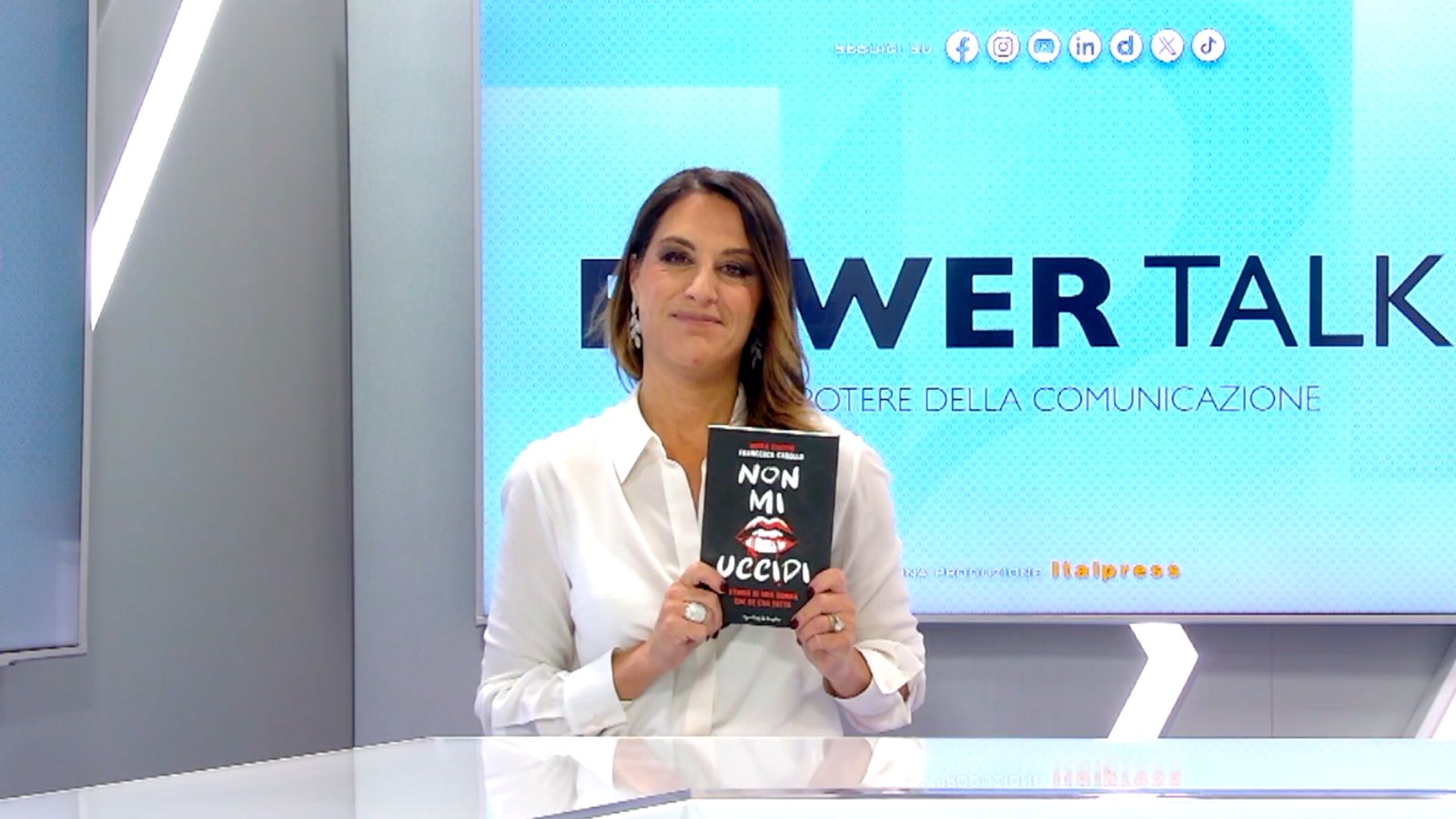
ROMA (ITALPRESS) – Words can tell a story, but they can also change their destiny and become instruments of awareness, listening and rebirth. In the twenty-nine episode of “Power Talks, the power of communication”, editorial format born from the collaboration between Italpress and Philia Associates, Jessica Nicolini interviews Francesca Carollo, journalist, writer and president of the association Wall of Dolls, to address a theme that concerns the whole society: violence on women and the responsibility of those who choose to tell it.
A comparison that takes on a particular meaning in the month leading to 25 November, International Day for the Elimination of Violence against Women, but which recalls a necessary commitment every day of the year. From his experience in the chronicle, Francesca has gained a precise conviction: the way we tell violence can help to counter it or, on the contrary, to make it even more difficult to recognize and denounce. But communication can also become a rebirth tool. “For me everything starts from my work in the chronicle, from the many cases I have followed, from the so much evil that I have absorbed,” says Francesca Carollo, author of the book “Don’t kill me: story of a woman who has made it”. From there the choice of “find and transform into positive”, telling and helping the victims through Wall of Dolls, the onlus founded by Jo Squillo.
In the middle there is the value of words: “The words we use in telling so many stories and in approaching women have a burden.” Many victims, when they denounce, feel they say by law enforcement: “Vabbè, ma’am, maybe her husband was just nervous.” Phrases that, he emphasizes, “I am a grin for women who perhaps already have no courage.”.
Even those who make information have a responsibility: the news must be given, but “it takes particular attention to remember always that first of all there are the victims”. It is necessary to avoid stereotypes and errors “which can offend or diminish those who are no longer there”. It is a “very delicate” work, and that care, he says, “makes the difference in those who tell”.
Wall of Dolls was born from an Indian custom, to hang a doll at the door of every woman killed by whom he said he loved her. The walls were reproduced in Milan, Genoa, Rome, Trieste, Portogruaro and in many small towns. They serve “to remember”, in a society in which “he lives a woman every three days as a feminist victim, and so often they are forgotten”.
The book is the story of Moira, who lived ten years of violence. “Once there was a great shame in women,” notes Carollo, but “now that shame is a little past, even thanks to the much done work.” Moira saved herself thinking about her children and decided to share her path: “If I stayed here there is a reason: I have to help other women.”.
As for the story, Carollo explains that “it’s not a sad book”, but “a book that gives you great emotions”, and that the author has tried “many anger, a lot of indignation”, feelings that she will also feel the reader.
Su Moira adds: “It struck me because it had this light” but “you can live a life even more beautiful than the one from which you left”. Basic prevention in schools: “Speaking with young people is fundamental,” says Carollo, and “the students, in the end, are the most attentive”.
Often, after the testimonies, someone comes forward to tell a problem. “Only so those who are potential bullies today will not become violent tomorrow.” I also decided on the role of the network: the association offers psychologists and lawyers and collaborates with law enforcement, because violent men, who she and Moira have renamed “energy vampires”, point on isolation: “They take away all your friends, they take control of your devices, so you stay alone.”.
For this reason, “it is also necessary to speak banally with a friend, a neighbor, with anyone”: already this “is a small step towards awareness”. And if you fail to report immediately, “no matter”: “You don’t always do it right now, but if you have someone who listens to you, builds a network, then you can do it.”.
In view of 25 November there are demonstrations throughout Italy, in cities where there are walls, and new meetings in schools. On 21 November Wall of Dolls will be in Genoa for the presentation of the book to Mondadori, with an afternoon of activity.
-Foto Italpress-
(ITALPRESS).