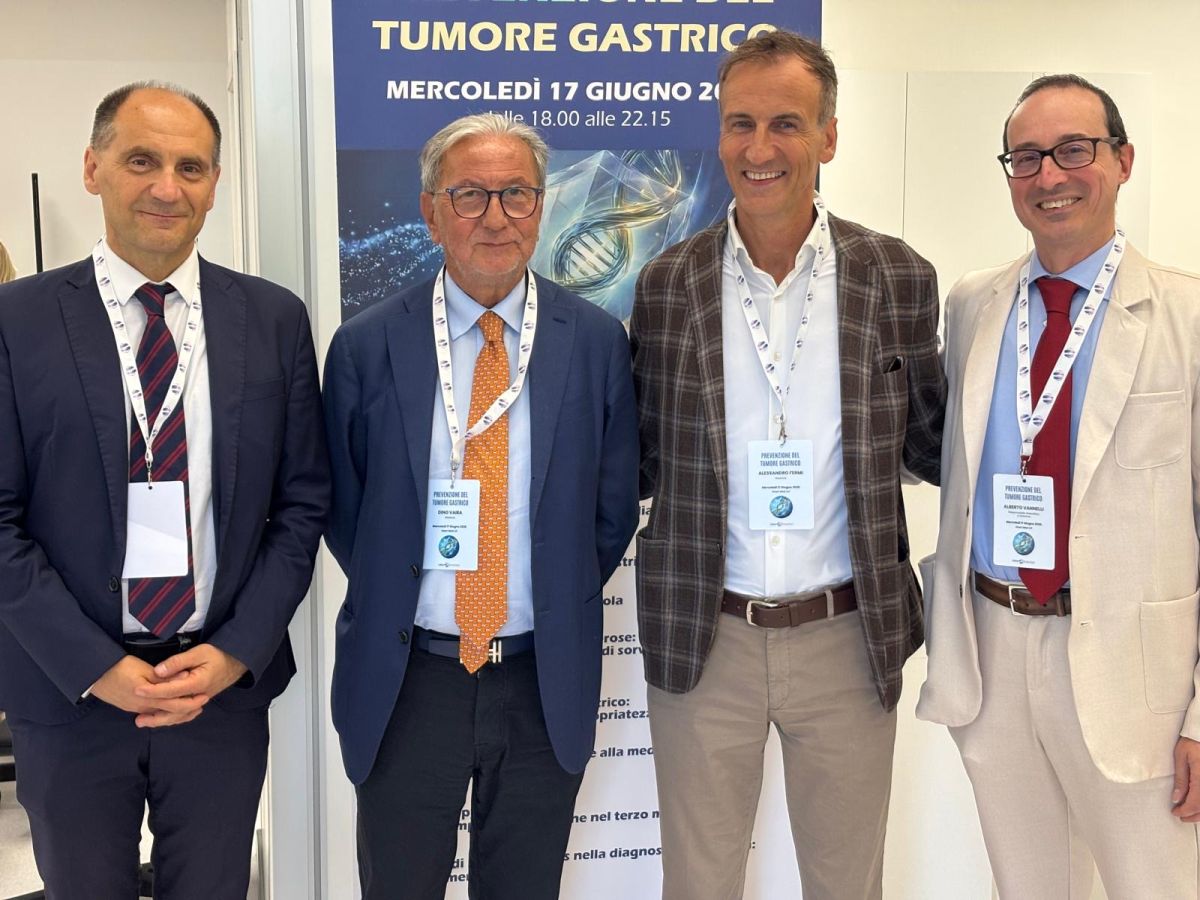
COMO (ITALPRESS) – Every year in Italy more than 14,000 citizens receive a diagnosis of stomach cancer. Although we are among the European countries with the best results in terms of survival, the gastric one continues to generate thousands of hospitals, complex surgery, oncological treatments and relevant health costs. Yet, when it comes to cancer prevention, this tumor almost seems to disappear from radar. A contradiction from which the reflection was born at the center of the meeting organized by the oncologist surgeon Alberto Vannelli with the patronage of Erone onlus and Regione Lombardia that took place in Como on 17 June, bringing together specialists, researchers, doctors of general medicine, representatives of the institutions and experts of new diagnostic technologies.
“The screening campaigns represent the greatest conquest of the social state as well as drinking water and public education – Alberto Vannelli, oncologist surgeon of ASST Lariana Hospital Sant’Anna and president of Erone onlus –; public opinion recognizes mammography, Pap test and occult blood research in feces as tools that have changed the natural history of important oncological pathologies. But there is a question that rarely enters the debate: what do we know about Helicobacter pylori? It is estimated that over 25% of Italians live with this bacterium. It is recognized by the World Health Organization as a certain carcinogen for man: in more than 20% of cases it promotes evolution in pre-cancer lesions. It is estimated that only a percentage between 1% and 5% will develop cancer over 10-20 years, and this justifies the need for surveillance.”
“Prevention does not replace therapies, but it would reduce the number of citizens who come to develop the tumor. In the case of the stomach we have an identifiable risk factor: the Helicobacter pylori, responsible for over 80% of cases of gastric carcinoma, diagnostic tools able to recognize it and effective therapies to eradicate it. It has been widely demonstrated that the eradication of bacterium reduces the incidence of gastric cancer up to 46% and related mortality by 39% – Vannelli points out. Yet we continue to intercept the problem mainly when the patient develops symptoms or when the disease is already present. According to a recent Italian analysis, only in 20% of cases the diagnosis allows a cure with possibility of healing. This is poured on health costs, estimated at about 12,800 euros per patient for a localized disease, 18,500 euros for the locally advanced one and more than 15,000 euros for citizens with metastatic disease. Over 88% of expenditure is linked to hospital shelters. This is unfortunately data collected before the spread of the latest innovative therapies, such as immunotherapy and new molecular target drugs. It is therefore likely that the real cost of gastric cancer management is even higher today. This adds the costs of follow-up, relapses, nutritional complications, loss of work productivity, invalidity and the often invisible but fundamental role of caregiver.”
“Today the citizen often discovers that he is the bearer of Helicobacter pylori randomly: after a gastroscopy performed for digestive disorders, during investigations for other pathologies or after a specialist evaluation. The participation of the Councillor at the University, Research and Innovation of the Lombardy Region Alessandro Fermi highlighted the strategic role that the research can have in the construction of new models of public health – explains again the oncologist surgeon -. In addition to clinical research, the conference also lit the spotlight on new technologies applied to prevention. On this issue, Raffaele Correale, Managing Director of NanoTech Analysis, presented Helitron: an innovative miniaturized mass spectrometer for the breath test possible thanks to patented technology and produced in Italy. Prevention of the future cannot be based solely on invasive examinations. The aim of research is to develop tools that can identify precocious biological signals through simple, fast and accessible procedures. Expirated air analysis is the most promising field because it could allow you to detect changes related to gastric pathologies before the appearance of symptoms and more appropriately orientate diagnostic insights. According to Correale, the real quality leap will transform technological innovation into a public health tool, capable of bringing prevention out of hospitals and closer to citizens.”
“There are no simple solutions. There are no shortcuts. But there is a possibility of starting a new reflection. Perhaps it is time for a screening of gastric cancer, leaving the orphan condition of oncological prevention. Not all tumors can be prevented – Vannelli concludes. Not all tumors have an identifiable causal factor. Not all tumors offer us the opportunity to intervene before they appear. The tumour of the stomach belongs to that rare category of diseases for which we know the enemy, we know how to recognize it and have tools to counter it. Continuing to consider it a marginal pathology means renouncing one of the few occasions when medicine can arrive before the tumor. Because medicine gives the best of itself not when it manages to cure a disease, but when it manages to make it avoidable.”.
– Photo Alberto Vannelli –
(ITALPRESS).