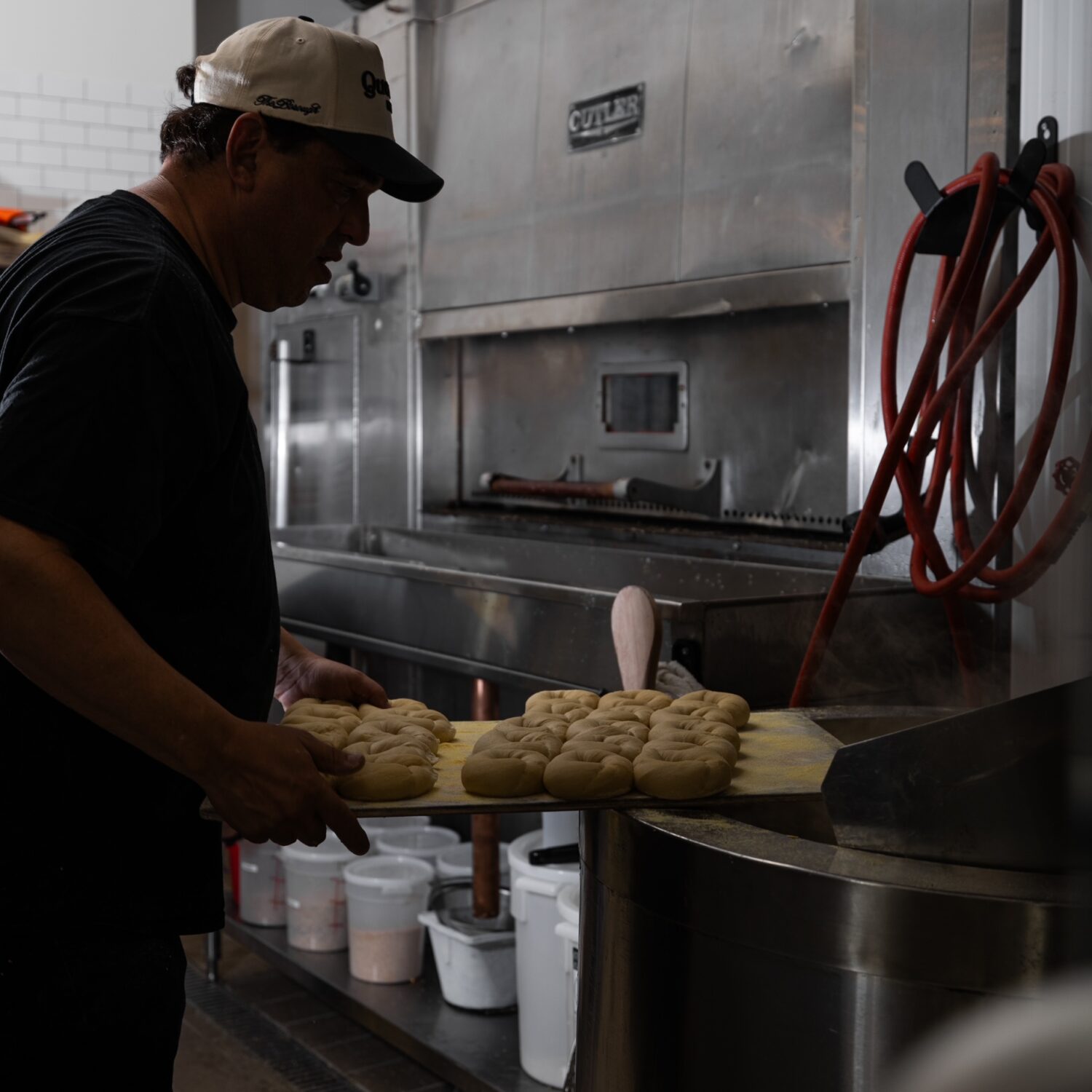
Founded in Queens and still today busy cooking bagels in the same oven of 1947 that helped build its reputation almost eighty years ago, Utopia Bagels passed from being a neighborhood landmark to one of the most celebrated gastronomic institutions in New York City. What was born as a local bagel shop today produces more than 100,000 bagels a week, shipped to all the United States and attracts customers from all over the country, eager to taste a product that many New Yorkers consider the standard with which to judge all other bagels.
When I sat with Scotty Spellman, I expected to talk about growth, expansion and difficulties in managing a business that has become synonymous with the New York bagel culture. Instead, a family story, loyalty, hard work and responsibility came out of it: what comes when you keep something that people really care about.
One of the first things Scotty wanted to clarify is that he does not consider himself the only creator of the success of Utopia.
“I always say co-owner,” he said. “I do not want to lack respect for the people who gave me this opportunity. Anthony Pantaleo was one of the originals, and my son Jesse is a partner. This path was possible thanks to all of us”.
This philosophy passes through every part of the activity. During our conversation, Scotty returned several times to the people around him: his family, long-time employees and customers who supported Utopia for generations.
The interesting thing is that Scotty doesn’t come from the bagel world. Before joining Utopia, he spent years in the waste management industry, building relationships and learning what it really means to run an activity in New York. His connection with Utopia had begun long before any participation in the property. First of all, he was a client.
His wife took him to the store years ago. After tasting those bagels, he convinced himself he found something special.
“There was nothing better,” he said.
At the time Utopia had already a very faithful follow-up, but it remained mainly a neighborhood activity. The product was exceptional, but there was no great interest in advertising or expansion. Scotty laughs recalling an episode with a New York Post journalist, arrived in the store to interview Anthony after hearing Joe Torre speak enthusiastically about the cinnamon bagels and Utopia raisins.
The reporter pulled out a tape recorder.
Anthony looked at him and closed the conversation right away.
“I don’t speak, ca*o.”.
Today, considering how recognizable the brand has become, it is a difficult story to imagine. But he says a lot about the origins of the company. The center has never been marketing. It was always the product.
The opportunity for Scotty to get deeper into the business came when Fresh Direct expressed interest in distributing Utopia products. Anthony wasn’t convinced it was worth trying. Scotty thought otherwise. Taking advantage of his entrepreneurial experience, he helped build that relationship and expand the distribution beyond the neighborhood. Looking back, it was one of the first important steps to make Utopia known to a much wider audience.
That success brought Scotty into the company more and more. He often describes Utopia as a raw diamond. The diamond, he says, was already there. His task was simply to polish it.
The store expanded, the menu grew and new sandwich proposals helped to show customers a wider side of the business. Today Utopia offers about thirty different varieties, from classics to tastes like jalapeño and cheddar, sourdough and piña colada. Yet, despite all the additions, Scotty remains very firm on what is at the center of everything.
“The beginning of what is this store”, he said, “is bagel”.
This attachment to the product is something on which he returned several times during the conversation. In a time when many activities pursue viral trends and moments, Scotty believes that authenticity can only be born from believing in what is sold.
The growth of Utopia on social media has brought millions of views and national attention, but Scotty insists: none of this has been built at a table.
“You must believe in the product,” he said. “I’m not making up these things for the camera.”.
According to him there are no elaborate production meetings or endless shootings to create the perfect viral clip.
“We don’t make three or four ticks. It’s early. They come from the heart”.
That authenticity works because it reflects something real. Long before social media discovered Utopia, Scotty talked about bagels with the same enthusiasm. The difference today is that there are more people to listen to it.
One of the most interesting parts of Utopia’s history is Jesse, Scotty’s son, who represents the next chapter of the company. Like many members of the second generation in a family business, Jesse grew up around the store, but saw possibilities that went beyond the original home.
Scotty admits that at first expansion was not something that attracted him. For years he felt comfortable focusing on one store. He knew every detail of the activity and appreciated the possibility to personally check the standards that made Utopia a success.
“I’ve always been afraid,” he admitted. «Not so much to fail, but to put the eggs in another basket».
Jesse saw things differently. He saw a brand capable of reaching new customers maintaining the quality he had built his reputation on. New offices, collaborations and wider recognisability were all part of his vision.
In the end, Scotty let the new generation take command in the areas where he saw opportunities he might not have grasped.
Today he speaks of those results with evident pride.
“The shops they created are incredible,” he said. “They really took this thing into their hands.”.
Despite growth, Scotty continues to talk about bagels in surprisingly personal terms. When I asked him what a bagel means to him, he didn’t start with ingredients or technique. He spoke instead of comfort.
For him, the bagel is interwoven with the habits of everyday life. Years ago the bagels were mainly associated with breakfast, often served with little more butter or cream cheese. Today people’s schedules have changed, eating habits are different and also the needs of everyday life have evolved. Yet the bagel remains extremely current because it continues to offer something familiar in a constantly changing world.
I was impressed how often Scotty came back to the idea that Utopia is not an occasional cuddle. It is part of the daily rhythm of people.
“People don’t really come here once a week,” he said. “He lives every day. He wants his bagel and his coffee, or he wants his sandwich at lunch.”.
In many ways, this is what separates a successful gastronomic activity from a neighborhood institution. Customers are not simply buying a product. They’re starting the day with you. They build their habits around you. Over time, you become part of their lives, often without even realizing it.
This idea brought our conversation to a broader speech about New York itself. Scotty believes Utopia could develop this way only in this city. The expectations are higher, the pace is faster and the competition is relentless.
People often romanticize the world of catering, but Scotty keeps us reminding aspiring entrepreneurs how reality really is.
“There is no Mother’s Day. There’s no Christmas. There are no birthdays,” he said. Seven days out of seven.
It’s not a complaint. It is simply recognition of what this job requires. The discipline to present each day, maintain standards, support their team and continue to offer the same quality year after year is what distinguishes the activities that last from those that disappear.
When our conversation ended up, Scotty shared a thought that perfectly sums up what Utopia Bagels became.
He talked about the families entering the door every day. Not customers: families. Grandparents bringing grandchildren. Parents bringing their children. People who have built memories around a place become part of their lives.
A grandfather can indicate the old oven and tell a child: “I was here when I was your age.”.
The remarkable thing is not only that oven is still there. That experience is still there.
In a city that continually reinvents itself, where activities close, neighborhoods change and family landmarks disappear, Utopia Bagels managed to preserve something ever more rare. The company evolved, expanded and took new opportunities, but did so without losing sight what had made people fall in love from the beginning.
Listening to Scotty, it became clear that its most important result is not measured in numbers, views or locations. Its most important result could be to have helped protect a tradition that belongs to the community as much as to the company itself.
Every morning, before most of New York really woke up, the ovens start working again. The dough is rolled, the bagels are cooked, the coffee is poured and begins another day. Some customers go to work. Others have been there for decades. Many come back because that experience connects them to a memory, a routine or a shared moment with someone they love.
In the end, this represents Utopia Bagels: not only a successful activity, but a rare sense of continuity in a city that never stops moving. And maybe that’s why, generation after generation, people continue to cross that door, give a bite and find something reassuring and familiar.
L’articolo Utopia Bagels, built one morning at a time proviene da IlNewyorkese.