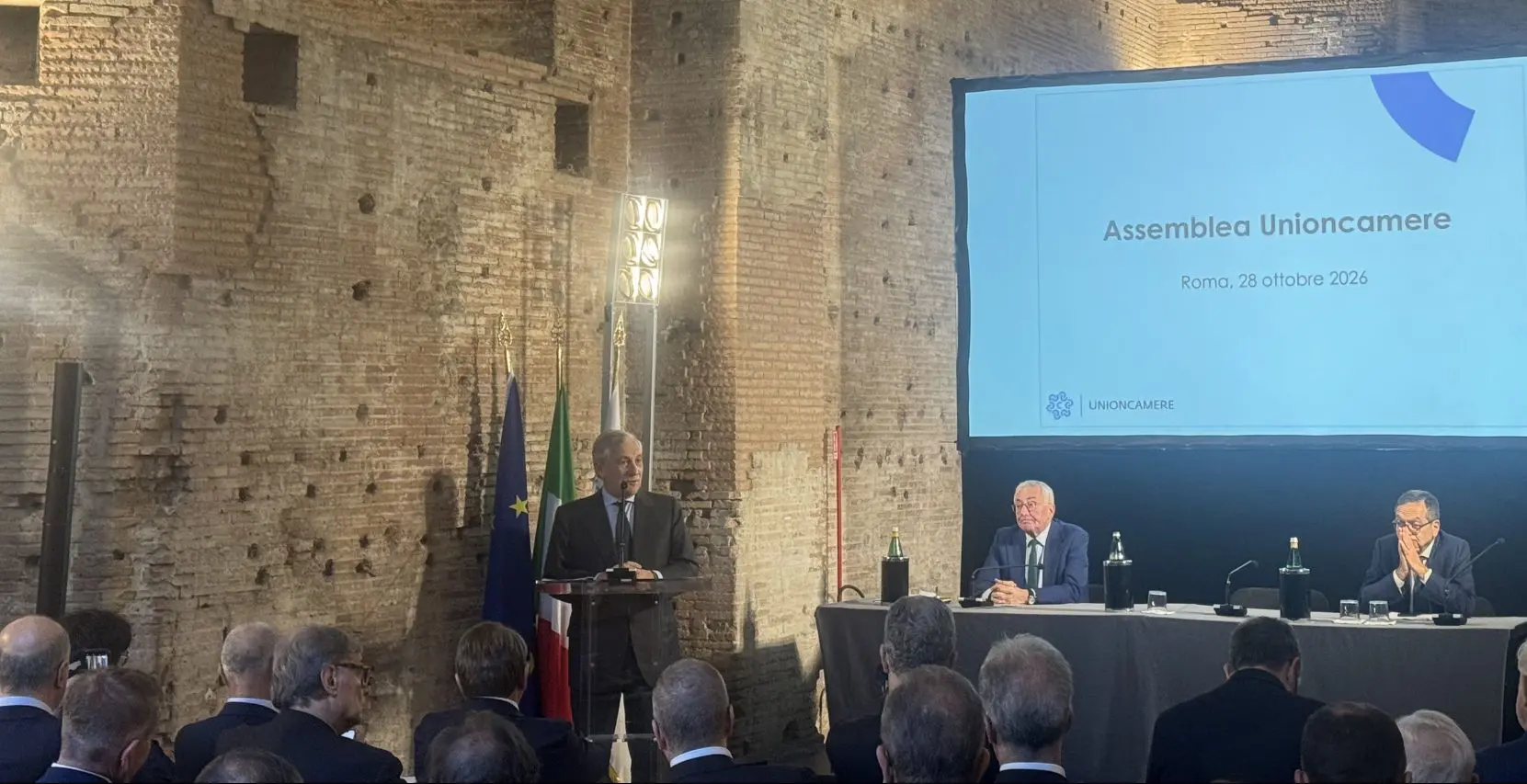
ROMA (ITALPRESS) – About 20 thousand Italian companies are starting to export or strengthen their presence on foreign markets. This is what emerges from the investigation conducted in 2026 by Unioncamere and the Centro Studi Tagliacarne on 4,500 companies, presented during the assembly of the presidents of the Chambers of Commerce, in the presence of the vicepremier and foreign minister, Antonio Tajani.
At the heart of the meeting the growth of Italian exports and the strengthening of the collaboration between institutions and enterprises to promote internationalization. “After the agreement signed in July, today we signed an operation to strengthen exports,” said Tajani. The agreement aims to expand the number of Italian companies present on international markets. “The Chambers of Commerce have fully entered the strategy of my ministry to reach 700 billion export by next year,” the minister added, recalling that the current value of Italian exports is about 650 billion euros. Tajani also stressed the role of Unioncamere in supporting companies interested in growing abroad. “It will be a valuable collaboration to increase the number of companies that will want to export,” he said.
Among the objectives also indicated the strengthening of the support of Italian embassies to companies and the promotion of international agreements to expand trade. According to the survey, companies exporting are more productive and invest more in innovation than those operating only on the national market. At equal size, sector and geographical location, labour productivity is higher than about 20%. In addition, a three-year exporting company provides for an increase in turnover in 2027, compared to 22% of non-exporting companies. The differences also concern investment. In the three-year period 2026-2028, 43% of exporting companies expect to invest in research and development, compared to 16% of other companies. For 4.0 technologies the percentages are 51% and 28% respectively, while for the green transition they are 47% and 28%. Exporting companies also pay greater attention to staff training: 61% expects to invest in the professional updating of employees, compared with 48% of non-exporters. One out of five intends to hire highly skilled workers.
Even in the use of artificial intelligence a gap emerges, with 26% of the exporting companies already using it, compared to 19% of the others. The potential for growth also concerns the Mezzogiorno, where 21 potentially exporting companies count each 100 companies already active on foreign markets, compared with 13 in Central-North. An important role is played by the services of the Chambers of Commerce: between 2020 and 2024, the enterprises that have used it have recorded a chance to start exporting more than 41.4% compared to those not assisted. The value of their exports was also higher than 21,8%, with an estimated impact between 600 and 800 million additional export.
During the meeting, the president of Unioncamere, Andrea Prete, also drew attention to Italian energy dependence from abroad. “Italy is too dependent on energy supplies from abroad,” he said, stressing the need to intervene to address the critical issues of the sector. “Well renewables, but not enough. Nuclear is a choice to follow,” said Prete, inviting us to overcome resistance and consider nuclear power among the possible sources of energy. The president of Unioncamere also recalled the comparison with France, which has nuclear power stations and from which Italy acquires electricity.
– Photo xu1/Italpress –
(ITALPRESS).