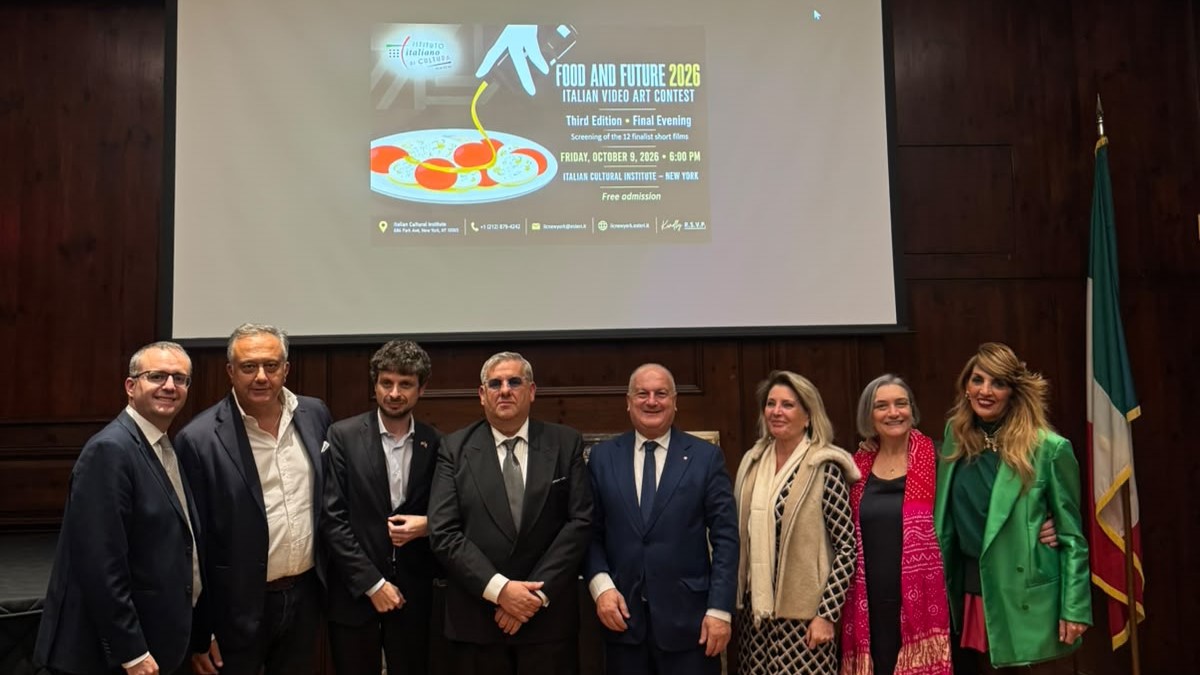
On October 9, the Italian Cultural Institute of New York, at 686 Park Avenue, hosted the third edition of the Food and Future – Italian Video Art Contest. Also this year the New York public responded with a large and careful participation, following with great interest the projection of short films and the communication of the winners.
In Italy food is much more than a daily habit: it preserves traditions, evokes places and people, accompanies moments that become family heritage. But what happens when reinterpreting these traditions are young artists? It is from this question that the video art contest was born, this year reached its third edition.
Twelve short films of about three minutes each brought in front of the audience of Manhattan the students of the Academy of Fine Arts of Bari, Lecce and Naples. Selected by the teachers of the respective academies, the works have told the link between food and Italian identity through very different languages: from family stories to irony, from tradition to visual experimentation.
The format, competition and award are owned by Pensiero Mediterraneo, the company of founding members Stefano Prior and Luigi Capone. The initiative aims to promote Italian culture abroad and, at the same time, to give visibility to new talents, combining two areas where our country enjoys a consolidated international reputation: art and gastronomy. In the background, a broader question: how do the new generations interpret Italian cultural heritage?
After the welcome greetings of Dr. Malina Mannarino, representing the Italian Institute of Culture in New York that hosted the evening, took the word Stefano Prior. Prior greeted the guests and thanked those who worked for the realization of this third edition, in particular Dr. Flavia Pankiewicz, who for personal reasons could not be present in New York. In his speech he recalled that the objective of the project is to involve young people in the construction of this story, leaving them full freedom of expression through the language of art. After the first edition of 2024 at the Casa Italiana Zerilli-Marimò of New York University and the second of 2025 at the Italian Institute of Culture, the project is now preparing for a new phase: as announced during the evening, from 2027 Food and Future – Italian Video Art Contest will become a national initiative, open to all Italian Fine Arts Academies who will want to join.
This year the jury, composed of representatives of the world of art, cinema, design, relations between Italy and the United States and Italian culture, confirmed the jurors of previous editions and expanded with the entrance of actor Kaspar Capparoni and Dr. Alma Laias, an expert in international relations. The only change involved the presidency: Jacqueline Greaves Monda, leading the jury in the first two editions, this year he could not be part of it and the role was entrusted to Davide Ippolito, publisher and producer, who thanked him for the work he had done.
It was then the same Ippolito who called on stage the guests of the evening, linked to the themes of health and food, for a reflection on the relationship between food and wellness. The first to intervene was Valter Quercioli, national president of Federmanager, who stressed the responsibility of enterprises towards the health of workers, observing how in recent years the attention of companies has progressively shifted from the quality of food to prevention and mental health.
Dr Pasquale Mugione, a baryster surgeon at the Monaldi Hospital in Naples, in New York, has also focused on prevention. Mugione drew attention to the link between nutrition and health, recalling that food is not only an element of cultural identity, but plays a fundamental role in the prevention of diseases and in the quality of life. To close the interventions was Professor Annamaria Colao, endocrinologa of the Federico II University of Naples and coordinator of the UNESCO Chair in Education to Health and Sustainable Development, who illustrated the scientific value of the Mediterranean diet as a model of prevention and longevity, to protect metabolic health and against chronic diseases.
The word then passed to Antonella Marino, professor of the Academy of Fine Arts in Bari, art critic and Art Director of Food and Future, who accompanied the public of the Italian Institute of Culture to discover the works.
In presenting short films, Marino highlighted some recurring themes that, after three editions, begin to outline the way the new generations look at food. Family, tradition, memory and bond with the earth return frequently, but next to these reassuring motives, less conventional readings also emerge: the table becomes a place of loneliness and incommunity, abundance is transformed into excess, the distribution of food opens questions on inequalities.
According to Marino, each Academy expresses its own sensitivity. Naples stands out for an ironic and irreverent approach, which at times touches the grotesque; Bari prefers a direct and emotional narrative, linked to the family, memory and daily life; Lecce instead tends to a symbolic language, where food sometimes takes on a spiritual value.
The works in competition confirmed it. “From the ground”, realized by the students of the Academy of Naples, tells the agricultural work and the cycle of cultivation, focusing on the path that brings food to us. On the other hand, “Do not open that cardboard” transforms a familiar symbol like pizza into a disturbing presence. Two readings almost to the antipods, showing how food can give life to stories far from the usual image of Italian cuisine.
Among the novelties of the 2026 edition, the official prize of the jury, which previews a recognition of 500 euros for the winner, has added the Award Parmigiano Reggiano, born from the collaboration with the Consorzio del Formaggio Parmigiano Reggiano, that has given new relief to the Mention of Honor, already present in the previous editions and assigned with the vote of the New York public. The winner, in addition to receiving a license plate, will have the opportunity to make a short documentary for the Consortium, with travel expenses, food and accommodation covered, and can count on an important showcase.
The awards thus offer a concrete opportunity to transform artistic experience into a professional opportunity. It is one of the distinctive features of Food and Future – Italian Video Art Contest: not only to celebrate the talent of young people, but to create the conditions for you to find space even outside the classrooms of the Academy.
At the end of the screening of the twelve finalist short films, the audience in the room was called to vote for the film winner of the Parmigiano Reggiano Prize. Waiting for the result the short film winner of the 2025 edition, “Do you really know what you’re eating?” by Francesco Silvaggi, was projected to allow the organization to verify and confirm the outcome of the votes. Jury president Davide Ippolito then communicated the decision of the jury: the Food and Future Award 2026 went to “Eat It, Don’t F*ck It” by Carlo Gargiulo and Simona Aiello (Accademia di Belle Arti di Napoli), in front of “Quanto Basta” by Raffaella Mastrorilli and Nicolò Tempesta (Accademia di Belle Arti di Bari) and to “Do not open that cardboard” by Gionata Andrew Dantec. The jury also attributed to “How much is enough” the mention for the best technical realization. Ippolito then invited on stage Dr. Pasquale Antonio Riccio, president of Campus Salute, who after a short presentation of the activities of the association announced the winners of the Award “Parmigiano Reggiano”, Honorary Mention of the Popular Jury of New York: first classified “How Enough”, which thus conquered the favor of the public, followed by “Do not open that cardboard” and by “Buy the book” of Davide Palamà).
After the final greetings of Dr. Malina Mannarino, on behalf of the Italian Institute of Culture in New York, the evening closed with a moment dedicated to food Made in Italy and Italian excellence: the opening of a form of Parmigiano Reggiano by chef Fabio Manfredi, a gesture that tells the work and craftsmanship behind one of the most famous Italian products in the world.
What makes Food and Future – Italian Video Art Contest an original initiative is not only the encounter between art and gastronomy, but above all the choice not to impose on new generations a preconstituted image of Italy. In short films, food is not always synonymous with conviality and tradition is never celebrated acritically: it can be memory and belonging, but also contradiction and change.
With the opening to the national dimension announced for 2027, the competition is preparing to welcome new looks and new prospects. This is the most significant contribution of Food and Future – Italian Video Art Contest: to remember that enhancing the Italian cultural heritage does not only mean preserving it, but to offer young people the opportunity to reinterpret it.
Because the future of Made in Italy will be told not only by what the country has created, but also by the way the new generations will know how to look at it.
Pensiero Mediterraneo and the associates Luigi Capone and Stefano Prior thank all the companies and the realities that have supported and contributed to realize this third edition: the Consorzio del Formaggio Parmigiano Reggiano, with a special greeting to President Nicola Bertinelli; Prosecco La Classe, for the final toast; New York and its staff, for communication activities; the Campus Salute Association; APCI North America – Professional Association of Italian Chefs North America; BCC Land of Otranto; We Quality; Elite Delight; The Popes Casa Mia at the Hawthorne; Pinsa Italiana; Studio Capone & Associati and Prior Consulting.
L’articolo Twelve different ways to tell Italian food proviene da IlNewyorkese.