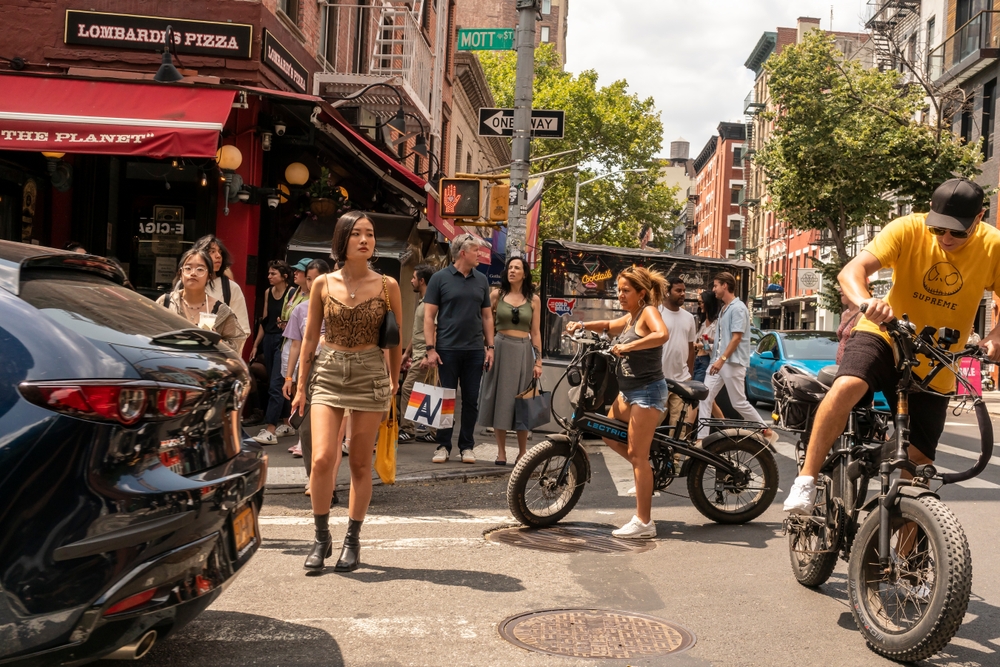
On Wednesday, July 29, just before 9am, Gabriel Nacato was crossing Lower Manhattan on an electric bicycle. Arrived at the crossroads between Centre Street and Chambers Street, near the town hall and at the exit of the Brooklyn Bridge, he moved from the bike path to the car lane and collided with an SUV that proceeded in the same direction. Nacato was 17 years old, he didn’t wear his helmet and died on the spot for head injuries. The driver of the car remained on the site of the accident and was not accused of any crime.
The bicycle on which Nacato traveled was a Deepower, a model that the department of the city has defined illegal because it can exceed 25 hourly miles, about 40 kilometers per hour. Some versions of the Deepower QS7 are published online with engines reaching 2,000 watts of maximum power and a speed of 28 miles per hour. They are sold as e-bikes, they have pedals and look like the electric bicycles become common in recent years, but according to the laws of the state of New York do not belong to the same category.
A New York are legal three types of electric bicycle. The first provide assistance only while pedaling and stopping doing so at 20 miles per hour; the second can move also using an accelerator, but they have the same limit; class 3 e-bikes can assist the cyclist up to 25 miles per hour and are only allowed in the city of New York. In all cases the engine must have a power of less than 750 watts. Electric scooters have to weigh less than one hundred pounds, about 45 pounds, and cannot be built to exceed 20 miles per hour.
The maximum speed allowed in the streets of the city is lower: from the end of 2025 e-bike and scooters can not exceed 15 hourly miles, about 24 kilometers per hour. Drivers must be at least 16 years old, they cannot go on the sidewalks and must use the bike path when it is present. The helmet is mandatory for minors, for delivery workers and for those driving a class 3 e-bike. For legal electric bicycles there is no license, plate or registration; for mopeds, e-motes and electric motorcycles, different rules apply instead.
This distinction has become difficult to apply because means with moped performance are often presented as simple bicycles. The State Attorney General’s Office, Letitia James, reminded sellers and consumers that vehicles capable of exceeding power or speed limits cannot be marketed as an e-bike or e-scooter. In many cases they would require registration, insurance and license; in others they cannot be registered and therefore could not circulate at all on public roads. The problem is mainly about online sales, where an illegal medium in New York can be purchased and delivered without the buyer knowing necessarily in which category you return.
The most serious accidents in recent months have often involved such devices. In May two men died after a frontal clash on the Queensboro Bridge cycle path. One was riding on a traditional bike; the other was driving a Teverun Blade GT II scooter, advertised as capable of reaching 53 miles per hour, more than 85 kilometers per hour. It was an illegal medium, but it circulated in the same narrow lane used by bicycles that normally proceed at a very lower speed.
The overall data however describe a situation less simple than the one suggested by the most told accidents. In the first half of 2026 road deaths in New York remained close to the lowest levels ever recorded, and the pedestrians and car occupants were reduced. On the other hand, 16 to 18 people died while driving e-bikes, scooters or cyclomotors; among the single users of scooters, the dead went from three to six. Also in this case the danger concerns mainly those who drive: between 2020 and 2023 e-bikes, scooters and mopeds were involved in eight of the 449 deaths of pedestrians recorded in the city, while in the same period tens of drivers of electric vehicles died.
This is one of the reasons why a part of the cycling associations challenge the idea of treating all micromobility as a single problem. Citi Bike electric bikes, for example, only provide pedal assistance and are limited to 15 hour miles. They have much more in common with a traditional bicycle than with a 50-mile scooter, although both are normally described as “electric vehicles”. A mandatory license plate for each e-bike could make it easier to identify those who run after an accident, but it would also impose new costs and controls on millions of trips made by means that already respect the limits.
The City Council is discussing a proposal that would impose registration and a plate visible to electric bicycles, scooters and other motor vehicles that are not registered today by the State Department of Motor Vehicles. The project is still in commission and has twelve sponsors. In March, mayor Zohran Mamdani eliminated the penalty quotes for minor infringements committed by cyclists and e-bike drivers, such as failure to comply with a stop: violations continue to be punished, but through the civil system used for motorists. The administration argues that security should also be faced by requiring delivery platforms to share data and not impose times that encourage riders to run.
The point on which there seem to be fewer divisions concerns the means that already exceed the limits provided for by law. But blocking the sale is more complicated than seizing them when they are on the street: it requires controls on shops, online platforms and descriptions with which they are advertised. They also need wide enough tracks to separate those who slowly proceed from the fastest means, especially on the bridges and stretches where everyone today has to share a few meters.
L’articolo Too fast e-bikes have become a problem proviene da IlNewyorkese.