There is a place in Manhattan where the noise of the heels on the marble is not only a sound of rush, but a call. To find it you have to go down below the level of the road, in the labyrinth of the Rockefeller Center Concourse, the dense network of underground tunnels connecting the skyscrapers of the citadel of Art Deco. Here, among the luxury boutique showcases, fashionable cafes and corridors run daily by thousands of white collars, resists one of the last temples of a rite we believed lost: the historic shoe shop.
Crossing the threshold of this workshop means making a leap back in time, an analogue anomaly in the pulsating heart of the digital New York. And before entering it it is worth knowing the story of this profession.
The figure of the shoe was born in Europe during the Industrial Revolution of the nineteenth century, parallel to the birth of the urban bourgeoisie. With the spread of leather footwear and still muddy city roads, keeping shoes clean became an immediate indicator of social status. In major cities such as London and Paris, the service was initially carried out precariously by street or immigrant children, until the United Kingdom raised the first mutual aid companies (such as the Ragged School Shoe-black Society) to regulate the profession and remove minors from crime.
The real economic and cultural boom of the profession, however, moved to the United States between the end of the 19th and the first half of the 20th century. In railway stations, at the corners of the streets of New York or Chicago and outside the big hotels, shoeshine boys became an iconic presence of the American landscape. Often organized in small territorial monopolies, the shoes used raised fixed positions, almost of the “troni” in wood and brass. In the U.S., this trade incarnated for decades the myth of self-made man, but also became a mirror of the country’s strong social and racial inequalities.
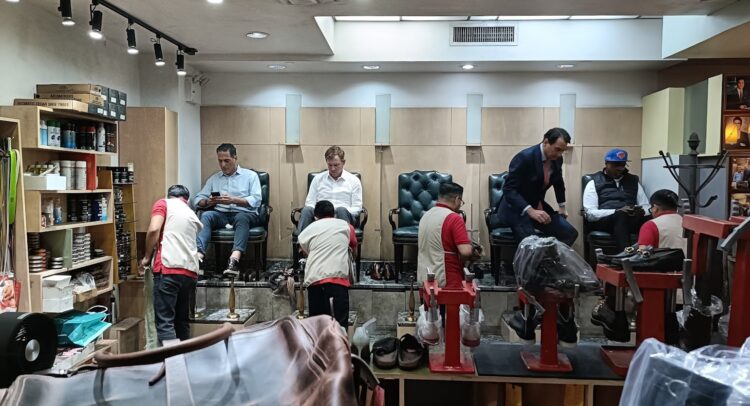
The scenography, Rockefeller Center Concourse, has been the same for decades. You sit on massive black leather armchairs raised on a wooden pedestal, almost wanting to return, for those ten minutes of treatment, a position of regal detachment to those who sit there. In front of each station there are the footrests of polished metal, where the shoes of customers – from the veal strings of the Wall Street brokers to the boots of the Lords of the Upper East Side – await the care of the artisans.
The workshop of the Rockefeller Center is a microcosm of precise sounds: the dry foam of the cotton cloth stretched among the hands of the shoe shine, the light pick of the brushes of horsehair on the leather and the penetrating smell of bees wax, carnauba cream and shoe polish. It is a fast and hypnotic choreography, made of gestures handed down that give life and shine to the most precious skins.
But the shoe store under the Rockefeller Center is not only a place where shoes are cleaned; is, forever, a space of decompression. For NBC managers, Midtown associate studio lawyers and pass bankers, those ten minutes on the armchair represent the only time of the day when it is allowed to detach eyes from the smartphone.
Here you can browse the paper newspapers, chat about the last game of the Yankees or the trends of Wall Street, and exchange jokes with the shoes, which of this underground are the real psychologists and confessors. A sartorial and rapid service that resists modernity, demonstrating that in New York, even under the ground, style and attention to detail are a damn serious thing.
Thus, while outside Manhattan runs and consumes in the digital flow, in this underground time slows down to the ancient rhythm of a brush on the leather. The workshop at the Rockefeller Center does not simply guard a job, but preserves an idea of urban civilization where the dignity of detail still makes the difference. When you go up to the surface, with the shiny shoes capable of reflecting the lights of the skyscrapers, you carry something more than a renewed shoe: the awareness that the true modern luxury, in New York, is to give yourself the time of a timeless ritual.
L’articolo The time still in the belly of the Rockefeller Center: the last rite of Manhattan shoes comes from IlNewyorkese.