For centuries sailing ships were the means by which Europe crossed its borders. Before the steam routes and engines, they were the sailing ships to bring men, goods, armies and knowledge from one coast to the other of the Atlantic. With ships very different from each other, but all in wood and moved by the wind thanks to their sails, Christopher Columbus arrived in the Americas in 1492, while Amerigo Vespucci contributed a few years later to understand that those lands were not a part of Asia, but a new continent for Europeans. This is why the story of the Ship Amerigo Vespucci School is not the simple story of a military ship: it is intertwined with a more ancient idea – and noble – of navigation, in which the sea was first ruled with the help of the wind.
The Amerigo Vespucci was born in fact from a choice that, already in the 1920s, could seem anachronistic. The Italian Navy, like all the marines of the world, was entering a new phase, where the ships depended more and more on the engines, the electrical apparatuses and an increasingly complex technology made of radar, sonar and various detectors. Despite this, when asked how to train the students of the Naval Academy of Livorno, the Staff decided that the first serious relationship of their students with the sea should still pass from a sailing ship. Because on a sailer, wind, currents, meteorology and onboard discipline are not abstract concepts, but things that are seen and subdued on their skin.
The decision arrived as it was finishing the operational life of the first Amerigo Vespucci, a motor cruiser and sail entered service in 1885 and adapted to school ship in 1893. For more than thirty years he had brought to the sea the students of the Royal Naval Academy, also in challenging campaigns through the Atlantic. In the middle of the 1920s, however, it was an old ship. In 1925, on the initiative of Admiral Joseph Syrianni, Minister of the Navy, he was decided to build two new school ships: Christopher Columbus and the Amerigo Vespucci. The project was entrusted to Francesco Rotundi, an officer of the Naval Genius, who designed two ships inspired by the vessels between the late 18th and early 19th centuries.
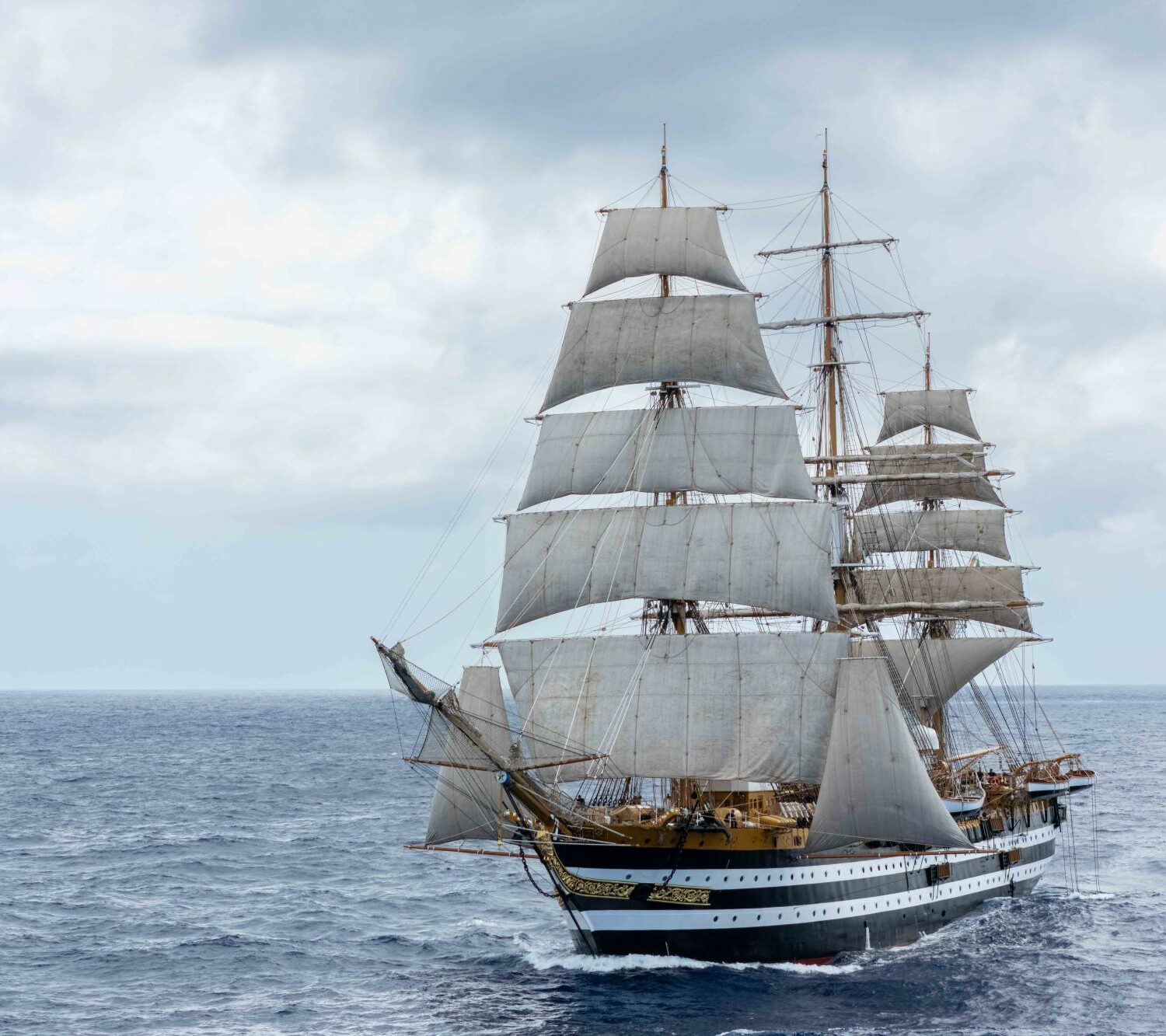
The Vespucci, however, was not a museum copy of an ancient ship. It is a modern ship with the forms of a past era. The hull was made of steel, the plates were bolted, the engine apparatus was diesel-electric, but the appearance recalled the great war sailing ships, with the black flank crossed by two white bands from which different portholes and reminiscent of the battery bridges of the cannons. Christopher Columbus entered service in 1928. The Amerigo Vespucci was set on 12 May 1930 in the Royal Naval Shipyard of Castellammare di Stabia, launched on 22 February 1931 and delivered to the Royal Navy a few months later. On 4 July of the same year he left for the first training campaign in Northern Europe, under the command of Augustus Radicati of Marmorito, who had also been the last commander of the previous Vespucci.
Il Vespucci nel porto di Brindisi nel 1943
The name chosen for the ship refers to a story often very simplified: Amerigo Vespucci did not “discover America” in the sense that it is said in school. His role was another: after the trips beyond the Atlantic he understood, and he helped to make European scholars understand that those lands were not the eastern end of Asia, as Columbus had thought. They were a different continent. The name chosen for the ship also refers to the second part of the life of Amerigo Vespucci, less told but more useful to understand why it became a symbol of navigation. After travelling beyond the Atlantic, Vespucci returned to Seville and in 1505 he obtained the Castilian citizenship. Three years later he was appointed Piloto mayor of the Casa de Contratación, the office that in Seville controlled trade and shipments to American lands. His task changed: he was no longer just traveling, but forming the commanders, controlling the navigation tools and helping to redesign the official map of the new routes and coasts of the continent he had discovered.
Amerigo Vespucci died on 22 February 1512 and many still today credit him, as well as as as the one who discovered America as said before, even as the one who gave the name to America. But it was not his choice: in 1507, the German cartographer Martin Waldseemüller proposed to call “America”, by the name of Vespucci, that newly discovered continent. And if today the most important and prestigious Italian school ship bears that name, it owes it to a man tied not only to navigation, but also to the construction of a new image of the world.
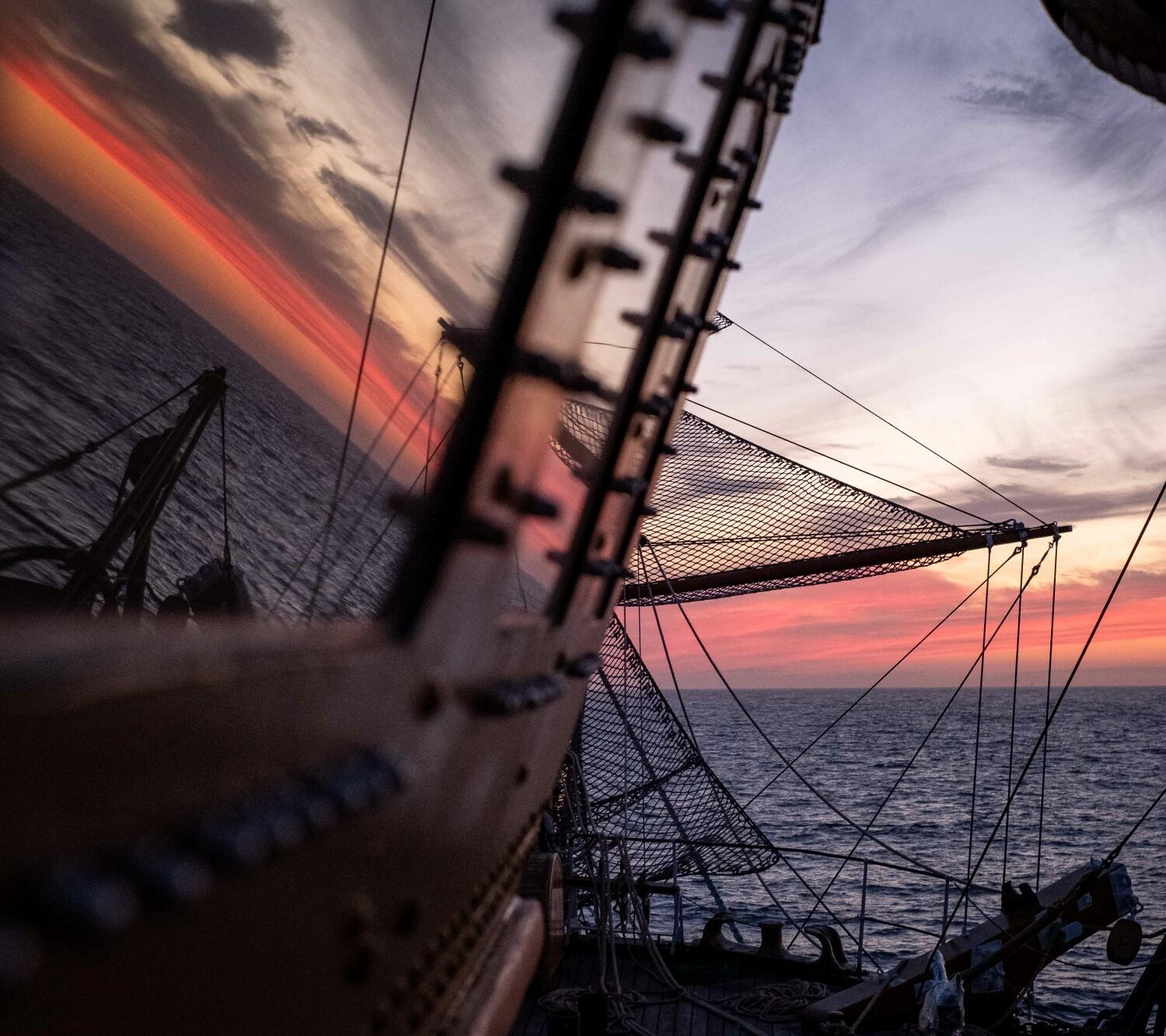
Even today the Vespucci works because it obliges those who climb on board to learn the sea. It is a 101-metre-long bompress ship, has three trees plus the bompress, 24 sails for over 2,600 square meters of sail surface and tens of kilometers of cables necessary to maneuver them. The crew consists of military with very different tasks, from navigation to machine, from health to logistics, but during the education campaigns the ship fills with pupils. It is then that complete sailing becomes really possible: they serve people on trees, people at maneuvers, clear orders, coordinated times. The training is not only about the sender or the nomenclature of the sails, but the teamwork to allow the ship to work.
The history of Vespucci is also the story of a survival. His twin, Christopher Columbus, had a very different fate: after World War II, he was ceded to the Soviet Union as compensation for war, renamed Dunay and employed in the Black Sea, before being removed in the 1960s after a fire. The Vespucci instead remained in service and continued to do what it had been built for, with interruptions due to war and extraordinary works. Over time it has been updated, restored, adapted to the new needs of the Navy, but never lose its main function.
This continuity explains why Vespucci has become something more than a school ship. He campaigned in the Mediterranean, North Europe, Atlantic, North America and South America; between 2002 and 2003 he made a circumnavigation of the globe, and between 2023 and 2025 he returned to make a long world tour. And then there is the most famous definition, “the most beautiful ship in the world”, born from a greeting attributed to the American carrier USS Independence in 1962. It is a phrase that almost everyone knows and has moved in many, but the Vespucci is not important because it is beautiful: it is important because it embodies the symbol of “Italianity” in the world, and it is an example of attachment to traditions, of craftsmanship of excellence and of refinement and elegance typically Italian.
Today this story has returned to North America with the “World Tour Vespucci – Campaign in North America 2026”, started from Genoa and also included in the celebrations for the 250 years of Independence of the United States. The “World Tour Vespucci – Campaign in North America 2026” is an initiative of the Ministry of Defense and Navy produced by Defense Services S.p.A. The project is developed in collaboration with the Ministry of Foreign Affairs and International Cooperation, the Ministry of Enterprises and Made in Italy, the Ministry of Agriculture, Food and Forestry, the Ministry of Culture, the Ministry of Tourism, the Minister for Sport and Youth and the Minister for Disability. In this sense the Vespucci continues to do two works together: he trains the official students and, when he enters the port, becomes a form of Italian diplomacy abroad.
L’articolo The story of the Amerigo Vespucci comes from IlNewyorkese.