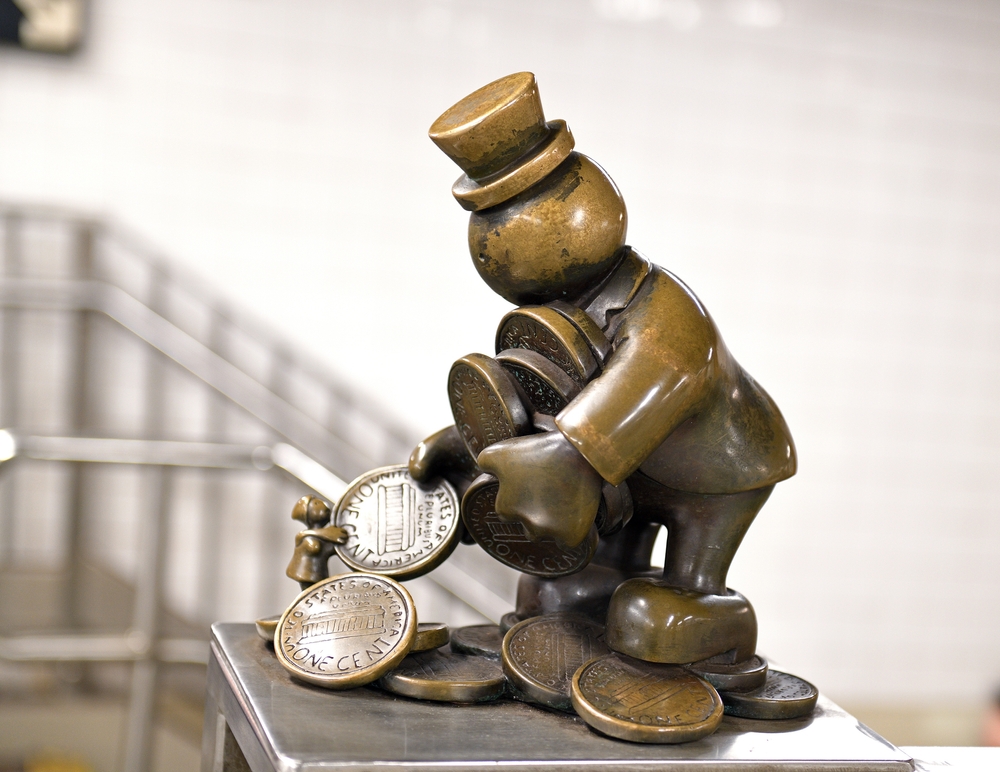
There is a bronze micro-universe hidden in the belly of New York, where art descends between the metro tracks to hump with irony the global capital of capitalism. Entering the 14th Street-8th Avenue station means encountering over one hundred sculptures of “Life Underground”, the famous cycle installed by public art pioneer Tom Otterness.
Among these, it is the iconic “omino with the lot of money”: a tark and comic figure, with a cylinder from bankers of old times and a lot of dollars tight in the hands or attacked by a crocodile that comes out from the grave. Otterness has scattered these ludicrous creatures in the underground corridors to short-circuit the routine of commuters and make them smile, but above all to offer a scratching social satire: a merciless and fairytale portrait of greed, financial power and its inevitable social contradictions.
If you could map Manhattan’s collective brain activity through a functional magnetic mass resonance, you would see a constantly illuminated brain area of a red button: the nucleus accumbens, the control center of our dopaminergic reward system. In New York, the dollar is not simply the current currency; it is a neurotransmitter. It is the chemical stimulus that modulates the circadian rhythms of eight million people, the binary code on which the software of survival and urban ambition is programmed.
To understand the relationship between New Yorkers and money, it is necessary to overcome the classic economic analysis and enter a frontier territory where cultural anthropology marries neuroscience and sociology of consumption.
From a neurobiological point of view, New York operates in a regime of constant high cortisol – the stress hormone – balanced by violent peaks of dopamine. Money, in this ecosystem, acts as an accelerator of both substances.
Neuroeconomic research shows that waiting for a financial gain activates the same neural circuits of primary biological gratification. In New York, this mechanism is amplified by the verticality and density of urban space: to see the success of others exhibited in Billionaires’ Row’s outbreaks or in the exclusive tables of Tribeca restaurants acts as a constant visual priming. The brain of New York is constantly bombarded by stimuli that say: “The money is close, you just have to run faster.”.
This generates a specific cognitive mutation: the trade of time. Every minute not monetized is perceived by the brain as a net loss, which explains the hectic gait on the Fifth Avenue sidewalks and chronic impatience in front of the metro doors.
From a sociological and economic point of view, New York realizes the paradox described by Georg Simmel in his Philosophy of Money: the dollar is at the same time the largest social leveller and the most ruthless instrument of fragmentation and classification.
The green banknote – greenback – is deeply democratic in its theoretical accessibility. Unlike old European societies, where the status was related to the offspring or title, in New York identity is fluid and is defined exclusively by the budget. No matter where you come from, which is your native language or your story: if you can pay, you are entitled to citizenship. Money is the free language that combines the immigrant of Astoria who serves coffee at the Wall Street broker.
However, this apparent monetary democracy collides with a very rigid social stratification, regulated by invisible but invariable barriers erected by the census. The money in New York decides everything: the air you breathe (the height of your apartment compared to the level of traffic), the time you use to go to work, the quality of the food you have access to and, paradoxically, even your mental health. The loneliness of New York is often an economic solitude: the fear of not succeeding, of being expelled from the gear of a city that does not provide emotional shocks for those who stop producing.
Maybe ani does it was worse. We mention “All About the Money” by DJ Squeeky, a song that is still remembered today with so much installations in the galleries of Brooklyn. It is the portrait without filters of hyper-capitalism seen from the lowest steps of the American social pyramid. In Memphis’s hungry ghetto in the mid-1990s, marked by fact segregation and deindustrialization, money hunting strips hip-hop narrative from every patina of hedonism or luxury celebration to become pure instinct of conservation.
In this dark and obsessive trace, the search for capital ceases to be a choice of style to transform itself into a claustrophobic necessity: a fixed thought that dominates the routine of popular neighborhoods, where the ethics of hustle overwhelms traditional morality. Squeeky thus transforms the American dream into an alienating mantra, offering a glossy and disenchanted photograph of a society that measures the value of the human being exclusively according to its purchasing power.
And here we are, therefore, the inevitable conclusion. Ultimately, the dollar in New York has stopped being a physical object – a tendency exasperated by dematerialization of digital payments – to become a pure energy abstraction. You do not have the money to accumulate it, but to put it back in circulation immediately, to feed the dynamo of a city that asks for a very high daily tribute in exchange for the possibility to be in the center of the world. The New Yorker knows, accepts the Faustian pact and continues to run, with a fixed look on the next goal, on the next dollar, on the next dopamine discharge.
L’articolo The complicated New York relationship with money comes from IlNewyorkese.