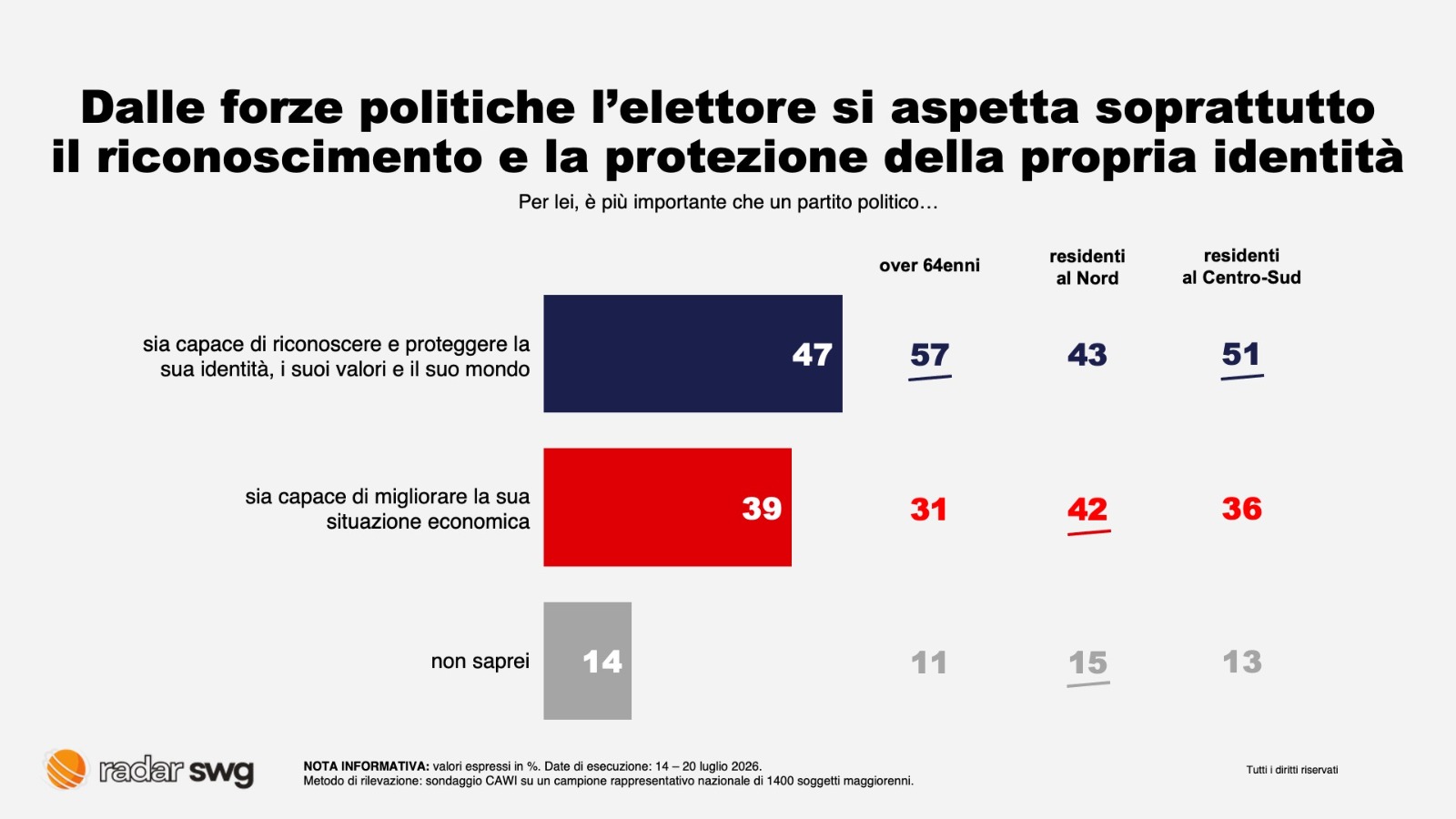
ROMA (ITALPRESS) – SWG has carried out an investigation into the role of identity in Italian voting choices, taking inspiration from the themes addressed in the book “The season of identity – From Brexit to Trump, because pride and values count more than wages and welfare” by Domenico Petrolo. The research shows that, “for a significant share of voters, recognition and protection of their identity today have a greater weight than economic proposals.” In the last thirty years, the dynamics of consensus and political communication have undergone significant changes, with transversal tendencies to many Western democracies. One of the determining factors of these changes “was the growth of the need for recognition of different social and political identities”. The results show that “47% of voters, in the choice of vote, attaches greater importance to recognition and protection of their identity, a share greater than 39% that instead assigns greater weight to economic proposals”. At the base of this data there is the fact that large layers of citizens today do not feel sufficiently respected and, somehow, live a feeling of humiliation. In fact, 39% of citizens say “not to feel adequately recognized and valued”. Political forces therefore gather consent when they can express a recognition of the dignity of voters who feel on the margins or not respected.
Some manage to intercept this question more than others, but at present 30% of citizens are not considered understood and valued by any party. The need for identity protection also arises from the perception of the presence of phenomena that threaten it. Identity fears assume different characteristics depending on political orientation. Among the left-wing voters, who show a greater lack of recognition, “the concerns focus mainly on the rebirth of fascism”. Among the right-wing voters, however, “the perceived threats mainly concern awakened culture and Islam”. The results “describe a complex social theme, which presents major challenges for political parties in the coming years.” The ability to interpret the requests for recognition, dignity and belonging will be increasingly central in the construction of consent and in the representation of the different identities present in society.
– SWG photos –
(ITALPRESS).